
A cat never marks its urine by chance. An international team led by Iwate University in Japan, with German and Spanish researchers, identified 13 branched-chain fatty acids in feline urine, whose combination and proportions vary from one cat to another, while remaining relatively stable within the same animal. Published on August 19, 2026 in Current Biology, these studies led by Professor Masao Miyazaki also advance an explanation for the origin of these molecules: they would originate from the kidney, an organ that has intrigued biologists for more than a century without understanding why.
- Each cat possesses a urinary signature made up of 13 branched-chain fatty acids, whose combination varies from one individual to another.
- Cats use flehmen to decode these chemical signatures and maintain a long-term memory of individuals they have encountered.
- The kidney produces these molecules via lipid droplets, a mechanism that has remained unknown for more than a century.
Flehmen, the starting point of the investigation
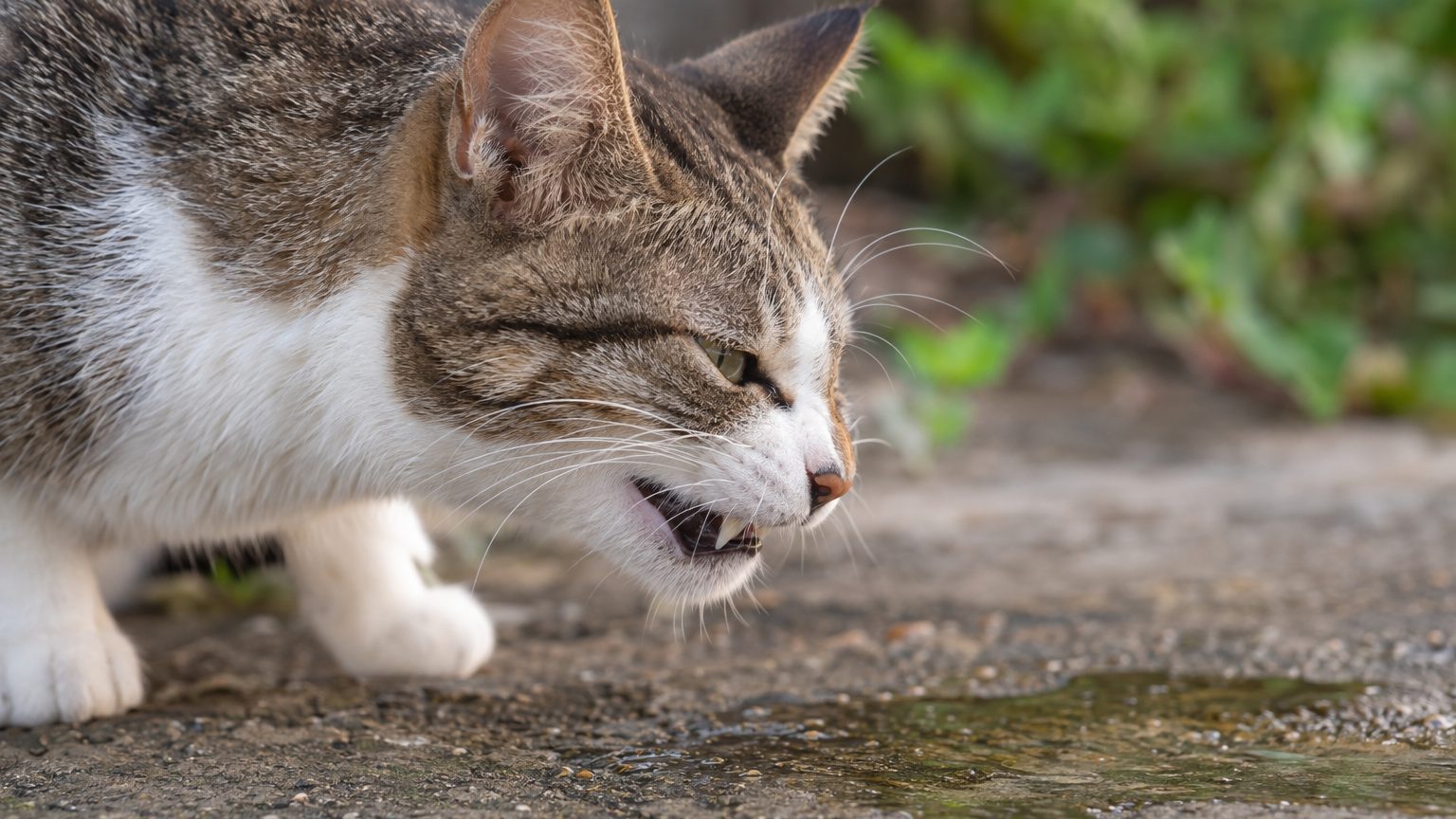
Every cat owner is familiar with that odd facial gesture, mouth slightly open, known as flehmen. The researchers used it as a through-line. They first confirmed that cats can distinguish the urine of different individuals, before seeking the molecules responsible.
The protocol was simple. Cats exhibited flehmen more often in front of an unknown urine than in front of their own, and the response diminished when the same sample was presented several times, before rising again upon the arrival of urine from another cat. This decrease in interest for a scent already encountered does not fade quickly. It could persist for months, suggesting that cats retain a long-term memory of individual urinary odors.
One detail changes everything here.
This behavioral experiment allowed the researchers to tighten their chemical search. Rather than analyzing all of the urine at random, they isolated the lipid fraction that seemed to carry the individual information, the one that cats sniffed differently depending on its provenance.
13 molecules never seen in a mammal
The chemical analysis revealed 13 branched-chain fatty acids, compounds that the authors’ literature review had never reported in any mammalian excretion or secretion. Their interest does not stop there. These molecules evaporate slowly, much more slowly than most usual urinary odors, and their profiles remain stable for at least 24 hours at 25 degrees Celsius, allowing them to continue carrying reliable information long after the urine has been deposited.
Behavioral evidence followed the chemical evidence. When the researchers altered only the fraction containing these 13 fatty acids, keeping other lipids identical, the cats detected differences in the fatty acid blend, demonstrating that they can actually read this information. It is not a vague, global odor that a cat perceives, but a precise chemical signature unique to each individual.
Kinship leaves a trace, but does not erase the individual. Related cats tended to show more similar profiles, but individual differences remained even within families. Two kittens from the same litter thus smell “of the same family,” without smelling identical.
The kidney, number one suspect for a century
Here is the turning point of the story. These fatty acids were detected in the kidney but not in the other tissues examined, and the lipids that carry them were found among neutral lipids stored in lipid droplets of the renal cortex. And these droplets have a long history in the scientific literature.
Their abundance in the cat kidney has been known for more than a century, without the biological role ever being elucidated. Miyazaki sums up the situation with a concise formulation: the kidney’s lipid droplets in cats have been known for more than a century, but why cats have so many remains a mystery, and this work suggests that one of their functions could be to support a stable chemical signature in urine.
The hypothesis rests on a single image: a reservoir. These droplets could act as a reservoir of lipids containing these fatty acids, buffering short-term fluctuations due to diet or physiological state, and helping to maintain a chemical profile unique to each individual. The exact mechanism remains unclear. How these fatty acids stored in renal lipids ultimately end up in urine is a crucial question for future research, the scientist himself admits.
A signature that goes beyond the house cat
The phenomenon does not stop at the domestic cat. Compounds related to these fatty acids have also been found in the urine of lions, tigers, leopards, jaguars, lynx, and the Iriomote cat. This broad distribution across the feline family suggests that this chemical system diversified through evolution, rather than having appeared only once in the domestic cat.
The feline strategy diverges from that of other mammals. In mice, urinary identity relies on major urinary proteins rather than lipids. The cat, therefore, seems to have chosen a different chemical route to write its name in every puddle.
Applications remain, for now, potential directions for future work. Understanding these urinary compounds at a deeper chemical level could lead to better ways of controlling cat urine odor, but also open the path to non-invasive monitoring of the rarest wild felids, simply by analyzing the traces they leave behind. A way to turn a long-standing biology puzzle into a field tool for conservation.
Sources: cell.com | technologynetworks.com
