
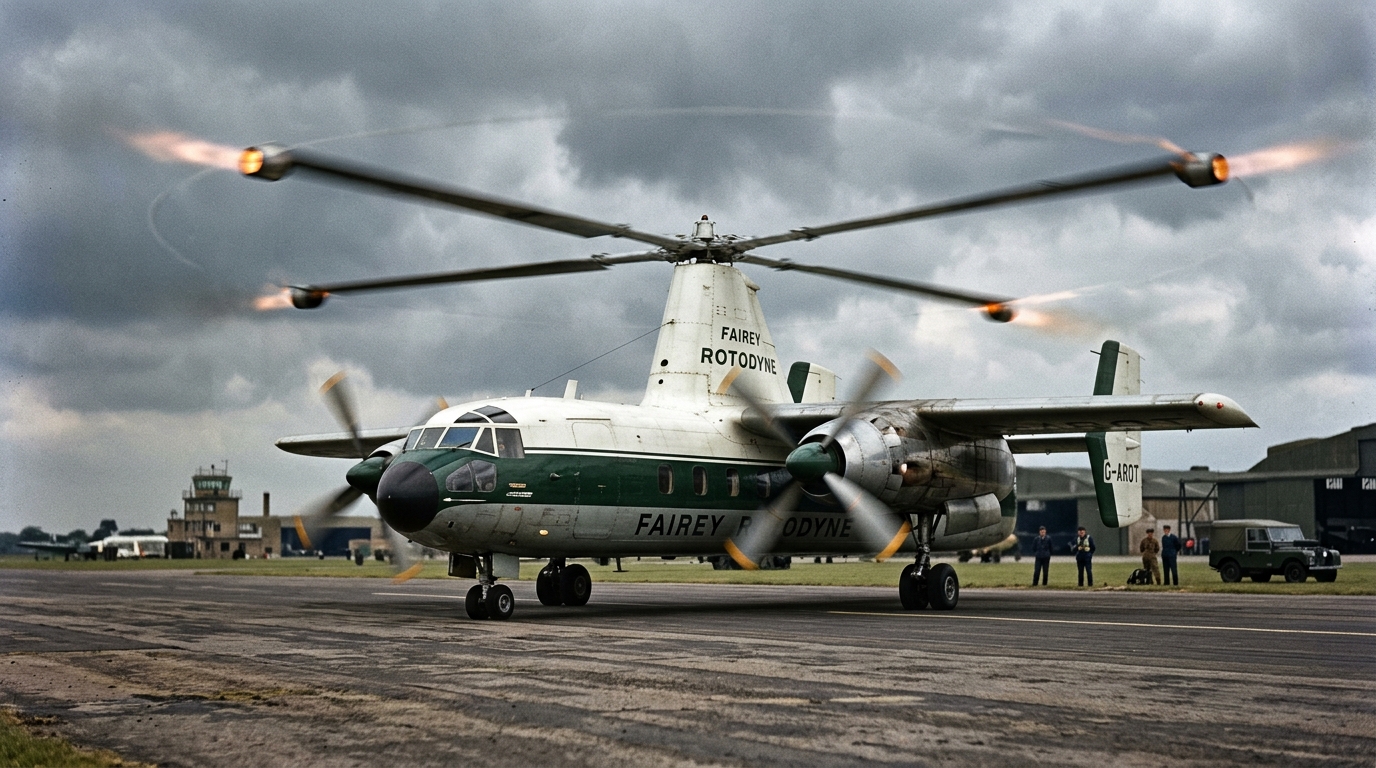
A machine capable of flying at 307 kilometres per hour in 1959 while taking off vertically was not felled by a mechanical failure. Nor by the deafening roar of its rotors, often blamed when its story is recalled. The real reason for its disappearance is far more banal, and far crueller: a simple matter of money. This story, almost forgotten today, deserves to be told, for it recounts as much an engineering feat as a quintessentially British industrial waste.
- The Fairey Rotodyne set, on January 5, 1959, a world speed record for rotorcraft at 307.22 km/h thanks to its autorotating rotor combined with two lateral turboprop engines.
- The noise from its tip-jet engines, reaching 113 decibels, posed a problem for urban operation but was not the cause of its abandonment.
- Lack of firm orders and, following the forced absorption of Fairey Aviation by Westland in 1960, the programme was halted and the sole example scrapped in 1962.
- When a helicopter beats airplanes at their own game
- The roar that nearly buried it before its time
- The price that doomed the British dream
- What the Rotodyne changed without ever taking off for good
When a helicopter beats airplanes at their own game
In popular imagination, the late 1950s is synonymous with speed conquest and the rise of jet air travel. But another equally audacious bet was quietly being played out on British airfields: to lift off like a helicopter, then fly like an airplane. That is precisely what the Fairey Rotodyne achieved, a hybrid gyroplane designed to combine the best of both worlds.
The concept rests on a mechanical trick as elegant as it is ambitious. At takeoff, landing and in hover, the aircraft relies entirely on its main rotor, just like a conventional helicopter. But once in cruise, that same rotor switches to autorotation, meaning it continues to rotate freely under the effect of the relative wind, without consuming propulsion power. All the engine energy is then redirected to two lateral turboprop engines, which propel the craft forward as the propellers of a traditional airplane would.
The result of this ingenuity was spectacular. On January 5, 1959, the Rotodyne set a world speed record for a 100-kilometre circuit, averaging 307.22 km/h, with no payload onboard. This figure, certified by the Fédération Aéronautique Internationale in the gyroplane category, exceeded by about 80 km/h the helicopter world record of the era. In other words, this hybrid machine simply ridiculed conventional helicopters on their own turf.
The roar that nearly buried it before its time
To understand the Rotodyne’s turmoil, one must dwell on the technology powering its rotor during vertical phases. Rather than using a conventional mechanical transmission system, the engineers opted for tip-jet engines mounted directly at the blade tips, a solution that simplified the internal mechanics but produced a truly frightening level of noise.
When these jets operated at full power, the noise could reach 113 decibels, an intensity comparable to a jackhammer or a rock concert outdoors. Such din posed an obvious problem for an aircraft intended, ultimately, to connect urban centers: no one would have accepted living near such an urban heliport. The Fairey engineers knew this perfectly well and set to work reducing this nuisance by testing various silencing systems.
Yet, the aim of dropping below 96 decibels necessary for urban-area operation proved a virtually insoluble technical challenge with the equipment available at the time. The Rotodyne’s noise thus became, in popular storytelling, the legendary cause of its abandonment. However, as is often the case in industrial history, the reality is more prosaic, and it was not this acoustic constraint that permanently sealed the fate of the aircraft.
The price that doomed the British dream
Despite its acoustic woes, the Rotodyne remained technically viable, and solutions were being studied to reduce the noise. The real threat did not come from engineers but from accountants. The British government, initially enthusiastic about this promising concept, began to show itself far more cautious as development costs piled up without any firm orders being signed.
From 1959, the very year of its speed record, public funding began to dry up. No airline, no army, no potential customer placed an order, depriving the programme of any profitability prospects. The coup de grâce arrived in May 1960, when the British government ordered the absorption of Fairey Aviation by its competitor Westland, as part of a broad restructuring of the national aerospace industry. This forced merger hastened the programme’s definitive halt, new industrial priorities leaving no room for this costly prototype.
The single built exemplar, the very one that had carried British colours high during the speed record, ended up scrapped in 1962. A new page turned, almost in indifference, marking the brutal end of one of the most original aeronautical projects of its era.
What the Rotodyne changed without ever taking off for good
It would be tempting to reduce this story to a simple failure, but that would miss the essential. The Rotodyne proved, with hard data, that the concept of a gyrodyne, this aircraft capable of taking off like a helicopter and then flying like an airplane, was not merely an engineer’s utopia but a fully functional technical reality. Its speed record remains, to this day, a benchmark in the history of British aviation.
Today, almost nothing remains of this pioneering prototype, except for a fragment of fuselage carefully kept at the Weston Helicopter Museum in England. This modest metal fragment—witness to a bygone ambition—reminds us that some visionary ideas do not fade for lack of talent, but simply because of a lack of financial support at the decisive moment.
Reflecting on the Rotodyne invites a link to modern hybrid aircraft projects that are resurfacing today, driven by ecological concerns and the need for decarbonized urban mobility. The story of this British machine, capable of surpassing 300 km/h as early as 1959, shows how technical innovation alone never suffices: without lasting funding and a ready market, even the most spectacular feat can end up in the scrap heap. The question remains whether the modern heirs of this concept will manage to avoid the same fate.
