
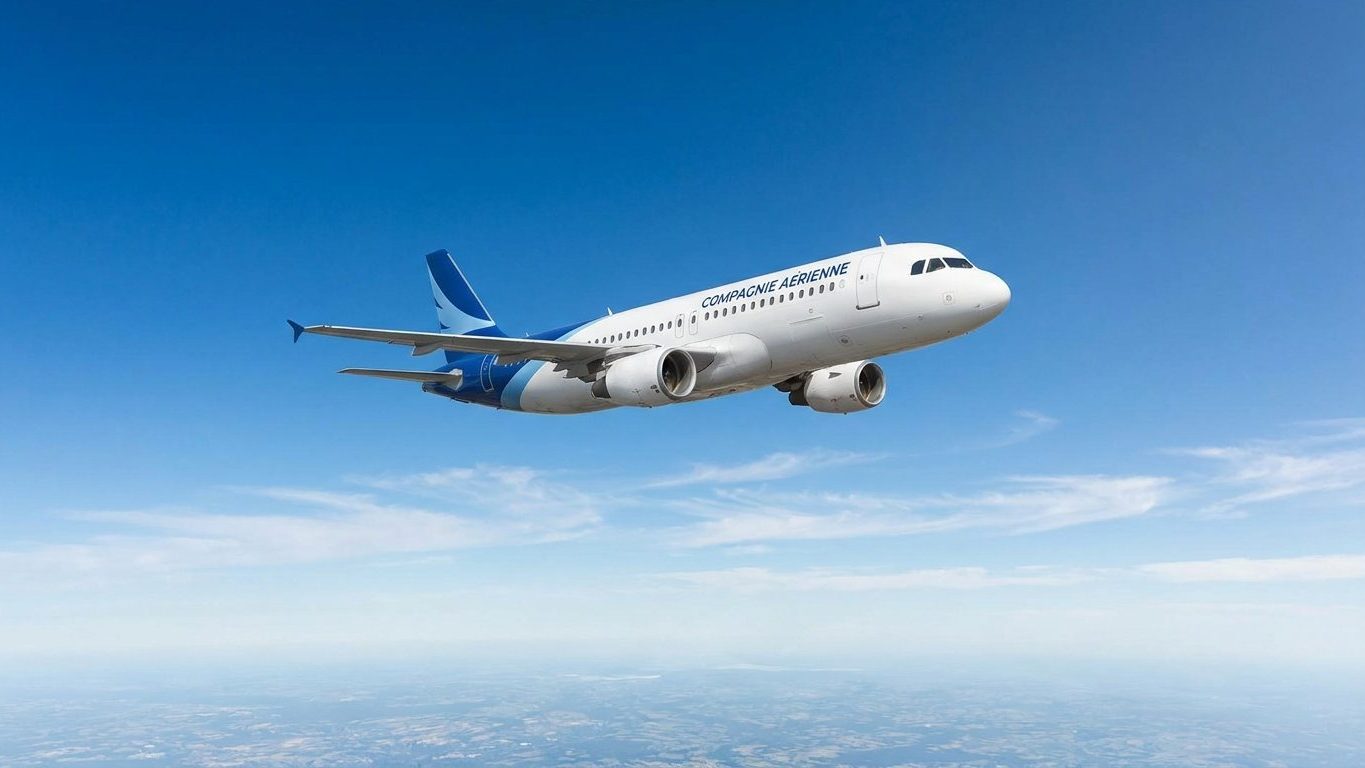
As a general rule, an Airbus A320 cruises at about 11,900 meters, a Boeing 777 usually around 10,700 meters, and a Boeing 747 can climb up to 12,500 meters. Cruising altitude of Boeing 777 and Airbus A380: 10,700 m (32,600 feet). Cruising altitude of Airbus A320: 11,900 m (39,000 feet). Cruising altitude of Boeing 747: 12,500 m (41,000 feet). These figures look alike, and it’s no accident: they are lodged between two physical ceilings that even the finest engineers cannot push back indefinitely.
- Thin air at altitude reduces aerodynamic drag, saving around 30% of kerosene compared with flying at low altitude.
- The “coffin corner” limits altitude: stall speed and Mach speed converge, narrowing the safe speed range.
- Fuselage pressurisation can only withstand a limited pressure differential without structural risk on each flight cycle.
- Airliners climb in successive step climbs during flight to adapt to their weight that decreases as fuel is burned.
Climbing saves fuel
The higher an aircraft climbs, the less dense the air becomes. At 11,000 meters, the atmosphere is roughly four times less dense than at sea level, and a plane slicing through this thinner air experiences far less resistance, what we call aerodynamic drag. Less drag means less thrust is required, and therefore less fuel burned per kilometer traveled. The difference is not trivial. A Boeing 737 flying at 5,000 meters would burn about 30% more kerosene than at its optimal cruising altitude.
On a long-haul flight, the difference is counted in tonnes of kerosene saved on every crossing. That is why airlines consistently strive to climb as high as possible as soon as conditions permit. Yet this logic has a limit, and it arrives sooner than one might expect.
The coffin corner, or why we can’t climb higher
As altitude increases, the wing’s ability to support the airplane diminishes. The air becomes thinner, it carries less, and the stall speed rises for a given indicated airspeed. At the same time, the air cools, and since the speed of sound scales with the square root of temperature, an airplane traveling at a given airspeed ends up nearer to the speed of sound at higher altitude. Two limits thus approach from opposite ends: the stall limit at the bottom and the compressibility effects associated with Mach at the top.
Pilots and engineers have a name for this tightening zone. The “coffin corner” designates the region of flight where the low-speed and high-speed boundaries converge, leaving only a narrow band of usable speeds—a description the Federal Aviation Administration itself uses to describe the situation where slowing down leads to buffet at low speed while accelerating drives you toward Mach buffet. The engines do not escape the phenomenon. They lose thrust as the air thins, the margin between stall and Mach buffet tightens, and the pilot must maintain meticulous precision because the safe speed range becomes narrow.
A slightly tighter turn or a bout of turbulence can push you out of the safe flight envelope. It is this restricted width that physically bounds the altitude attainable, long before the aircraft’s structure becomes a limiting factor. The onboard computers inform pilots of a maximum recommended altitude, REC MAX, and a heavy airliner can indeed climb to around 12,000 meters and even a bit beyond, but the higher you go, the thinner the air becomes.
Other factors weigh in too
Pressurisation adds its own constraint. It makes high-altitude flight possible by preventing physiological risks from reduced atmospheric pressure and lower oxygen levels. Beyond roughly 10,000 feet, pressurisation becomes necessary to shield the crew from hypoxia, acute mountain sickness, decompression illness, and barotrauma. Yet, the higher the plane cruises, the greater the pressure difference between the cabin and the outside, and the more structural stress the fuselage endures with every flight cycle.
That pressure difference is not unlimited. Aviation regulations require that pressurized cabins not exceed an 8,000-foot cabin altitude at the aircraft’s maximum operating altitude. There is also a requirement that the aircraft be able to descend swiftly to a breathable altitude in the event of depressurisation, a timing that stretches with higher cruise altitude.
Weather also plays its part. In mid-latitudes, the majority of thunderstorm clouds cap below this cruising band, allowing aircraft to fly above the most violent turbulence. Traffic is also organized into vertically separated flight levels, a bit like lanes on a multi-tier highway.
Why an aircraft climbs in steps during cruise
A plane does not cruise at a fixed altitude for the duration of a long-haul flight. It takes off heavy, full of fuel, and cannot immediately aim for its highest altitude. As it burns fuel, it becomes lighter, and its optimum cruising altitude rises with it. Hence the “step climbs,” a cruise at successive levels, for example 33,000 feet, then 35,000 feet, then 37,000 feet. This mechanism explains why, on a transatlantic flight, the aircraft quietly climbs one or two times along the voyage.
The altitude chosen at each step also helps avoid thunderstorms, reduces icing exposure, and sometimes exploits jet streams to gain groundspeed. Turboprops, slower, remain considerably lower. Their typical cruising altitude ranges between 5,200 and 7,600 meters.
The Concorde, by contrast, broke the usual frame of reference. It flew at an exceptionally high altitude of 18,288 meters while maintaining a cabin altitude of 1,828.8 meters, which led to complex structural challenges. A reminder that the band of 9,000 to 12,500 meters where today’s airliners operate is not universal: it is the compromise specific to subsonic aircraft, not a universal law written in the sky.
Sources: facebook.com | letribunaldunet.fr
