
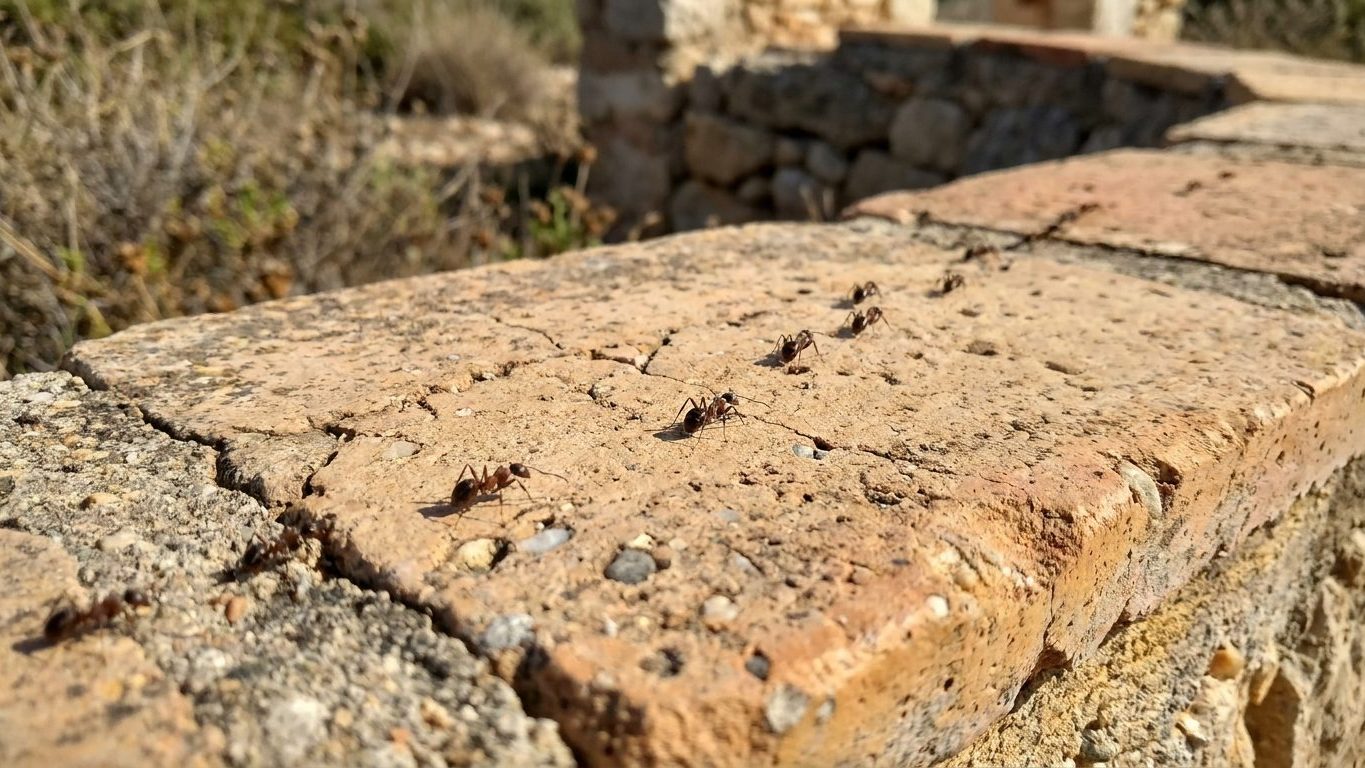
A team of Swiss researchers one day demonstrated something that had seemed impossible: ants taken from the Spanish Atlantic coast and others captured near Italian lakes, when brought into contact, did not fight. The main supercolony stretches 6,000 km from Italy to the Spanish Atlantic coast, making it the largest cooperative unit ever recorded. In a century, these insects have built the world’s largest cooperative network, a single colony that runs along the coasts of Portugal to Italy, passing through Spain and France.
No queen governs this ensemble. No central nest organizes it.
This supercolony is not a single giant ant hill but a mesh of thousands of small nests linked together, each housing several queens at once: biologists refer to it as a polygyne structure. A single colony contains multiple small nests housing several queens. The scale is dizzying: estimates place the northwest Mediterranean supercolony as comprising about a million nests containing a total of one billion individuals. None of these nests lays claim to territory against its neighbors.
- A supercolony of ants extends 6,000 km along the Mediterranean coasts without internal conflict.
- The workers share a single chemical recognition code that unified after introduction in Europe.
- Without wars between nests, all energy goes into conquest, which destroys local ecosystems and eliminates native ants.
The chemical password that unlocks all doors
In nearly all ant species, each colony has its own olfactory signature. Each ant bears cuticular hydrocarbons, waxy signals on the exoskeleton used for recognition between colonies. It is this chemical identity card, deposited on the carapace, that lets a worker know in an instant whether the individual it meets belongs to her nest.
An intruder is detected, then attacked without delay.
To investigate what was happening with the Argentine ant, Laurent Keller’s team at the University of Lausanne carried out a remarkably simple experiment. Researchers captured workers at 33 sites along the southern European coastlines and performed behavioral and genetic tests. They first placed pairs of ants from different places in a small tube and observed whether aggression occurred. The result surprised even the study’s authors: workers from the same supercolony are never aggressive toward one another, despite the great geographic distance and substantial genetic differentiation between the sampled sites.
A depleted genetic heritage, key to the puzzle
The explanation lies in the invasion history. These introduced supercolonies stem from a small number of reproductive individuals, sometimes as few as a dozen, indicating a strong founder effect, i.e., a loss of genetic variation. But classic genetic impoverishment does not suffice to explain everything: the introduced populations show only a limited loss of diversity at neutral markers, which suggests that the breakdown of recognition capacity is probably not due solely to a genetic bottleneck; researchers instead propose a “genetic cleansing” of recognition signals that occurred after introduction.
Result: chemical diversity collapsed far faster than overall genetic diversity.
However, this scenario is not universal across the entire Mediterranean rim. European samples come from two distinct and well-known supercolonies: the main European supercolony, established in 1906, and the Catalan supercolony, established in 1916, which live partly side by side along the Mediterranean coast. Between these two blocks, tolerance is completely gone: aggression remains extremely high between the two supercolonies, indicating that they have fixed different recognition alleles. Two chemical worlds thus coexist on the same shore, each internally united and hostile to the other.
Without internal wars, all energy goes into conquest
The species originates from subtropical South America and was unintentionally introduced by human activities to all continents and several islands, primarily through the transport of potted plants and commodities. In Europe, the first records date from the early 20th century: the Argentine ant was reported in France in 1906, in the Alpes-Maritimes in 1917, in Portugal in 1921, and in Spain in 1923. With no internal conflicts to fund between neighboring nests, all the colony’s energy goes into growth and in contesting other species: in its introduction range, the Argentine ant dominates competition among species, destroys local ecosystems, and causes species extinctions.
In gardens and on coastal terraces, this dominance translates into the gradual disappearance of native ants, often unable to compete with uninterrupted columns of workers. These same workers also maintain aphid colonies to harvest honeydew, a practice observed in the field all the way to Corsica. They can be seen moving along pheromone trails and collecting aphid honeydew.
The expansion is not confined to historical shorelines. A colony genetically linked to the Catalan supercolony has been found much farther north than expected, right in the center of Nantes. This colony was observed for three consecutive years, 2016, 2017 and 2018, and covers more than three hectares in the heart of the city. In a warming continent, such an isolated foci could well herald the next stage of expansion, far from the beaches where it all began.
Sources: persee.fr | letemps.ch
