
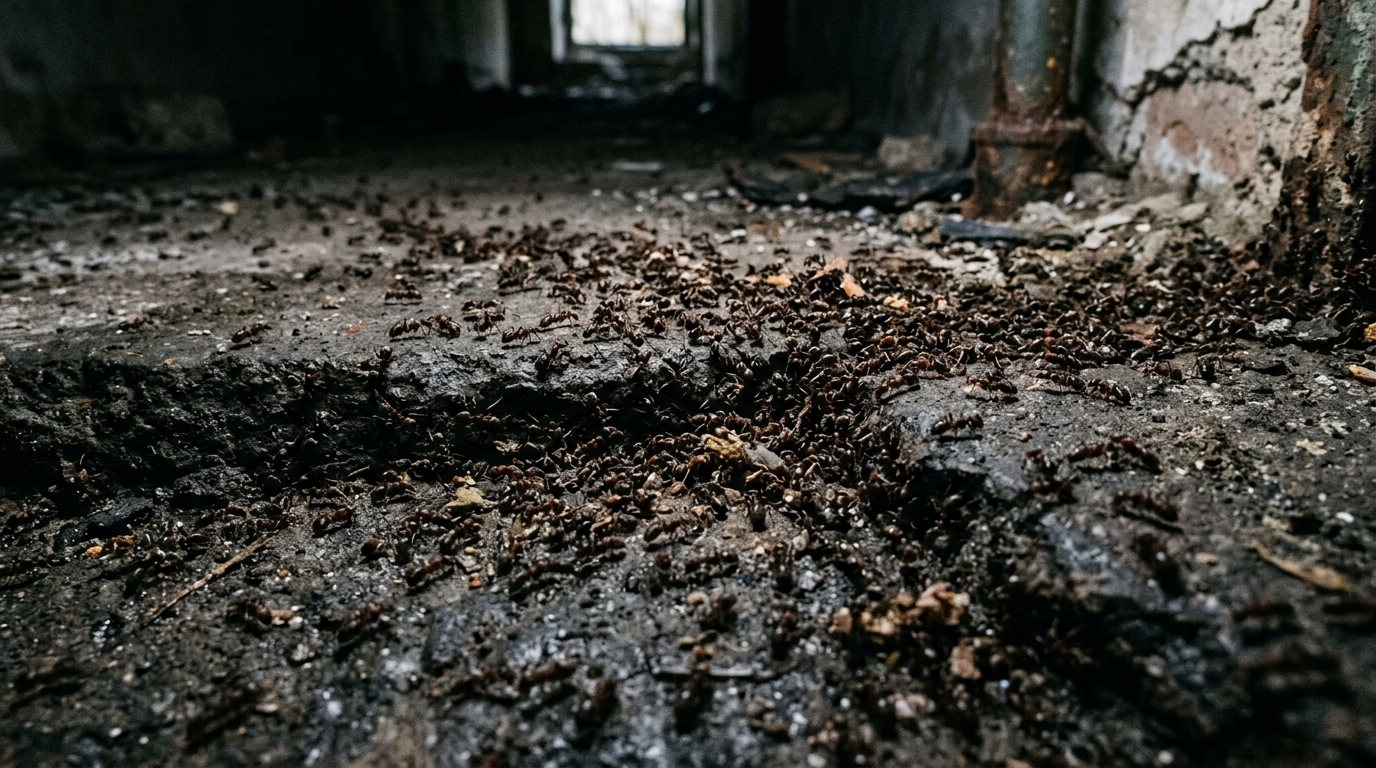
People often think that a colony of ants deprived of its queen is doomed to die out within a few weeks, lacking offspring and renewal. This is, in fact, the common teaching: without queen layings, there is no future for a society of social insects. Yet, beneath an old military bunker in western Poland, an entire colony of red wood ants defied this received wisdom for years, surviving in total darkness without a queen, without a male, and without brood. This case, documented by Polish zoologists after a chance discovery in 2013, challenges our understanding of what keeps an animal society afloat.
- Under a Soviet-era bunker in Templewo, Poland, nearly a million red wood ants had been surviving for years without a queen, without males and without brood after having fallen through a defective ventilation shaft
- Deprived of food and exposed to cold, the trapped workers practiced cannibalism on the bodies of their dead companions while being regularly replenished by new ants tumbling from the surface colony above
- In 2016, researchers installed a wooden walkway that allowed the ants to climb back up and peacefully reintegrate into their original surface colony
- A fall that should never have stopped
- A colony without a queen, without a future, but very much alive
- The upper nest feeds the prison below
- What these trapped ants reveal about collective survival
A Fall That Should Never Have Stopped
It all began with a routine visit. In 2013, a team of researchers from the Polish Academy of Sciences legally entered a former Soviet-era nuclear weapons depot, located at Templewo. Their initial goal had nothing to do with ants: they intended to conduct the annual census of bats occupying these underground galleries. But what they discovered deep inside the concrete structure far exceeded their expectations. Nearly a million worker ants stirred among millions of corpses in a closed environment where, in theory, no ant should have been able to survive for long.
The explanation for this living trap lies in a detail of architecture. Just above the bunker, a mother colony of Formica polyctena, the red wood ant, had built its nest directly atop the exit of a vertical ventilation shaft. Over the years, rust and wear on the metal transformed this duct into a real trap. Thousands of workers plummeted through the pipe each season, crashing several meters lower into a concrete cavern whose ceiling prevented any possibility of climbing back up. A one-way fall, repeated tirelessly, that eventually populated this long-forgotten basement for good.
A Colony Without a Queen, Without a Future, But Very Much Alive
Analyses of this captive population revealed a puzzling reality: there was no queen, no male, and no trace of eggs or larvae. Biologically, this colony had no possibility of reproduction. It did not grow or sustain itself through internal birth, which is the hallmark of surface nests. The usual social structure of ants, organized around laying and brood-rearing, was completely absent here.
Living at a constant temperature that never rose above 10 degrees Celsius and deprived of any external food source, the population should have quickly gone extinct. Yet researchers observed sustained, almost organized activity within this giant graveyard. To cope with the famine, the workers developed a drastic adaptation: cannibalism. The study of the corpses accumulating in the cemetery zones revealed numerous bite marks on their abdomens, evidence that the survivors fed on the bodies of their dead counterparts. It was a brutal, but effective, strategy to buy time.
The Upper Nest Feeds the Prison Below
However, cannibalism alone does not explain the group’s persistence over several years. The true secret lay elsewhere: the ongoing supply of fresh recruits tumbling down from the surface. Each year, new workers from the mother colony above fell through the shaft and joined their trapped sisters below. This steady influx compensated, at least in part, for the losses caused by the cold, the lack of food, and the internal resource conflicts.
Put differently, this underground community did not live in isolation: it functioned as a kind of satellite colony, entirely dependent on a surface nest that it could never reach. The upper nest fed, unknowingly, a captive population deep inside the bunker, creating a silent bond between two worlds separated by only a few meters of concrete and rusted metal.
After several years of observation, the scientists finally intervened directly. In 2016, they installed a simple wooden bridge linking the bunker floor to the ventilation duct. In just a few months, nearly all of the ants trapped in the duct managed to climb up this improvised ramp and reintegrate into the surface nest. Remarkably, no aggressive behavior was observed during these reunions, as if the two groups had never really ceased to belong to the same colony.
What These Trapped Ants Reveal About Collective Survival
This case study, discovered almost by accident during a bat-survey campaign, upends some certainties about how insect societies function. It shows that a colony can stay alive for years without reproduction, provided it receives a steady, albeit small, influx of outsiders. Collective survival, therefore, does not rely solely on the fertility of a queen, but also on the group’s ability to adapt, to pool resources, and, if necessary, to resort to extreme behaviors such as cannibalism.
That Polish Cold War bunker, a relic of a tense era, ultimately housed for years a natural, real-life experiment on the resilience of animal societies. While life on the surface follows its usual seasonal rhythm, underground a handful of ants demonstrated that a group can endure even when deprived of what appears essential for its survival.
This story of ants trapped beneath an old military site is a reminder of how much of nature’s survival toolkit remains hidden, far from the universal rules we tend to assume. It also invites us to ask: how many other colonies, whether of animals or humans, endure thanks to invisible ties with the outside world rather than solely through their own internal resources?
