
Imagine a craftsman who, one morning, discovers that the electric drill he has used for years has just given up the ghost. No hardware store nearby, no after-sales service reachable, and for only option: cobble together a makeshift fix with whatever is at hand. Now transplant that scenario to 250 million kilometers away from Earth, on a rocky, hostile surface where every technical move must be conceived, tested, and then executed remotely, with several minutes of delay between each instruction. This is exactly the challenge NASA engineers faced when the Curiosity rover’s drill—crucial to its scientific mission—suddenly stopped working. There were no spare parts, no miracle software update to fix this kind of failure. They had to improvise, and the solution ended up leaning more on manual ingenuity than on cutting-edge technology.
- In December 2016, the drill’s extension motor failed, rendering the instrument inoperative after fifteen successful drillings.
- NASA engineers devised the method “Feed Extended Drilling” (FED), using the robotic arm to push the drill bit directly against the rock, with added hammering action.
- After nineteen months of interruption, this technique allowed drilling to resume, and Curiosity has since drilled 42 holes since landing in 2012.
- When Curiosity Loses the Use of Its Drill Bit
- Mars, a Remote Repair Workshop That Is Impossible
- Percussion Drilling with an Outstretched Arm, a Constraint-Born Trick
- What This Breakdown Reveals About the Future of Martian Exploration
When Curiosity Loses the Use of Its Drill Bit
Since its arrival on Mars in 2012, Curiosity had earned a strong reputation for its ability to bore into Martian rock to extract powder samples, which were then analyzed by its onboard instruments. Before the breakdown, the procedure relied on a fairly standard mechanism: two contact hooks would seat themselves on either side of the target rock to stabilize the setup, while an internal electric motor progressively pushed the drill forward. It was an efficient system, having already completed fifteen successful drilling operations.
But in December 2016, that extension motor—the one in charge of advancing and retracting the drill bit—suddenly seized. The mechanism, also known as the feed mechanism, became completely inoperative. For Curiosity, it was as if its arm had been paralyzed at the wrist: the tool could no longer be manipulated as originally intended. The rover’s most valuable scientific instrument, which allowed it to dig beneath the surface to reveal Mars’s geological secrets, was suddenly out of service.
Mars, a Remote Repair Workshop That Is Impossible
Back on Earth, such a mechanical failure would likely have required a technician’s intervention, a replacement part, or even sending a new instrument. None of that was feasible for Curiosity. The rover operates alone in Gale Crater, with no possibility of physical assistance. Each command sent from NASA’s Jet Propulsion Laboratory must travel tens of millions of kilometers, with a transmission delay that can reach several minutes depending on the relative positions of the two planets.
In this context, engineers could only rely on the capabilities already onboard the rover. They therefore had to reinvent the use of an existing tool, rather than hoping to fix it in the traditional sense. A first encouraging step was nonetheless achieved in August 2017, when the teams managed to command the drill’s full extension to about 110 millimeters. This result, obtained on Sol 1780 of the mission, opened the door to a broader approach to bypassing the fault altogether rather than merely mitigating its effects.
Percussion Drilling with an Outstretched Arm, a Constraint-Born Trick
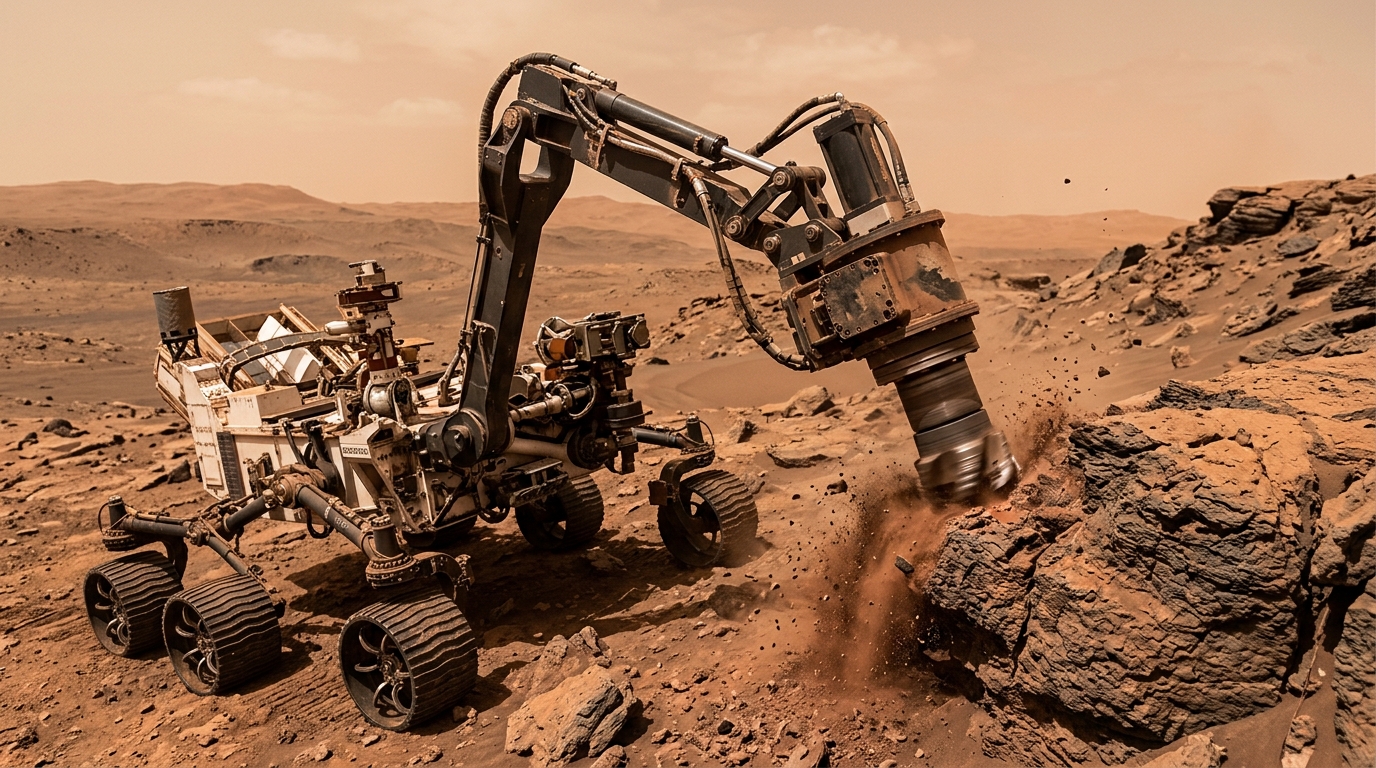
This is where the true technical breakthrough of the story comes into play. The engineers devised a method called Feed Extended Drilling, or FED. The idea is as straightforward as it is bold: instead of relying on the failed internal motor to drive the drill forward, the rover’s entire two-meter robotic arm now pushes the drill directly against the rock. The drill remains extended in its projection, beyond the stabilizing posts that previously kept it steady against the Martian surface.
It can be compared to a handyman who, lacking a fixed support for his drill, chooses to hold the tool firmly at arm’s length to bore a wall. A later iteration of this technique even added a hammering force, turning the tool into a makeshift percussion drill. After nineteen months of interruption, this approach paid off: Curiosity managed to drill a 50-millimeter-deep hole in a rock named Duluth along the Vera Rubin ridge. Unlike earlier attempts that produced partial, unusable holes, this one contained enough powder to be analyzed.
There remained one final hurdle: how to transfer this precious rock powder to the CheMin and SAM analyzers, knowing that the original sieving mechanism depended on the very device that had failed? The answer was almost a home-stove trick. The teams developed a delivery technique called feed extended sample transfer, which involves rotating the drill in reverse to gently vibrate the sample. The powder then trickles out gradually, much like a salt shaker being lightly tapped over a dish.
What This Breakdown Reveals About the Future of Martian Exploration
This technical adventure, though quiet in the space news cycle, perfectly illustrates the adaptive mindset that characterizes Martian missions. The deputy project manager for Curiosity at JPL lauded at the time the ingenuity of the engineering team faced with a major failure tens of millions of kilometers away, with no possibility for direct intervention. Rather than write off the instrument as permanently lost, the engineers managed to turn a mechanical constraint into a new way of working, almost more versatile than the original approach.
Today, this solution continues to prove its worth. The rover has far surpassed the symbolic milestone of forty successful drills since its 2012 landing, with a total of 42 holes drilled on Martian soil to date. This longevity testifies both to Curiosity’s initial robustness and to the innovative capacity of the teams guiding it from Earth. It also reminds us of a fundamental reality for future crewed or robotic missions: on Mars, traditional repairs do not exist, and it is often collective intelligence, more than raw technology, that enables continued exploration.
This tale of a blocked drill that was revived through a simple shift in method highlights how space exploration relies as much on human creativity as on the performance of machines. As new Martian missions are being planned with increasingly ambitious goals, one can reasonably wonder what other engineering tricks will someday rescue instruments we once feared were doomed to drift millions of kilometers from home.
