
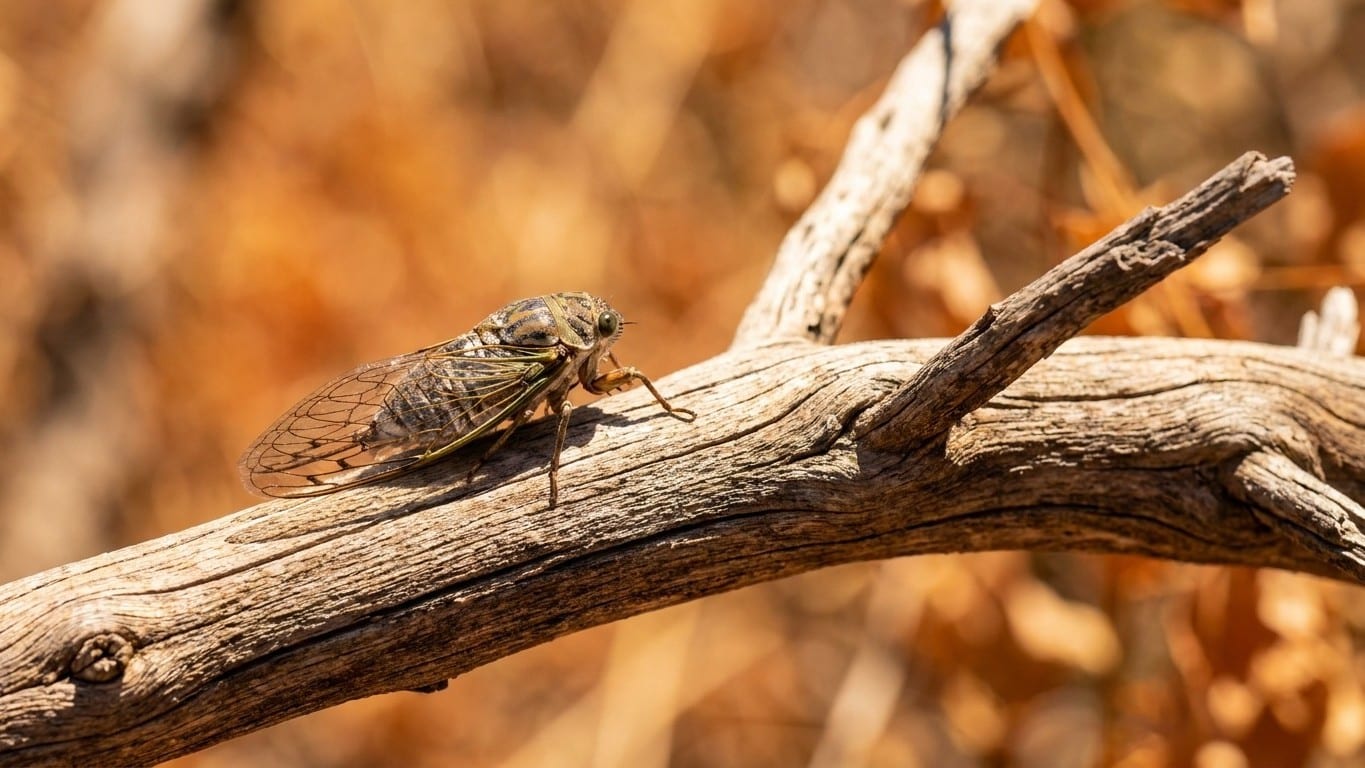
A thermometer hovering near 40°C, and then… nothing. Not a sound in the pines anymore. Last summer, residents of Nîmes and Aix-en-Provence recounted the same strange scene: the cicada chorus, expected to saturate the air until evening, suddenly ended during the peak of the heatwave. This silence has nothing mystical about it. It is pure mechanics, and scientists have just clarified the workings behind it.
Key takeaways
- Cicadas produce their sound via cymbalization, an ultra-fast muscular mechanism that depends entirely on temperature
- There exists a critical thermal threshold beyond which the singing becomes deadly for the insect
- This summer silence could soon become the norm in southern France according to climate projections
A muscle that snaps, not a voice that sings
Contrary to popular belief, the cicada does not possess vocal cords. The phenomenon commonly referred to as the “cicada song” is not vocal production at all, but a complex sound mechanism called cymbalization, used by males to attract females. On its abdomen, the insect has two rigid membranes—the cymbals. Under muscular action, they buckle inward to produce a “click,” then rebound to their initial convex shape, generating a “clack.”
The dizzying detail is the cadence. This motion can repeat at rates from 300 to 900 times per second. The result is a sound that can exceed 90 decibels, roughly the noise of a power drill one meter away. All of this comes from a hollow abdomen that acts as a resonating chamber. A remarkable feat of biological engineering, except that it comes at a price: this ultra-fast muscular gymnastics depends entirely on the ambient temperature.
The precise threshold that triggers, then stops, the concert
There is first a lower threshold, well documented. To activate the ultra-fast muscles needed to produce their sonic signal, these insects must reach a precise internal thermal threshold, generally around 22°C to 25°C depending on the species. Below it, the membrane becomes too rigid to be deformed by the muscles, and all cicadas stop singing almost simultaneously. This mechanism explains why a single cloud passing in front of the sun can silence an entire colony in a matter of seconds.
But the real story of this heatwave summer is the other end of the thermometer: the upper threshold. For while heat helps the cicada up to a point, cold can paralyze them, and extreme heat becomes their ally: the higher the temperature climbs, up to a certain threshold of around 40°C, the more the muscles perform and the louder and faster the song. Beyond this point, everything flips abruptly.
Agricultural climatologist Serge Zaka, based near Montpellier, offered the most straightforward explanation of this shift. He says that “when it gets too hot, between 36 and 38 °C, from those temperatures onward the cicadas stop singing because they can no longer regulate their body temperature through the song. Consequently, they stop singing.” The singing acts somewhat like a safety valve: by vibrating, the insect dissipates heat. But beyond a certain threshold, continuing to operate this muscle at full speed would accelerate its own overheating. The cicada thus falls silent to avoid dying, literally trapped by the physics of its own body. Other specialists place the threshold a bit higher: the optimal temperature range for outdoor functioning lies between 22 °C and 37 °C, depending on species. Not all cicadas are affected equally: some Saharan populations tolerate heat much better than their Provençal cousins, evidence that this critical threshold varies with each species’ evolutionary path.
A living thermometer, and a warning signal
The summer of 2025 provided a textbook case. Between August 8 and 18, a heatwave settled over a wide swath of the country, with the mercury regularly exceeding 40°C in the south. A resident of Nîmes told Reporterre: “It’s unsettling. Since the end of July, I don’t hear cicadas where they used to be so loud you could hardly hear yourself speak.” A similar observation in Aix-en-Provence, where a resident noted this sudden “flat calm” among the cicada population as the mercury rose.
Climate scientist Serge Zaka also notes a shift in timing: the insects now express themselves mainly in the morning and the evening. “In the afternoon, you hear nothing: neither birds nor cicadas,” he points out, reminding us that the entire ecosystem suffers during the hottest hours, with the cicada only being the audible part of a broader problem.
Not all entomologists share the same reading of this silence. For some, it is not necessarily a sign of distress. Entomologist Stéphane Puissant defends a more reassuring theory: “There is nothing to worry about. If they stop singing, it means they have completed their reproductive cycle.” Yet long-term projections point toward a future noisier landscape. According to the same climate analyses, by 2050 cicadas could stop singing as early as July, while their range continues to expand northward, with populations now observed as far as the Toulouse region and even Paris. The next time silence falls in the middle of a heatwave, it will not be a whim of insects: it will be a living thermometer that has reached its limit.
Sources: futura-sciences.com | ici.fr
