
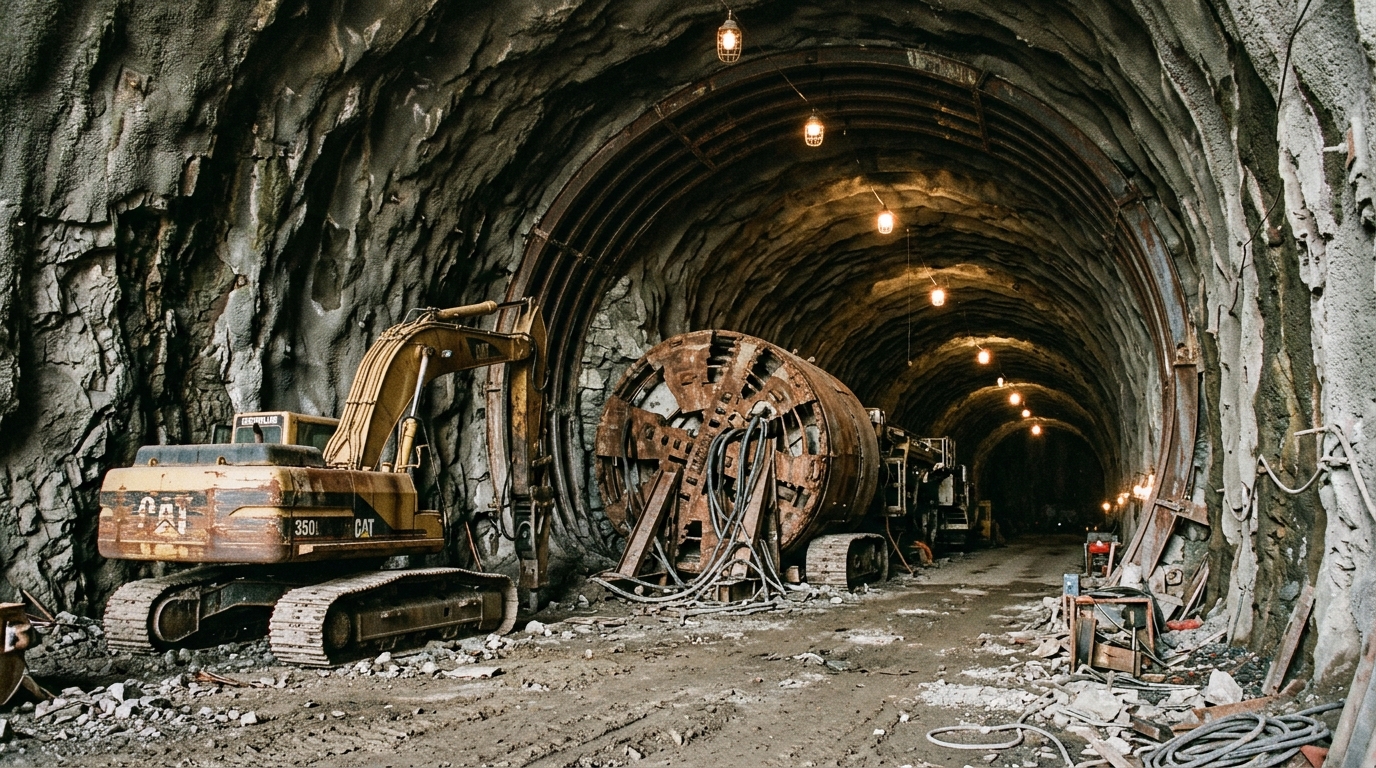
Imagine a titanic construction site buried beneath the Texas plains, where tunnel-boring machines bored 22 kilometers of rock to bring to life what was meant to be the largest particle accelerator ever built. Engineers pressed on, geology cooperated, and physics kept its promises. And then, overnight, everything stopped. Not because of a collapse, nor a scientific miscalculation, but following a vote in the United States Congress, thousands of kilometers away from the underground galleries. This story, largely little-known in France, deserves attention for it illustrates how grand science sometimes depends more on politics than on technique.
- The Superconducting Super Collider was to have an 87.1 km circumference, more than three times the LHC, but the United States Congress canceled its funding on October 21, 1993 after only 22 kilometers of tunnel had been dug
- The initial budget of $4.4 billion in 1987 ballooned to over $12 billion by 1993, due to mismanagement, the end of the Cold War, and the absence of international partners
- The abandoned tunnels near Waxahachie, Texas are now flooded and their access shafts sealed, while CERN discovered the Higgs boson in 2012 by reusing an existing tunnel
- Le Texas a percé 22 km de tunnel géant, puis a tout abandonné
- Un accélérateur deux fois plus puissant que le LHC
- Quand Washington coupe les vivres à la physique mondiale
- Waxahachie, la ville qui devait changer l’histoire des sciences
- Ce qu’il reste aujourd’hui d’un rêve américain enterré
The Texas drilled 22 kilometers of giant tunnel, then abandoned everything
In the early 1990s, near the small town of Waxahachie, about 55 kilometers south of Dallas, a pharaonic project began to take shape underground. The Superconducting Super Collider (SSC) was supposed to host a particle-collision ring capable of pushing the boundaries of known physics. The boring machines had already carved 22 kilometers of tunnel along a planned total of 87.1 kilometers, a figure that makes one’s head spin when you consider this was only the portion already completed. The rock had been tamed, technical teams were advancing on schedule, and nothing in pure science suggested such a sudden halt was in sight.
Yet, on October 21, 1993, the United States Congress voted to permanently cancel funding for the project. A few days later, President Bill Clinton signed the act bringing the venture to an official end. More than $2 billion had already been invested in the infrastructure, including the tunnel now rendered useless, left open beneath the Texas fields.
An accelerator twice as powerful as the LHC
To grasp the scale of what was abandoned, one must compare the SSC with today’s known facilities. The Large Hadron Collider (LHC) at CERN, operating near Geneva, measures 27 kilometers in circumference. The Texas project would have stretched to 87.1 kilometers, more than three times the size of its European counterpart, with an energy announced at 20 TeV per proton, vastly exceeding the LHC’s current capabilities.
Technically, the challenge was colossal: roughly 10,000 superconducting magnets would have guided the particle beams around the ring. The stated objective was clear: to search for the famous Higgs boson, that elusive particle theorized to grant mass to other particles. Ironically, the Higgs boson was eventually discovered at CERN in 2012, nearly two decades after the American project was halted, confirming that Europe had taken the baton where Texas had paused.
When Washington cuts funding to global physics
One might think that only a global budget crunch felled the project. In truth, that is an overly simple explanation. The initial budget, announced at $4.4 billion in 1987, swelled over the years to exceed $12 billion by 1993, with some estimates even suggesting up to $11 billion depending on the source. This drift was largely explained by internal mismanagement, the absence of reliable accounting systems that prevented firm oversight of expenditures.
Other equally decisive factors augmented this financial spiral. The end of the Cold War stripped the project of its symbolic dimension: proving American scientific supremacy over the USSR lost much of its meaning after the Soviet Union collapsed. The United States also failed to convince international partners, notably Japan, to co-finance the infrastructure in a meaningful way. Finally, a portion of the scientific community worried that a project of such immense scale would siphon away the entire budget for basic research from other disciplines. In short, it was not solely global budgetary constraints that killed the SSC, but a tangle of internal drift, national political choices, and a geopolitically changed context.
Waxahachie, the town that was to change the history of science
For the residents of Waxahachie, the SSC represented more than just a scientific project. This small Texan town, previously best known for its historic architecture, was about to become one of the world’s premier hubs of particle physics, alongside CERN. Thousands of skilled jobs, cutting-edge laboratories, international scientific prestige: the dream was within reach.
The project’s cancellation delivered an economic and symbolic shock to the region. After the federal government withdrew, the Texas National Research Laboratory Commission, tasked with overseeing the project, was dissolved. It was ultimately the Texas General Land Office that inherited the heavy responsibility of selling the land and the facilities left behind, putting an administrative end to what would have been one of the United States’ largest halted construction sites.
What remains today of an American dream buried
More than thirty years after the project’s stoppage, the site has never regained its original purpose. The tunnels dug beneath the Texas plains are now flooded with water, and the access shafts that once allowed descent have long since been sealed. Under the ground lies only a silent relic of what could have been a major scientific revolution.
This American renunciation also left lasting geopolitical consequences for high-energy physics. By reusing an existing 27-kilometer tunnel, CERN was able to concentrate its resources on developing high-field superconducting magnets—the very technical challenge that had troubled the Texan project. The global leadership in particle physics research thus shifted, almost naturally, across the Atlantic.
From this abandoned construction site, there emerges a lesson that extends far beyond physics: even the most ambitious ventures, backed by solid science and capable engineers, can collapse under the weight of political and budgetary decisions. The Waxahachie tunnel, silent and buried beneath the Texan plains, reminds us that between an idea and its realization lie stakes that are often decidedly more down-to-earth. Whether, one day, a new project will awaken these forgotten galleries remains to be seen, or whether they will endure as the quiet tomb of an American dream too large for its era.
