
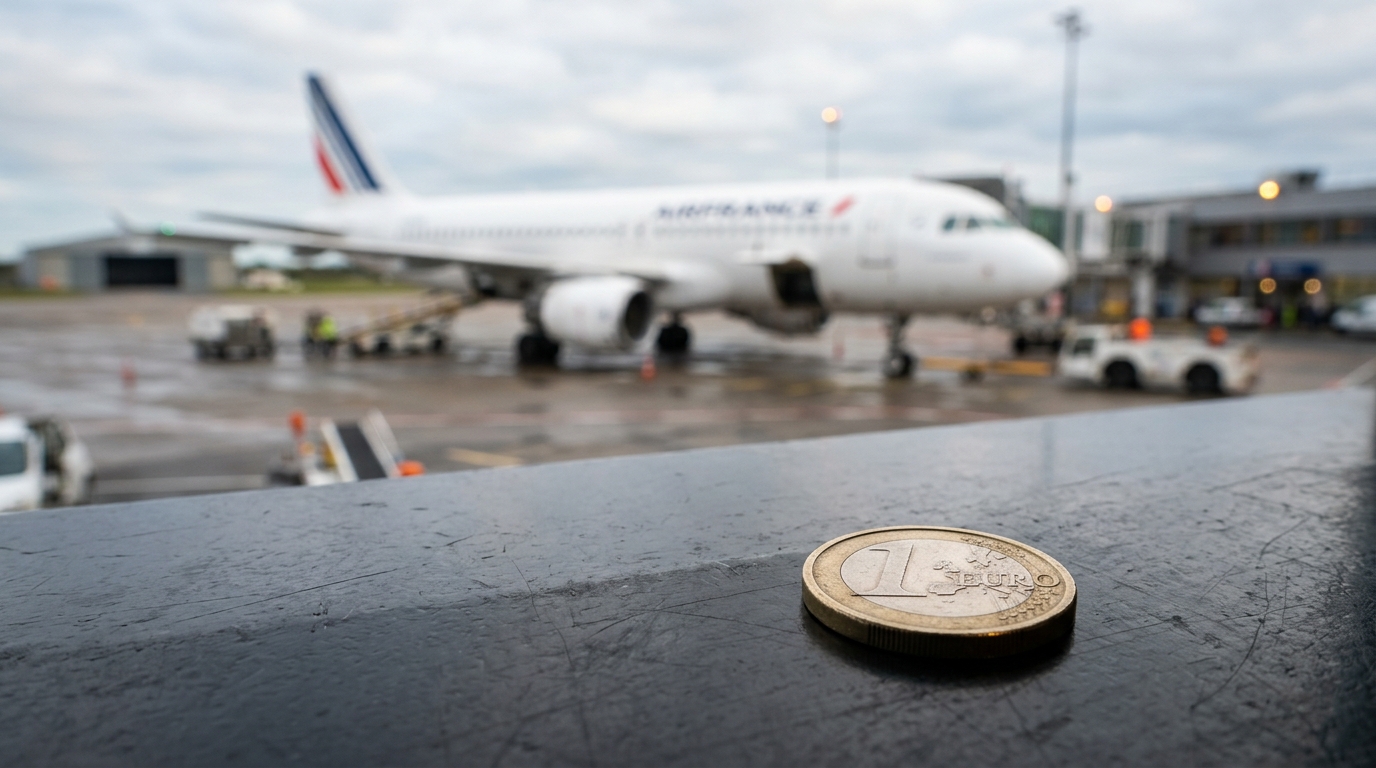
An airline ticket advertised at 1 euro may seem almost too good to be true, and for good reason: it is never truly the actual price of the trip. Behind that smile-inducing tag on online comparison sites hides a financial mechanism far less rosy, where local authorities sometimes dip into their coffers for sums that would make any taxpayer’s head spin. Between subsidies granted to low-cost carriers, commercial discounts at small regional airports, and routes kept afloat despite cabins that are nearly empty, the real cost of air travel is often decided far from the passenger’s eyes, in the austere reports of regional audit chambers. One such report, concerning a link between Pau and Paris, alone illustrates the scale of the problem with figures that raise questions about how public money sometimes supports services doomed to failure.
- The subsidy for the Pau-Paris line cost 764 euros per passenger, for only 255 travelers carried in two weeks before the service was halted.
- On the Le Puy-en-Velay-Paris line, the regional audit chamber recorded a subsidy of 190 euros per passenger, with an average load factor of 7 passengers for 19 seats.
- Between 2008 and 2014, Beauvais airport granted about 85 million euros in commercial discounts, of which 78 million benefited Ryanair.
- The 1-euro ticket that costs the community 764 euros
- Pau-Paris, the case that triggered the regional audit chamber
- How public money ends up subsidizing empty seats
- Behind every low-cost, an unseen bill
The 1-euro Ticket That Costs the Community 764 Euros
There is a dizzying gap between what a passenger pays for their ticket and what the community will actually spend to get the plane off the ground. In a parliamentary report on the practices of public support for airlines, a specific case drew particular attention: the Pau-Paris Roissy route, funded up to 194,914 euros for only 255 passengers carried in two weeks. When calculated, this amounts to a public contribution of 764 euros per passenger, far higher than the price of a round-trip in first class on any other domestic line.
This figure is not journalist’s guesswork: it comes directly from the analysis of the regional auditing chamber, which judged this financial support as “largely unfounded.” In other words, local tax money was used to artificially keep a service alive that the market, left to itself, would never have sustained for so long.
Pau-Paris, the Case That Prompted the Regional Audit Chamber to Take Notice
Let’s review the facts. In 2020, as the aviation sector was trying to recover from lockdown, the Pau metropolitan area, then led by François Bayrou, granted nearly 195,000 euros in subsidies to the ASL Airlines company to relaunch the Pau-Paris Roissy link. On paper, the objective looked commendable: to reopen a strategic service for the Béarn region. In reality, the outcome was disastrous. Only ten round trips were offered, and a mere 255 passengers boarded aircraft capable of accommodating 147 people per flight. On average, that equates to fewer than 13 passengers per flight, i.e., a feeble occupancy rate.
Due to insufficient demand, the service was halted just two weeks after its launch. The regional audit chamber of Nouvelle-Aquitaine, in its May 2023 report, did not mince words, labeling the operation “highly questionable.” This case is unfortunately not isolated: it sits within the chronic fragility of the Pau-Orly link, whose annual deficit reached nearly 3 million euros according to several investigative reports, before Transavia eventually suspended the route at the end of October 2024, citing an “insufficient level of demand.”
How Public Money Ends Up Subsidizing Empty Seats
The Béarn case is, sadly, not a standalone example in France. Hundreds of kilometers away, the Le Puy-en-Velay–Paris link shows similar symptoms. Another regional audit chamber, this time in Auvergne-Rhône-Alpes, pointed to a subsidy cost of 190 euros per passenger, about three times the average typically observed on so-called territorial development routes. Between 2017 and 2019, the average occupancy rate on this line never exceeded 7 passengers per flight, while the aircraft offered 19 seats.
These examples reveal a structural mechanism: when demand does not suffice to cover the operating costs of a route, local authorities step in financially to prevent its closure, often in the name of reducing territorial isolation. A parliamentary question addressed to the Ministry of Transport in 2025 confirmed that the Pau-Orly link deficit, already significant before the Covid crisis, reached nearly 5 million euros and further deteriorated in 2023. So these are empty seats, literally, that the community funds at regular intervals, in the hope of a hypothetical rebound in ridership.
Behind Every Low-Cost Carrier, an Unseen Bill
This funding system is not limited to struggling regional routes. The parliamentary report cited above also mentions commercial discounts granted to Ryanair at Beauvais airport, with about 85 million euros in foregone revenue between 2008 and 2014, of which 78 million directly benefited the Irish company. These sums, often described as marketing contracts or help to develop new routes, actually feed into a system where small airports become structurally dependent on low-cost carriers to keep their activity going, even at the cost of granting them substantial financial advantages.
Aware of this fragility, the government announced plans to implement pooled public service obligations for the Pau-Tarbes airport axis, a solution intended to shield these sensitive links financially. Since then, the Pau-Orly service has been relaunched in 2025, with a tender closing later that same year: Amelia Airlines placed a bid to serve Pau, while Volotea was selected for Tarbes. The question remains as to whether this new financial arrangement will manage to avoid the pitfalls that derailed earlier attempts.
At the end of the day, the story of the 1-euro ticket is really about an invisible bill, paid collectively without most travelers realizing it. Between the 764 euros spent per passenger on the Pau-Paris route and the millions of euros in foregone revenue at Beauvais, these examples raise a simple but essential question: how far should local authorities go to artificially sustain deficit-ridden air links, in the name of regional planning? For now, the answer seems to be decided line by line, report by report, with no overarching national doctrine.
Source : Assemblée nationale
