
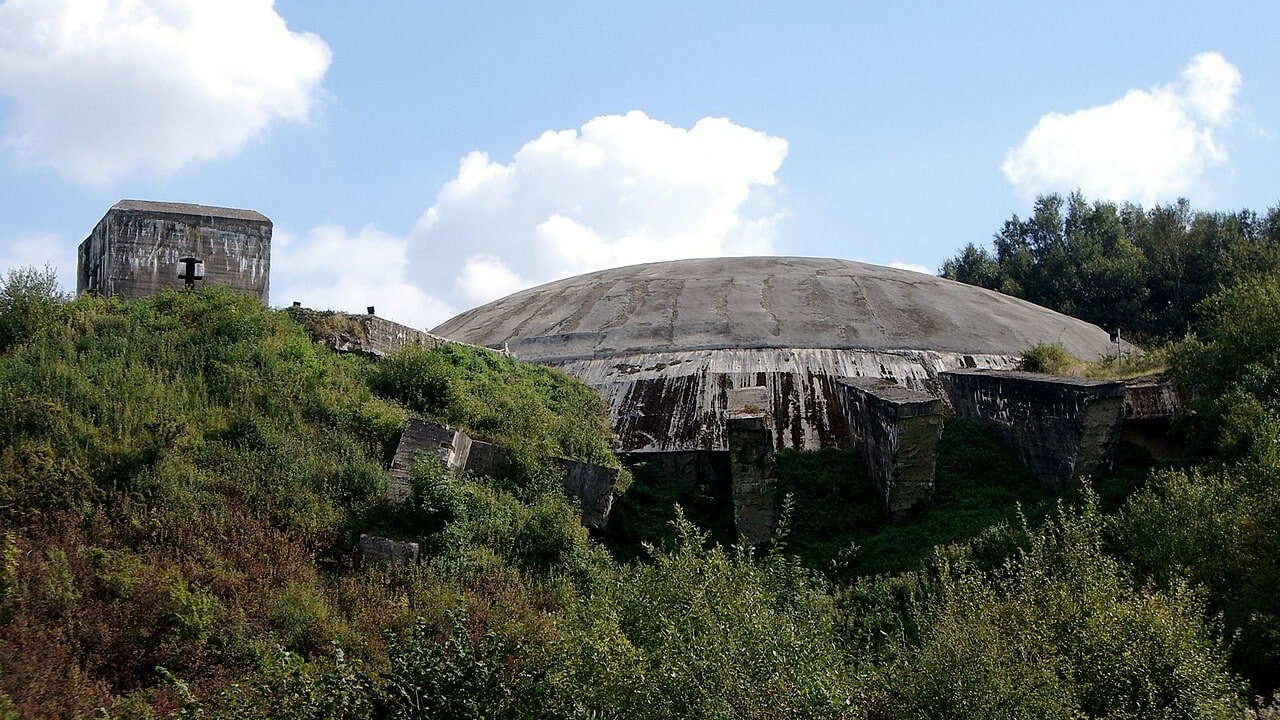
La Coupole owes its name to this colossal reinforced-concrete dome, 5.5 meters thick, perched atop a chalk quarry at Helfaut-Wizernes, a few kilometres from Saint-Omer. Seen from the road, it looks like a crashed flying saucer on a limestone plateau. The reality, however, is more chilling: it was the first launch base for the V2 rockets, the secret weapon developed by the Nazis. And for fifty years after the war, this monument of pharaonic proportions remained sealed, silent, forgotten.
Key takeaways
- A 55,000-tonne dome built in secret to shelter a revolutionary weapon never used
- Sixteen massive air raids and 4,260 tonnes of bombs did not crack its 5.5-metre-thick reinforced concrete
- The chief engineer of this Nazi project would later become the architect of the American space program
An idea born from defeat
Construction of the dome began in October 1943, at a moment when Nazi Germany was clearly on the back foot—defeated at Stalingrad, in North Africa, and in the Battle of the Atlantic. Hitler sought to respond by pouring massive resources into the V weapons, retaliatory arms meant to reverse the course of the war. The regime banked on technology to compensate for the collapse of its military position.
The V2 rocket was the first long‑range ballistic missile in history. Propelled by a mixture of methanol and liquid oxygen, this 12.5‑ton projectile stretched 14 metres in length and boasted a range of 320 km. The V2 could rise to 90 kilometres in altitude and travel at about 5,760 km/h. No Allied aircraft could intercept it, and no radar could detect it in time. In 1943, the V2 stood as a weapon with no known countermeasure. It was planned that fifty rockets would be launched daily toward London, roughly 200 km distant, with the aim of weakening the Allies.
After the failure of the first Watten bunker, bombed by the Allies, the German army sought an alternative site nearby. It settled on an former quarry between the villages of Helfaut and Wizernes, southwest of Saint-Omer. The quarry was chosen to house the rockets, which would be stored in tunnels carved into the chalk hillside before being transported to the launch ramps.
How the unbuildable was constructed
German engineers poured reinforced concrete directly onto chalk that had been shaped into a concave mold. Once the structure was in place, the chalk beneath it was excavated. The result is a dome that seems to emerge from the ground itself, anchored in the rock like a root. The 5.5-metre-thick concrete dome, designed to protect the firing-preparation chamber for the rockets, was completed in January 1944.
Under the dome lay a vast hexagonal preparation hall and a network of about 7 kilometres of tunnels intended to house rockets, liquid-oxygen facilities, workshops, and barracks. Two launch tunnels, named Gustav and Gretchen, were to lead outward from the quarry, each ending in a firing ramp pointed at London. For supply, engineers devised a rail loop called “Ida,” enabling trains to enter the site without the need to back out.
The Todt Organisation, responsible for major state projects in Nazi Germany, entrusted the work to Philipp Holzmann AG, a powerful construction firm. Alongside foremen and skilled German workers, forced labor was used: workers from the Reich Labour Service, foreign workers requisitioned abroad, and Soviet prisoners of war. At the Mittelbau-Dora camp, the deportees who fabricated the rockets endured brutal living and working conditions, and mortality was alarmingly high. At least 20,000 people would lose their lives there.
Sixteen raids, 4,260 tonnes of bombs, an intact dome
It was not until March 1944 that the Allies added Wizernes to the Crossbow target list, the campaign against the V1 and V2 sites. In the months that followed, the US Eighth Air Force and the Royal Air Force conducted 16 raids involving 811 bombers, dropping 4,260 tonnes of bombs. The surrounding area was reduced to a lunar landscape. The bombardments repeatedly disrupted access to the construction site, delaying work. Yet the dome itself, with its 5.5 metres of reinforced concrete, remained unshaken.
Ultimately, it was military geography that doomed the project, not the bombs. It was the bombardments and the Allied advance through Normandy in late July 1944 that compelled the Germans to abandon the project, just weeks before completion. Thus, no V2 rocket ever lifted off from a site intended to be the world’s first base for strategic missiles. Beginning on 8 September 1944, the Nazis began firing V2s from mobile bases, notably toward London and Antwerp.
Fifty years of silence, then a rebirth
Abandoned after the war, the site became the property of the Pas-de-Calais Department. For decades the dome stood there, massive and mute, with no explanation for anyone who happened to pass along the Wizernes road. It was only in the early 1990s that a rehabilitation project took shape. Plans were approved in 1993, the commune of Helfaut bought the site, and the Pas-de-Calais General Council acquired it the following year, contributing 35 million francs to a total project of 69 million.
The works included excavating two extra metres beneath the dome, clearing certain tunnels, constructing the museum at the bottom of the quarry, and installing an elevator to carry visitors from the former firing-preparation room up to the dome. The site opened in 1997 as a center of World War II history and the development of rockets, and a planetarium was added in 2012.
Today the museum welcomes about 120,000 visitors each year and houses a restored V2 rocket (loaned from the Smithsonian) and a V1 flying bomb from the Science Museum in London. A memorial is also dedicated to the 8,000 inhabitants of Nord-Pas-de-Calais who were executed or deported during the war. Yet history holds a fruitful irony: behind this weapon designed to destroy London lies the career of Wernher von Braun, the Nazi engineer who was recruited by the Americans after the war and who later developed the Saturn V rocket to take man to the Moon. Von Braun would obtain American citizenship in 1955, never being pursued for his role in the Nazi regime. The same intellect, the same equations, two opposite fates. Perhaps this is the most vertiginous tale this concrete dome has to tell.
Sources: cote-dopale.com | historius-montoire.fr
