
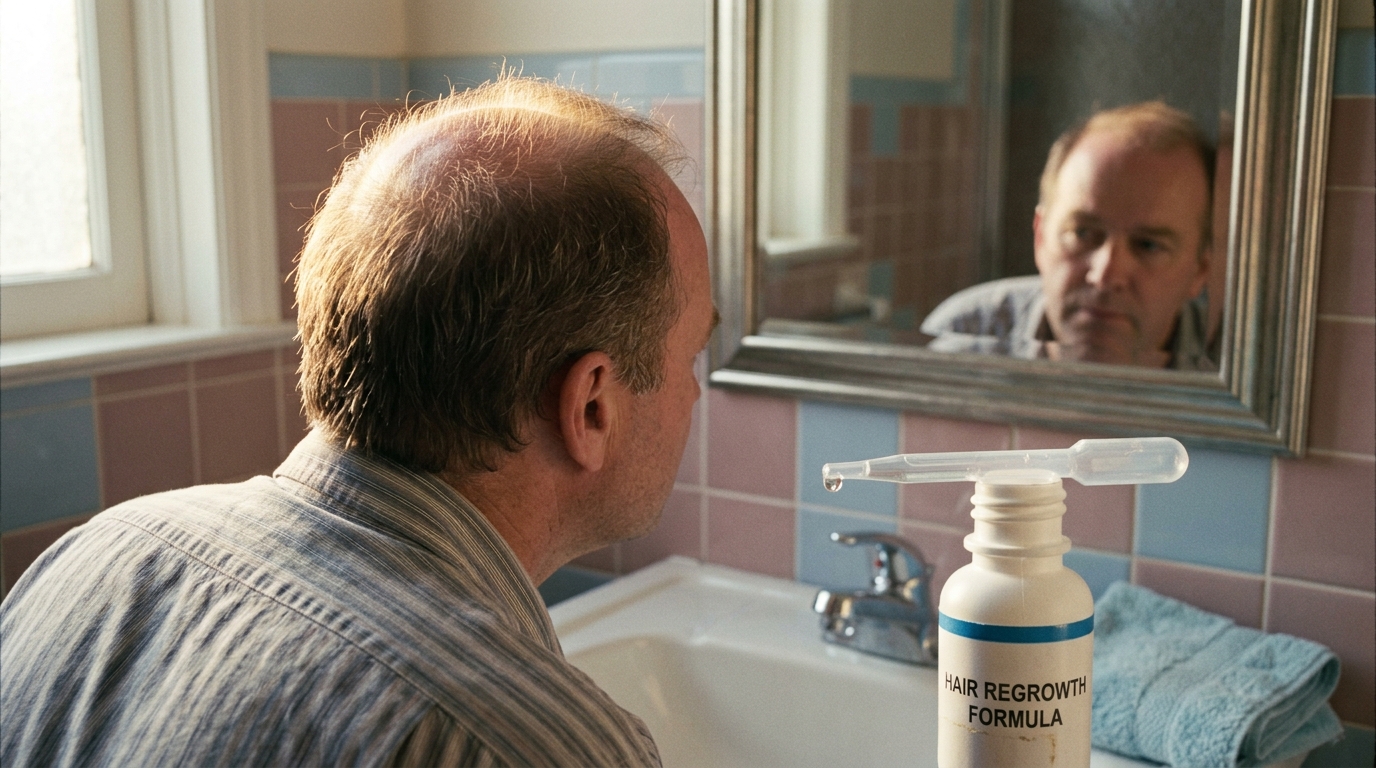
Imagine a patient admitted to hospital with blood pressure so high that a stroke could strike at any moment. He is prescribed a last-resort treatment, a potent pill reserved for the most desperate cases. A few weeks later, this same patient discovers hair sprouting in areas of the body that had never grown hair before. This scene, far from being an isolated anecdote, recurred in American medical practices at the end of the 1970s. And it is precisely from this clinical anomaly that one of the most lucrative industries in modern pharmacology was born almost by accident: the treatment of baldness.
- Minoxidil, initially developed as an anti-ulcer treatment and later repurposed as a drug for severe hypertension (Loniten, 1979), caused hypertrichosis in 60 to 80% of treated patients
- Upjohn filed a patent for a topical application of minoxidil on the scalp as early as 1971, eight years before Loniten’s approval, anticipating its hair-growth potential
- In 1988, the FDA approved a 2% topical solution under the name Rogaine, becoming the first approved treatment for male pattern baldness and laying the groundwork for a market that remains active today
- A cardiac drug that was never meant to touch hair
- The side effect that no one dared mention in consultation
- Upjohn senses the opportunity and turns an accident into a strategy
- From pill to bottle, how Rogaine rewrote market rules
A Cardiac Drug That Was Never Meant to Touch Hair
The story begins in the laboratories of the pharmaceutical group Upjohn, based in Kalamazoo, Michigan. In the 1950s, researchers there were working on a molecule intended to relieve stomach ulcers, a digestive scourge widespread at the time. The compound, named minoxidil, turned out to be a crushing failure for this therapeutic target. Nothing, absolutely nothing, suggested it would someday become synonymous with hair regrowth.
But the scientists at Upjohn did not discard the molecule. Upon closer study, they noticed an unexpected property: minoxidil acts as a powerful peripheral vasodilator, capable of relaxing the smooth muscles lining the walls of blood vessels. This discovery changes everything. By the late 1960s, a cardiologist at the University of Colorado, Charles Chidsey, conducted clinical investigations on this repurposed molecule, testing its oral administration in patients with severe hypertension. The results were spectacular: in patients for whom no standard treatment worked, blood pressure fell significantly. The FDA eventually gave its green light in October 1979, under the brand name Loniten, with a strict restriction: this drug was to be prescribed only for hypertension unresponsive to maximal doses of a diuretic combined with two other agents.
The Side Effect That No One Dared Mention in Consultation
Very quickly, treating physicians noticed a troubling phenomenon among their patients on Loniten. Between 60 and 80% developed what medical literature calls hypertrichosis, i.e., excessive and generalized hair growth, affecting the face, arms, back, and even the scalp. It was neither rare nor anecdotal: as soon as treatment exceeded two weeks, the effect became almost systematic and clearly documented in clinical records.
For patients hospitalized for a serious cardiac issue, this side effect seemed almost comical in light of the life-or-death stakes. Yet something interesting happened before the eyes of the medical staff: a molecule intended to save lives by reducing blood pressure revealed, through a mechanism still poorly understood at the time, a remarkable ability to stimulate hair growth. This paradox would soon intrigue Upjohn’s strategists far more than its cardiovascular effects.
Upjohn Senses the Opportunity and Turns an Accident into a Strategy
What sets Upjohn apart from many other laboratories is its capacity to turn a simple adverse effect into a serious commercial pathway. The company did not discover this opportunity late: as early as 1971, eight years before the official approval of Loniten for hypertension, it filed an initial patent on a topical application of minoxidil directly onto the scalp. This detail is telling: the executives had anticipated the hair-potential of the molecule long before the public heard about it.
The idea was straightforward on paper, but complex to implement: if one could isolate the hair-stimulating effect of minoxidil without triggering the cardiovascular repercussions tied to oral ingestion, one would potentially have a groundbreaking hair treatment. The task remained to scientifically demonstrate that a local application, directly to the scalp, would yield a similar result without the risks associated with ingestion. This development phase stretched across nearly two decades, with clinical trials and formulation tweaks.
From Pill to Bottle, How Rogaine Rewrote Market Rules
The bet eventually paid off. In 1988, the FDA approved a 2% topical minoxidil solution, marketed under the name Rogaine, specifically intended for the treatment of male baldness. A drug originally conceived to rescue distressed cardiac patients thus became, through an almost as long as improbable scientific detour, the first topical treatment validated for hair loss.
This shift had profound implications for the pharmaceutical and cosmetic industries. An entire market formed around a molecule that no cardiologist could have imagined applying as a lotion to a thinning scalp. The next generations of hair care products, whether sold in pharmacies or drugstores, still rely heavily on this same active ingredient, proof that this fortuitous discovery of the 1970s continues to feed a thriving commercial sector, decades later.
This story illustrates how pharmaceutical research sometimes advances along winding paths, where yesterday’s failure becomes tomorrow’s unexpected triumph. Minoxidil, sidelined as an anti-ulcer treatment, a last-resort cardiac lifesaver, and then a hair-care star, embodies the science’s ability to turn missteps into unforeseen opportunities. So, the next time you encounter a bottle of hair lotion in a pharmacy, you might think about this molecule born from a digestive setback and saved by a side effect that, at the outset, no one truly dared to mention.
