
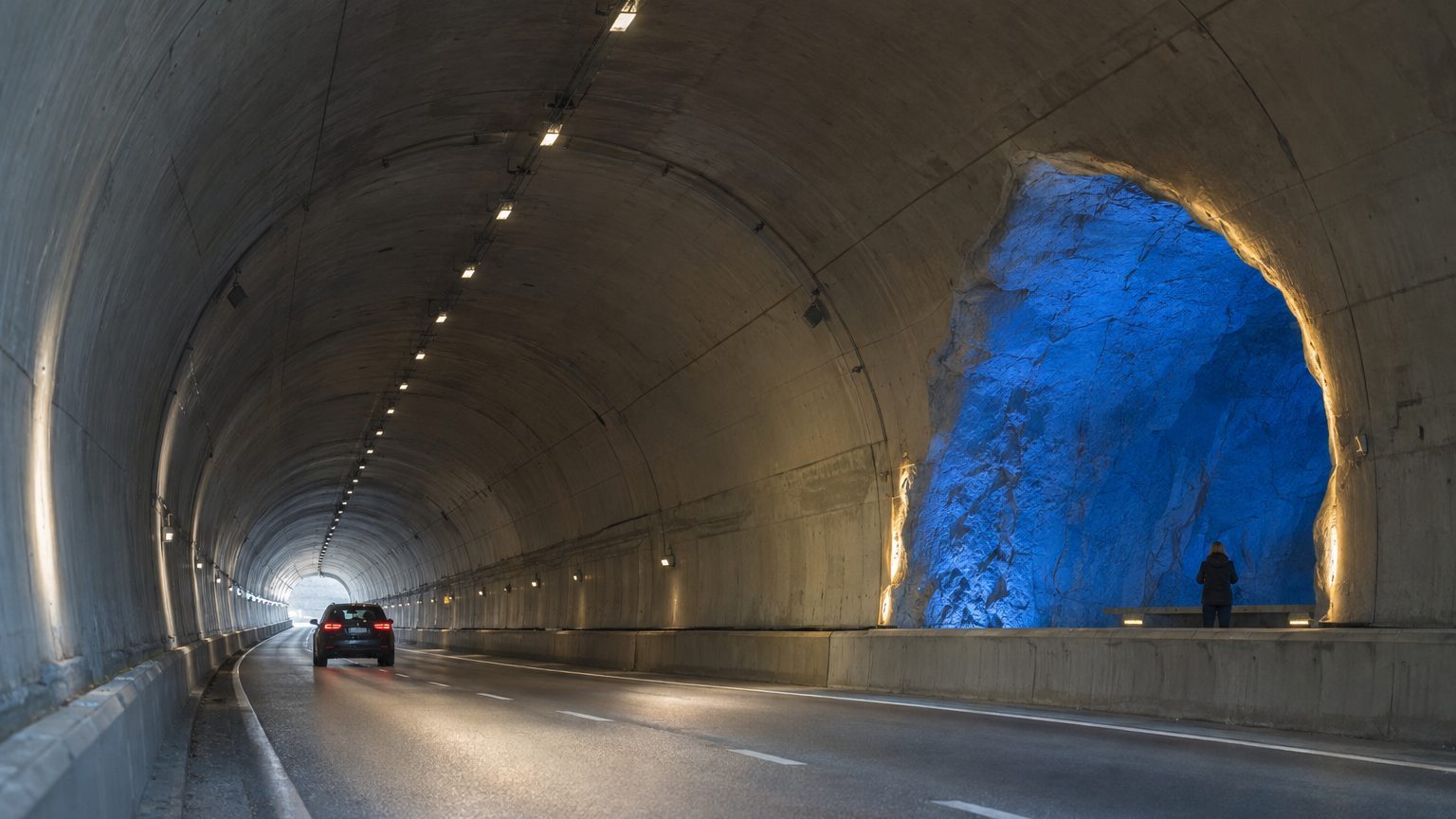
Four sections, three caverns, one single tube: the Lærdal tunnel, on the E16 in Norway, was designed to spare drivers’ minds even before confronting the mountain. Store norske leksikon, the Norwegian reference encyclopedia, attributes 24,509 metres to it and calls it the longest road tunnel in the world. The segmentation visible from the driver’s seat responds primarily to fatigue, not to rock.
The project began in 1995, and it opened on November 27, 2000.
- The Lærdal tunnel measures 24,509 metres and contains only three large caverns.
- Each cavern is lit in blue edged with yellow, to evoke a sunrise.
- The crossing lasts about 20 minutes, with no horizon or natural light.
- Rough strips along the centerline make the car vibrate if it drifts from its lane.
Three caverns, four sections, one tube
On paper, the division suggests a fragmented tunnel. In reality, three large caverns carved into the mountain, spaced roughly six kilometres apart, split the journey into four sections. The main tube is lit with white light, while each cavern bathes in blue light edged with yellow, intended to evoke a sunrise. Parking bays are provided, and motorists can stop there or turn around.
The excavation removed 2.5 million cubic metres of rock, roughly the equivalent of about 1,000 Olympic pools of 2,500 m³. Up to 1,400 metres of mountain overlook the tube, stabilized by 200,000 anchor bolts, according to the Norwegian edition of Wikipedia.
The designers did not shy away from the argument: the length of the construction requires varying the driving experience. The encyclopedia speaks of widenings of the tunnel with special lighting. Some guides compare them to the Northern Lights, and it is these halls that travelers photograph.
Twenty minutes facing the same scenery
The crossing lasts about twenty minutes, according to Store norske leksikon. At 80 km/h, the published limit according to Wikipedia, the 24,509 metres are covered in just over 18 minutes. Twenty minutes with no horizon, no daylight and no change in scenery: few daily journeys impose this format.
Light, variation in the driving experience and ventilation aim to reduce the risk of accidents.
In addition, textured bands integrated into the median, noted by Visit Norway, cause the car to vibrate if it drifts. A sign marks at each kilometre how far has already been travelled and how far remains, according to the Nordge site. The caverns also serve as rest areas to ease claustrophobia.
What the tube contains for the worst-case
An emergency phone every 250 metres, a fire extinguisher every 125 metres: the network is dense. Visit Norway also lists 48 emergency niches and 15 turning-around niches.
When an emergency phone is picked up, lights and electronic signs display throughout the tunnel the command “snu og køyr ut,” meaning “turn around and exit.” The tunnel has only one tube, and English Wikipedia does not mention any dedicated emergency exit. As the project was the longest ever built, the encyclopedia notes that it underwent a thorough analysis of risk factors and safety measures.
Air quality remains a concern. Lærdal was the first tunnel in the world equipped with an air-treatment station, installed in a cavern 100 metres wide, about 9.5 kilometres northwest of Aurlandsvangen. Large fans draw air in from both entrances, and stale air is expelled through a ventilation tunnel toward Tynjadalen.
A record that no one has beaten
Nearly 26 years after opening, the Norwegian encyclopedia still places Lærdal at the top of the world’s road tunnels, ahead of Tokyo’s Yamate (18.2 km). Wikipedia lists newer challengers, such as Sydney’s WestConnex (22.4 km, 2023) and China’s Tianshan Shengli (22.13 km, 2025), which remain shorter. Before the opening, the title belonged to Switzerland’s Saint-Gotthard, according to NRK, the public broadcaster. Other tunnels are longer, such as the Channel Tunnel, but they are rail tunnels.
Traffic remains modest: about 2,247 vehicles per day in 2025.
Since 2013, the Norwegian Public Roads Administration has been measuring average speed over roughly 20 kilometres—the longest such section in the world, according to a site dedicated to Norwegian tunnels, which notes a maximum of 193 km/h. Depending on sources, the length is written as 24,509 metres, 24,510 metres or 24.5 kilometres—mere rounding. The figures in this article are based on the encyclopedia rather than on documents from Statens vegvesen.
Sources: nordge.fr | tripadvisor.com
