
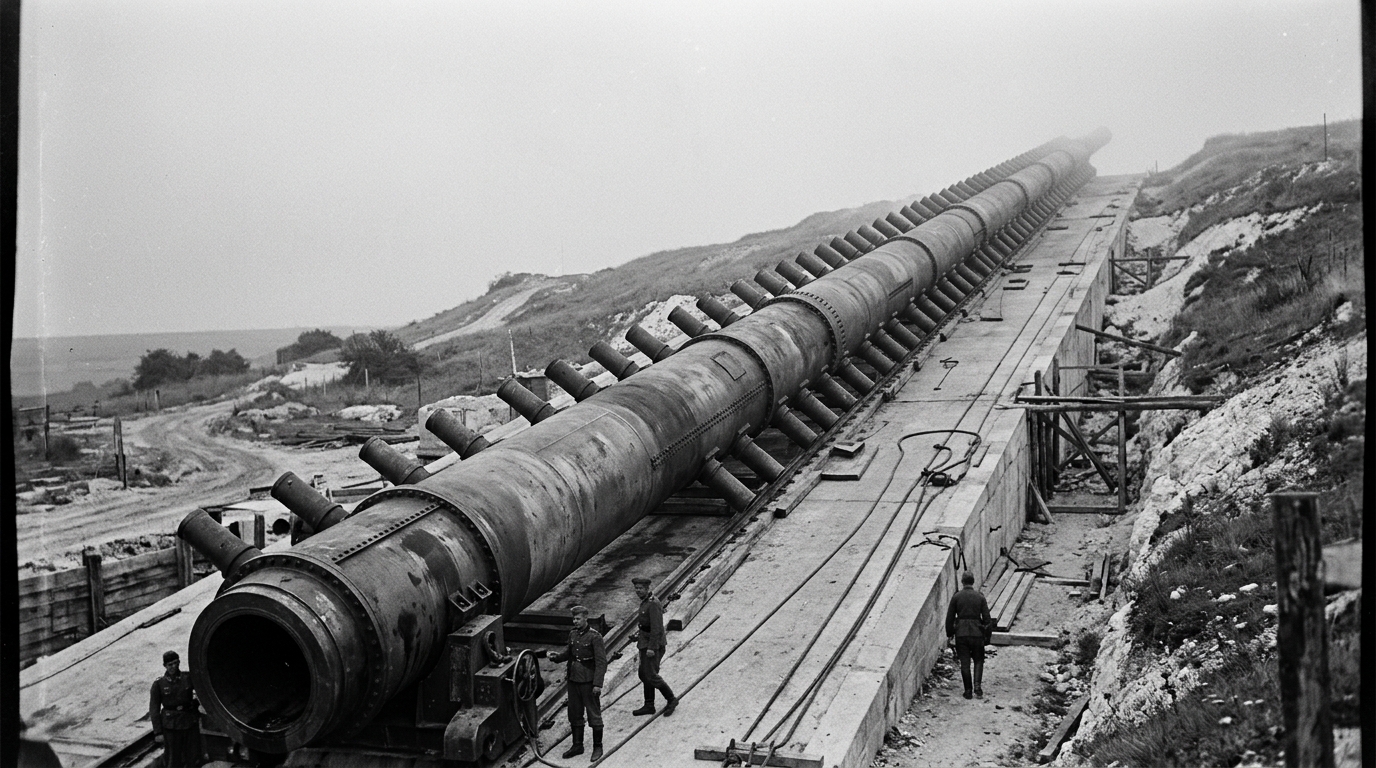
Important note: no drop of British blood was ever shed by this weapon, yet it haunted Allied high command for months. Nestled beneath the peaceful hills of the Boulogne region, just a stone’s throw from the Channel, Nazi Germany began constructing one of the war’s most ambitious military installations. A project so colossal, so secret, that it might have altered the course of the conflict if it had come to fruition. In this autumn of revisiting the little-known corners of French history, examining the fate of this forgotten site helps explain how a simple hill in Pas-de-Calais nearly became the scene of a silent massacre, before being shattered by a thunderclap from the sky.
- At Mimoyecques, Nazi Germany built an underground complex to house the V-3 cannon, a multi-charge weapon meant to bombard London continuously from 165 kilometers away.
- The site employed 430 German miners and almost 5,000 Soviet prisoners of war forced to work under brutal conditions.
- On July 6, 1944, a RAF raid using Tallboy penetrating bombs destroyed the site before it could become operational, preventing any bombardment of London.
- Under a Pas-de-Calais hill, a weapon meant to pulverize London
- The V-3, Hitler’s invincible weapon
- Mimoyecques seen from above: why the Allies panicked
- On July 6, 1944, a six-ton bomb ends the project
- What the cannon’s silence really saved
Under a hill in the Pas-de-Calais, a weapon meant to pulverize London
In Mimoyecques, not far from Calais, the Nazi regime began digging in 1943 a gigantic underground complex designed to house a weapon of a new kind. The aim was deceptively simple on paper: install a battery of cannons capable of pounding London continuously, never stopping, from a fixed and nearly hidden position. London stood 165 kilometers away, a distance that strategists in the Reich believed could not be covered with the precision and cadence required by modern warfare.
The project mobilized engineers and 430 German miners from the Ruhr, accustomed to the most complex underground work. Yet the bulk of the workforce—nearly 5,000 workers—consisted of Soviet prisoners of war forced to labor under brutal conditions. This detail, often overlooked, serves as a reminder that behind every engineering triumph of the war lies a human tragedy.
The V-3, Hitler’s weapon he hoped would be invincible
What would later be known as the V-3 cannon was not a simple extension of the infamous V-1 and V-2. It was a wholly different system, built on the principle of a multi-charge cannon: extraordinarily long tubes in which successive propulsive charges accelerated a shell along its path, in a manner akin to an electromagnetic train propelling a projectile rather than a row of passenger cars.
The initial plan envisioned two separate installations, each consisting of five inclined galleries armed with five tubes apiece, for a total of a vertiginous 50 guns. But shortages of steel and technical components, worsened by regular bombing of German industry, forced Reich engineers to scale back their ambitions. Only one installation was actually completed, with its 25 long tubes of 105 meters each, plunging into the heart of the hill. The stated objective remained dizzying: to fire ten shells per minute, i.e., 600 rounds per hour, for a theoretical total of 1,500 shells per day raining down on London without pause.
Mimoyecques from above: why the Allies panicked
A project of such scale could not long escape the attention of British intelligence. By September 18, 1943, Allied aviation had spotted suspicious movements around this Pas-de-Calais hill, where cavernous galleries were being carved into the earth at a steady pace. Convinced that it posed a direct threat to the capital, British command launched an initial raid on November 5, 1943, dropping more than 350 tons of bombs on the site.
This first assault, though massive, did not stop the works. The Germans reinforced concrete protections and pressed on with construction under a rain of conventional bombs, incapable on their own of piercing the thick protective slabs. The Allies’ real concern lay less in the weapon’s raw power than in its theoretical precision and rate of fire: never had an artillery piece promised such a continuous volume of fire on a densely populated urban target like London.
On July 6, 1944, a six-ton bomb ends the project
Ultimately, a surgical strike would bring the beast of concrete to its knees. On July 6, 1944, the 617 Squadron of the Royal Air Force, the same unit famed for destroying the German dams months earlier, took to the skies under the command of Leonard Cheshire. This time, the bombers dropped not ordinary bombs but a new breed: the Tallboy, bombs weighing nearly five tons and designed to penetrate deep into the ground before exploding, producing a localized earthquake.
Among the 98 Avro Lancaster bombers deployed, unleashing almost 400 tons of bombs, one Tallboy struck directly the concrete slab guarding shaft IV, pulverizing it. Three other bombs severely damaged the adjacent tunnels, causing the collapse of several underground galleries. In a few seconds, months of monumental work—paid for by thousands of forced laborers—were buried under mountains of rubble.
What the cannon’s silence really saved
Here is the revelation that gives the story its ironical resonance: the Mimoyecques V-3 cannon never fired a single shell at London. It wasn’t limited range or the Allied advance a few weeks later during the region’s liberation that ended the threat. It was this exact air raid on July 6, 1944, conducted while the installation was still far from fully operational, that definitively buried the project—literally.
The site, deemed irrecoverable by the occupiers, was later abandoned and finally dynamited by the Allies in 1945 to prevent any future reuse of its infrastructure. Today, the remnants of this subterranean fortress remain visible at Mimoyecques, transformed into a memorial site where one can walk its collapsed galleries and measure the scale of what London narrowly escaped.
This history illustrates how the race for technological supremacy in World War II sometimes played out within a few meters of concrete and a handful of minutes of flight. The V-3 cannon could have altered the war’s course if completed in time; today it leaves only a hollow hill, silent, and a question that continues to echo: how many other projects, equally secret until their last breath, quietly shaped the course of our history?
