
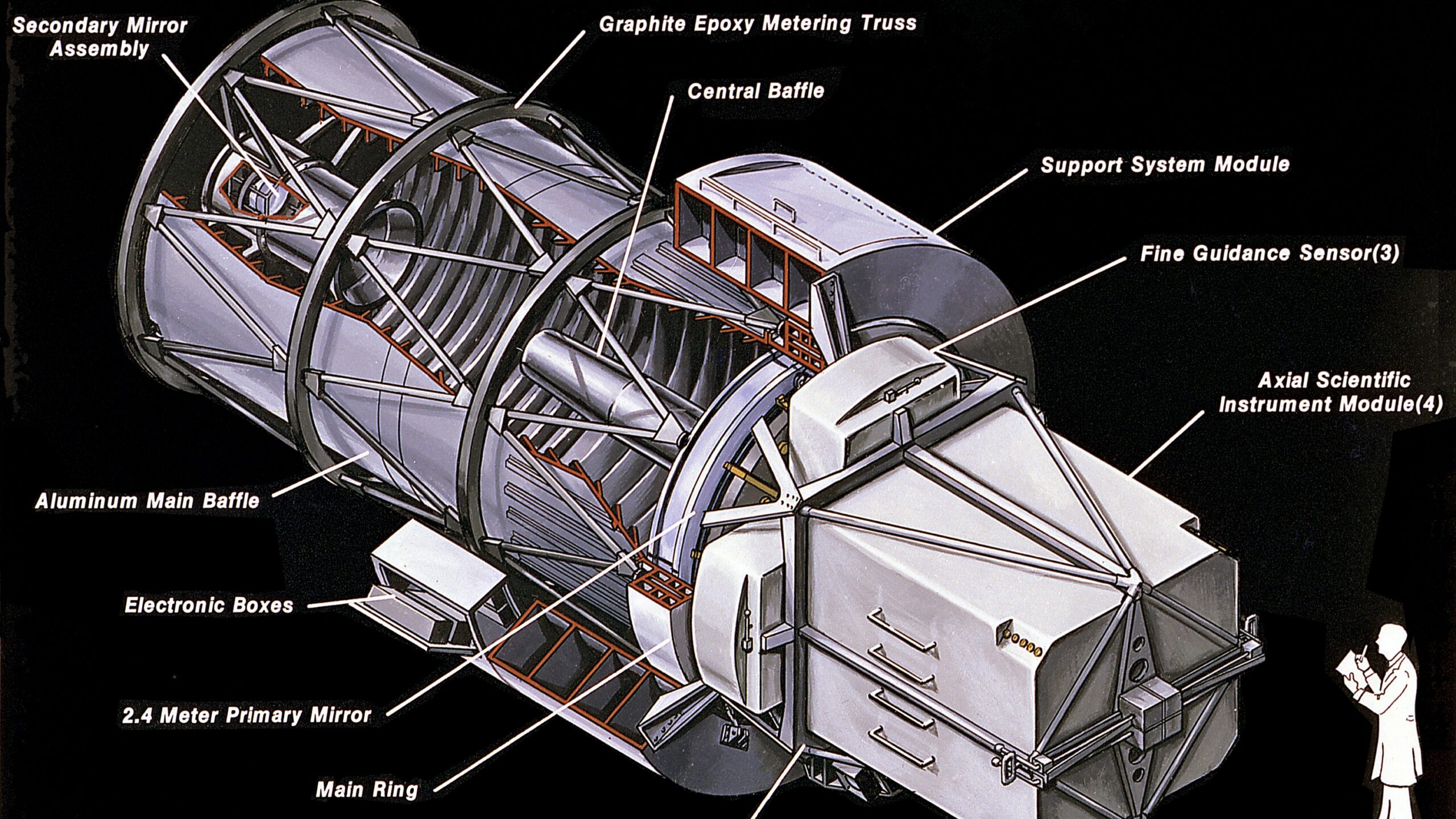
Two mirrors identical to Hubble’s slept for years in a warehouse of American intelligence, until someone recalled their existence. In 2012, the National Reconnaissance Office (NRO), the agency that operates the United States’ spy satellites, quietly handed over to NASA two complete telescopes, never launched, each fitted with a 2.4-meter primary mirror — exactly the same size as the one that has equipped Hubble since 1990.
To Remember
- Why would an American secret agency have two clones of Hubble sitting in its reserves?
- How could a simple phone call reveal technology worth $250 million?
- Whatever became of the second telescope, the one no one seems to be using with NASA?
An Unexpected Phone Call to NASA
The story begins with a nearly trivial call. According to contemporary accounts, the NRO contacted NASA officials to discuss unused hardware that the agency wished to discard. Apparently the NRO had phoned NASA officials a year earlier to talk about handing over “unused equipment,” and NASA began examining them, discovering that they were remarkable and highly complex instruments. The transfer of ownership occurred discreetly in August 2011, but the public announcement only came on June 4, 2012, stunning the astrophysics community.
The shock was commensurate with the gift. Astrophysicists were stunned to learn that the optics of these telescopes were “stunning,” and that they were equipped with technology that would make them easy and affordable to operate in low-Earth orbit. John Grunsfeld, the former astronaut who had repaired Hubble three times in space and then led NASA’s astrophysics division, initially feared that these bulky devices would mostly become a storage headache, before realizing their genuine scientific potential.
Spy Satellites Never Launched, More Powerful Than Expected
These two instruments were anything but ordinary. Built in the late 1990s and early 2000s by Harris Corporation for the NRO, they were originally intended for space surveillance missions, following in the footsteps of the KH-11 spy satellite family. But the program was abandoned along the way, plagued by cost overruns and delays, a fate not uncommon even for the most secret projects. Overruns and delays caused the program to fail in 2005, and NASA announced in June 2012 that the NRO had bequeathed the instruments to the space agency.
On paper, these telescopes surpassed even NASA’s ambitions. To the great delight of scientists, the 2.4-meter telescopes proved to be even better than the 1.6-meter instrument originally planned for the WFIRST mission. The agency inherited equipment that it would likely never have afforded to build from scratch. A contemporaneous estimate cited by the New York Times suggested potential savings of $250 million. A remarkable gift for equipment that no one outside the tight circle of intelligence knew existed.
However, these two structures were not ready-to-use telescopes. There was no instrument mounted on either telescope, only the primary and secondary mirrors and the support structures, and it would take time to design the instruments and integrate them into the framework. In other words, a magnificent yet cumbersome gift: without cameras, without scientific electronics, and without a spacecraft to transport them, there remained a colossal engineering task before these empty hulls could become real observatories.
From Military Surveillance to a Dark-Energy Hunter
It took NASA several years to find a destination for this unexpected heritage. One of the two telescopes, renamed for the occasion, became the cornerstone of the Nancy Grace Roman Space Telescope. On February 17, 2016, the Nancy Grace Roman Space Telescope, then known as the Wide Field Infrared Survey Telescope (WFIRST), was officially designated as a NASA mission, leveraging one of the two telescopes. A nearly romantic transformation for an instrument born in military secrecy.
Its scientific mission bears little resemblance to espionage. Astronomers used Hubble’s observations of dozens of Type Ia supernovae to demonstrate that the expansion of the universe is accelerating, and Roman will build on that heritage by finding tens of thousands of these explosive stars, including very distant ones, to better understand dark energy. Roman’s wide field of view far surpasses that of Hubble: while remaining as sensitive as Hubble’s cameras, the instrument’s wide-field imaging will cover a sky area 100 times larger, so a single Roman image equals 100 Hubble photos.
The telescope’s construction was completed by the end of 2025. NASA announced on November 25, 2025, that Goddard Space Flight Center teams had completed the entire telescope, paving the way for final tests and launch preparations. And the countdown is moving quickly: according to the agency’s official information, the launch is scheduled for August 30, 2026, aboard SpaceX’s Falcon Heavy rocket from the Kennedy Space Center in Florida. In practical terms, the former espionage mirror will lift off in just a few days.
One question that few articles raise: what happened to the second telescope, the one not chosen for Roman? To date it has not received any definitive official mission and remains a kind of luxury spare in NASA’s reserves—a Hubble-class mirror still waiting to be put to use, more than a decade after leaving the American intelligence hangars.
Sources: grokipedia.com | en.wikipedia.org
