
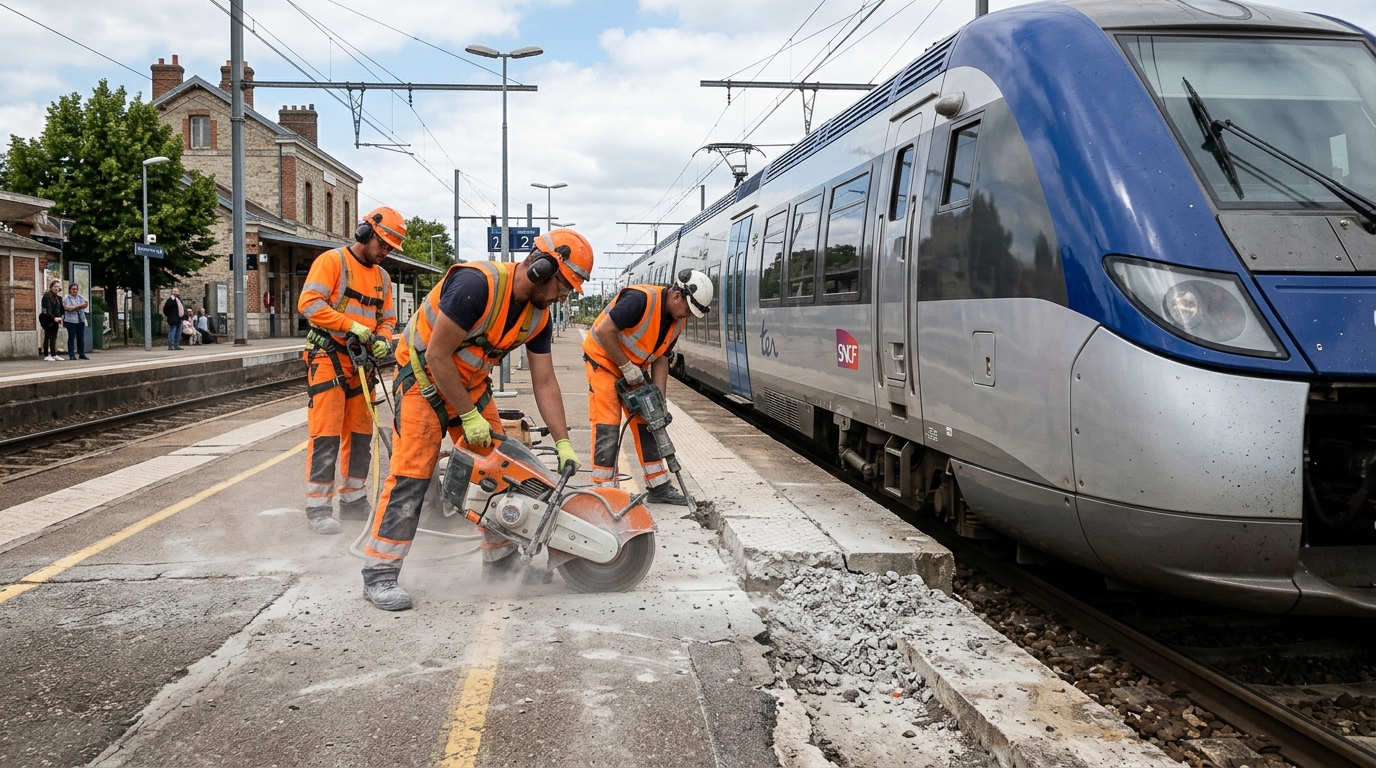
A rail gauge is simply the set of dimensions a train must respect to travel smoothly on the tracks and to stop properly at stations. A technical notion, almost trivial, that one imagines checked a thousand times before any order. And yet, France experienced one of the most amusing industrial blunders in its modern railway history. SNCF, in ordering 341 brand-new train sets, forgot to ask a basic question: will these trains really pass between the platforms across the country? The answer, discovered far too late, forced the state to bring out the grinders to shave the concrete of hundreds of stations. Here is the story of a measurement error that became a textbook case in public administration.
How a Simple Omitted Measurement Derailed an Entire Program
It all began with a gigantic order: 341 TER train sets, spread across 182 Regiolis units from Alstom and 159 Regio 2N from Bombardier. The objective was noble and awaited by users: to offer trains that are newer, more comfortable, and above all wider, in order to relieve road congestion during peak hours. These train sets were to progressively enter service to replace an aging fleet. On paper, everything seemed fine.
The snag is technical, but devastating. The engineers defined the specification by relying on the platform gauges of stations built after 1950. The problem is that the French network is much older, and most stations date from an era when platforms were not measured according to today’s standards. Result: the new train sets proved too wide to pass safely along 1,300 platforms out of 8,700 on the network, or about 15%. In other words, the garment had been designed before taking the body’s measurements. The decision chain, for its part, let this fundamental check slip, each assuming the neighbor had handled it.
Shaving the Platforms, a Concrete Solution for a Steel Problem
Faced with this fiasco, it was impossible to return the trains to the sender or to shrink train sets already in production. The only way out was to adapt the stations to the rolling stock, not the reverse. Specifically, it was necessary to plane the platforms by a few centimeters to move the concrete away from the edge of the tracks. In other cases, the solution involved moving obstructive equipment, such as an electrical cabinet installed too close to the danger line.
The national project took on the look of a broad race against time, with staggered works to avoid disrupting traffic. The officials even acknowledged having worked on 300 platforms before the issue became public. Each station posed its own constraints, between old configurations, cramped spaces, and the need to maintain passenger flow during interventions. A painstaking, secretive effort, but on a large scale.
The Hidden Bill Nobody Budgeted For
An error of this magnitude naturally carries a price. The cost of widening works was estimated at 50 million euros, a sum that did not appear in any initial budget and was added, like an unforeseen supplement, to an already colossal order. These millions did not spring from nowhere: they were borne by Réseau Ferré de France, the entity then responsible for the infrastructure.
Responsibilities, meanwhile, ended up shared and diluted among the various actors in the system. SNCF had defined the dimensions, RFF managed the tracks, and the regions financed a portion of the rolling stock. Each acknowledged a share of blindness. The RFF spokesperson delivered a frank mea culpa, admitting that the problem had been discovered late. What remains is that every euro spent on shaving the concrete was a euro not financing either a new line or a renovation hoped for elsewhere on the network.
What This Fiasco Reveals About the Governance of French Rail
At the highest levels of the state, reactions oscillated between consternation and irony. The then Secretary of State for Transport described the situation as rocambolesque, while the Minister of Ecology denounced an incredible error, pointing the finger at Paris-based decision-makers deemed too detached from on-the-ground realities. A telling phrase that reveals a deeper malaise: the disconnect between design offices and the real concrete of provincial platforms.
This misadventure served as a salutary wake-up call. It highlighted the vital importance of coordination among actors and of field verification before any major financial commitment. Like other industrial failures where progress is made quickly without looking back, the case of overly wide TER trains perfectly illustrates what happens when theory ignores reality. Notably—and somewhat frustratingly—despite the scale of the mess, no prosecution was pursued.
From the forgotten measurement to the shaving of the platforms, through a 50-million-euro overrun, this story sums up the fragilities of a system where the right hand sometimes does not know what the left hand is doing. One universal lesson stands out, applicable far beyond rail: checking before ordering always costs less than correcting afterward. The lingering question remains: in an era of large-scale network modernization, have we really learned to measure before we cut?
