
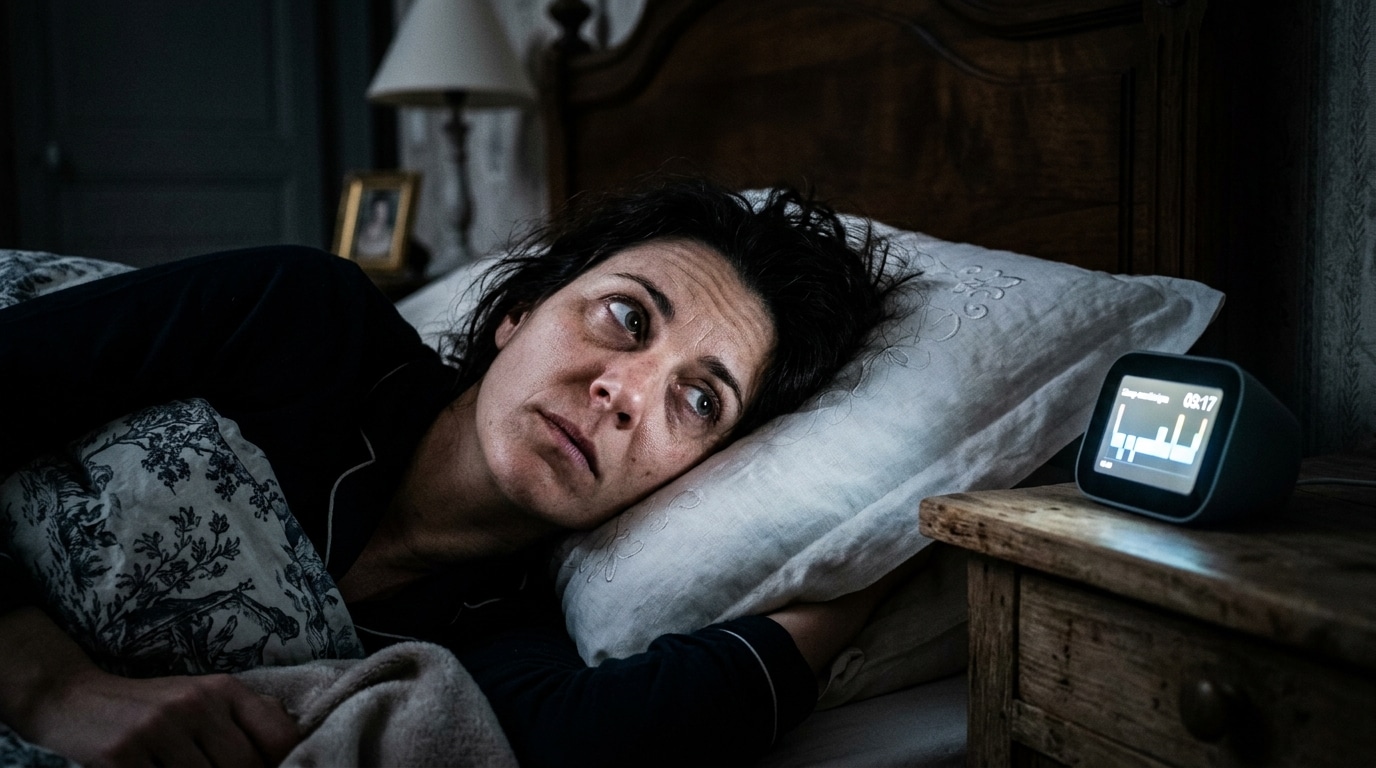
Have you ever wondered whether a brief detour to the bathroom in the middle of the night truly leaves your sleep intact? For many of us, rising once before slipping back under the covers seems utterly innocuous, a simple interlude with no consequences. Yet what today’s sleep recordings reveal challenges this long-held conviction. Behind that quiet awakening lie tiny, almost imperceptible interruptions that fragment our nights far more than we imagined. Far from being a harmless gesture, this nocturnal passage could well weigh on the quality of our rest, and on much more. Let’s explore together what the sensors tell us when we believe we are sleeping peacefully.
What the sensors reveal when you think you’re sleeping peacefully
When sleep is recorded from an individual using a polysomnography, what you get is a genuine map of the night. This examination measures brain activity, eye movements, heart rate, and breathing, drawing what specialists call the hypnogram, a kind of musical score of our various sleep stages. On this trace, the cycles clearly follow one another, from light sleep to deep sleep, up to the famous REM sleep, the stage of dreams.
And that is where the surprise appears. The trace often reveals micro-awakenings, those short interruptions of which we have no memory upon waking. Too brief to be consciously perceived, they nonetheless suffice to disrupt the smooth continuity of the night. When they multiply, we observe too frequent changes of sleep stage and an overall architecture that becomes disordered. In other words, a night that seemed peaceful can in reality resemble a patchwork far more disjointed than we had imagined.
Nocturia, this nocturnal visitor that leaves more traces than you might think
Nocturia is the medical term for the need to rise at least once during the night to urinate. In a healthy adult, urine production naturally slows during sleep thanks to a hormone called vasopressin, also known as antidiuretic hormone. Picture it as a discreet regulator that puts the kidneys into a resting state so you can sleep uninterrupted. When this mechanism misfunctions, nocturnal urine production increases and rest is interrupted.
However, what may have seemed like a minor nuisance now appears in a different light. Recordings show that nocturia is associated with more micro-awakenings and more fragmented sleep. The act of getting up is only part of the problem: around this awakening swirl multiple interruptions that fragment the night. It should also be noted that waking several times after the age of 60 is often perfectly normal, and does not necessarily need to be a cause for alarm.
Why fragmented sleep weighs on more than the morning fatigue
One might think that a choppy sleep only leaves you feeling a bit foggy upon waking. The reality is more nuanced. Micro-awakenings interrupt the phases of deep sleep and REM sleep at the very moment when they should stabilize, as if you were stirring a pot just before it reaches a simmer. These phases are essential for physical and mental restoration.
Even more troubling, each micro-awakening briefly activates the sympathetic nervous system, triggering a small adrenaline spike that accelerates the heart rate. If such micro-alerts recur throughout the night, they accumulate into effects very close to a sleep debt. Add to this a factor that is often underdiagnosed: obstructive sleep apnea. These episodes of interrupted breathing reduce oxygenation, trigger micro-arousals, and can even contribute to nocturia. A true nocturnal vicious circle.
What we take away from nights that seemed inconsequential
Detecting these micro-awakenings remains a meticulous task. Traditionally, experts analyze the tracings by eye, a lengthy process that is sometimes subject to interpretation. This is why recent work seeks to automate this detection. An algorithm based on signal processing, without resorting to artificial intelligence, was tested against recordings that had been manually analyzed by specialists. The goal: to gain precision and speed in order to better understand what unfolds in our nights.
What this approach teaches us is valuable. An isolated waking often hides a much more complex invisible mechanism, made up of tiny interruptions that, when added together, diminish the quality of rest. Understanding this phenomenon opens the path to better support for those whose nights are fragmented.
Ultimately, this small nocturnal detour that we believed to be harmless proves to be far more revealing than we imagined. Sleep recordings remind us that the quality of our nights is not measured only by the number of hours spent in bed, but by their deep continuity. So, the next time you rise in the middle of the night, perhaps you will view this seemingly innocuous gesture through a different lens. And perhaps our most quiet awakenings are precisely the ones that deserve the most attention?
