

Every week brings its own batch of new artificial intelligence models capable of writing text that, at first glance, is indistinguishable from what a human would type. GPT-5, Gemini, Claude, LLaMA, Mistral and an expanding list of open models now produce prose that is hard to tell apart from human writing. This realization has quietly given rise to two parallel industries: one that tries to detect AI-generated text, and one that tries to pass that same text off as human. Neither side has gained the upper hand, and it is precisely in this gap that a large portion of today’s debate over AI-generated content unfolds.
The stakes are not trivial. Universities penalize students based on false positives almost as often as they catch real cheating. Editorial desks discreetly reject freelance articles on the sole basis of a detector score, with no explanation behind the figure. Applicants see their cover letters dismissed by an automatic check of which they were unaware even existed. None of this will disappear: it is becoming an almost reflexive habit in evaluating a text, whether the people involved know it or not.
Why a Simple Percentage Is No Longer Enough
For the past two years, most AI detectors operate the same way: you paste a text, you receive a single number — 85% AI, 12% human, regardless of the model. Handy for a quick check, but insufficient when the stakes are real. A professor hesitating to sanction a student, an editor evaluating a freelancer’s contribution, or a recruiter filtering cover letters needs more than a lone score, without any justification behind it.
The most useful detectors analyze a text sentence by sentence rather than giving a global score. Lynote’s detector, for example, studies rhythm, repetition, lexical variance and predictability — the signals that distinguish machine-written prose from human writing — then highlights, line by line, the passages that appear AI-written, AI-edited, or mixed, with model-specific cues (typical ChatGPT turns, Claude-style structure, Gemini-style synthesis). The tool also flags texts that have merely been reformulated by AI, not only those created from scratch — a crucial point, since some workarounds involve routing a text through a paraphrasing tool before submission.
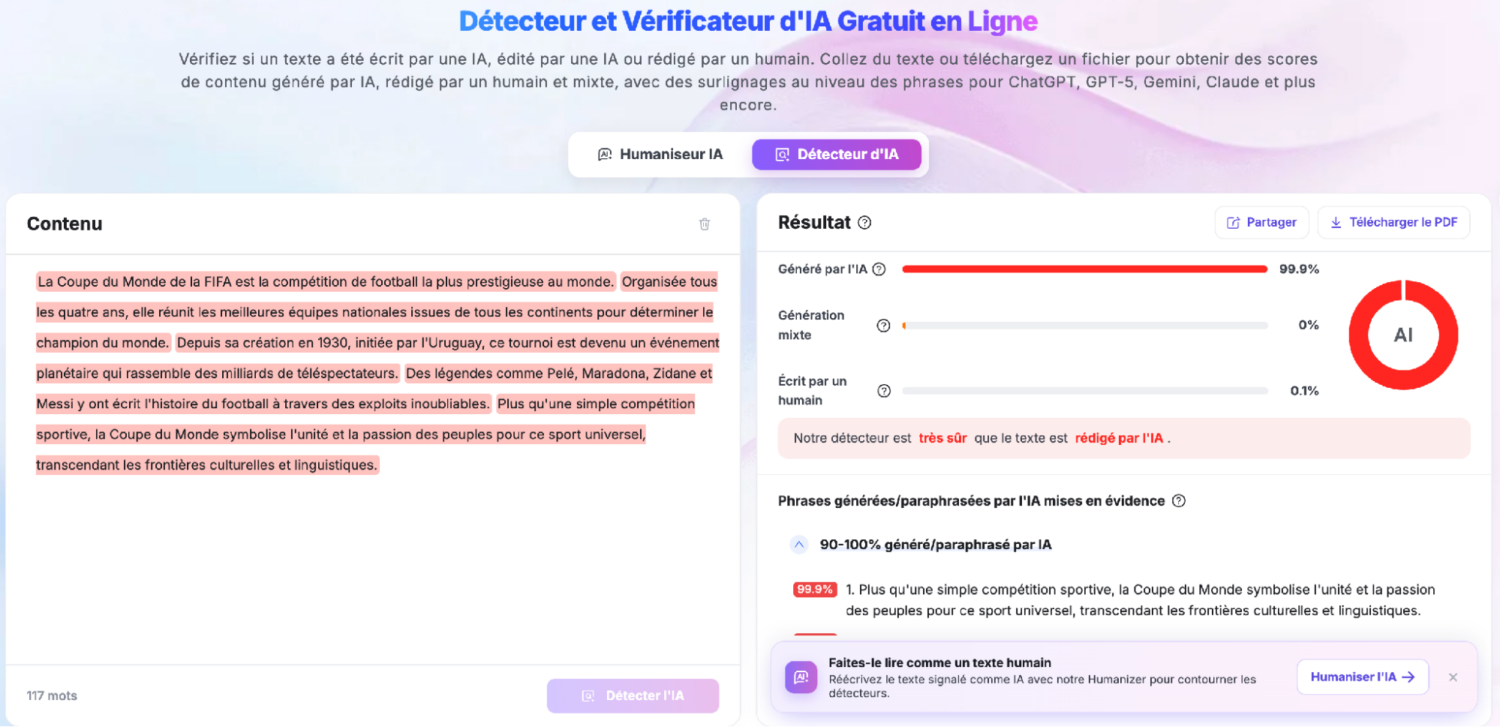
For those comparing available solutions, best ai detector gives a good idea of what to expect from a serious tool on lynote.ai/fr/ai-detector: no signup required for quick checks, coverage in more than 50 languages, and a stated policy that submitted texts will never be used to train a model — a detail that matters for anyone pasting unpublished material.
The Other Side of the Problem
On the opposite end of detection lies humanization, and this kind of tool has moved from gadget status to an almost standard step in AI-assisted writing. Uses extend far beyond the stereotype of “the cheating student”: editorial teams smooth an AI-generated draft before publication, non-native speakers refine text drafted with AI help so it sounds natural, and marketing teams producing content at scale don’t want every post to sound like it came out of the same mold.
A mere “spinner” that swaps synonyms is no longer enough, because detectors have learned to spot exactly that kind of manipulation. Tools that truly manage to bypass modern detectors rewrite at the sentence and paragraph level rather than word by word, tackling the low perplexity and the lack of variety in sentence length that give AI-generated text its flat and predictable tone.
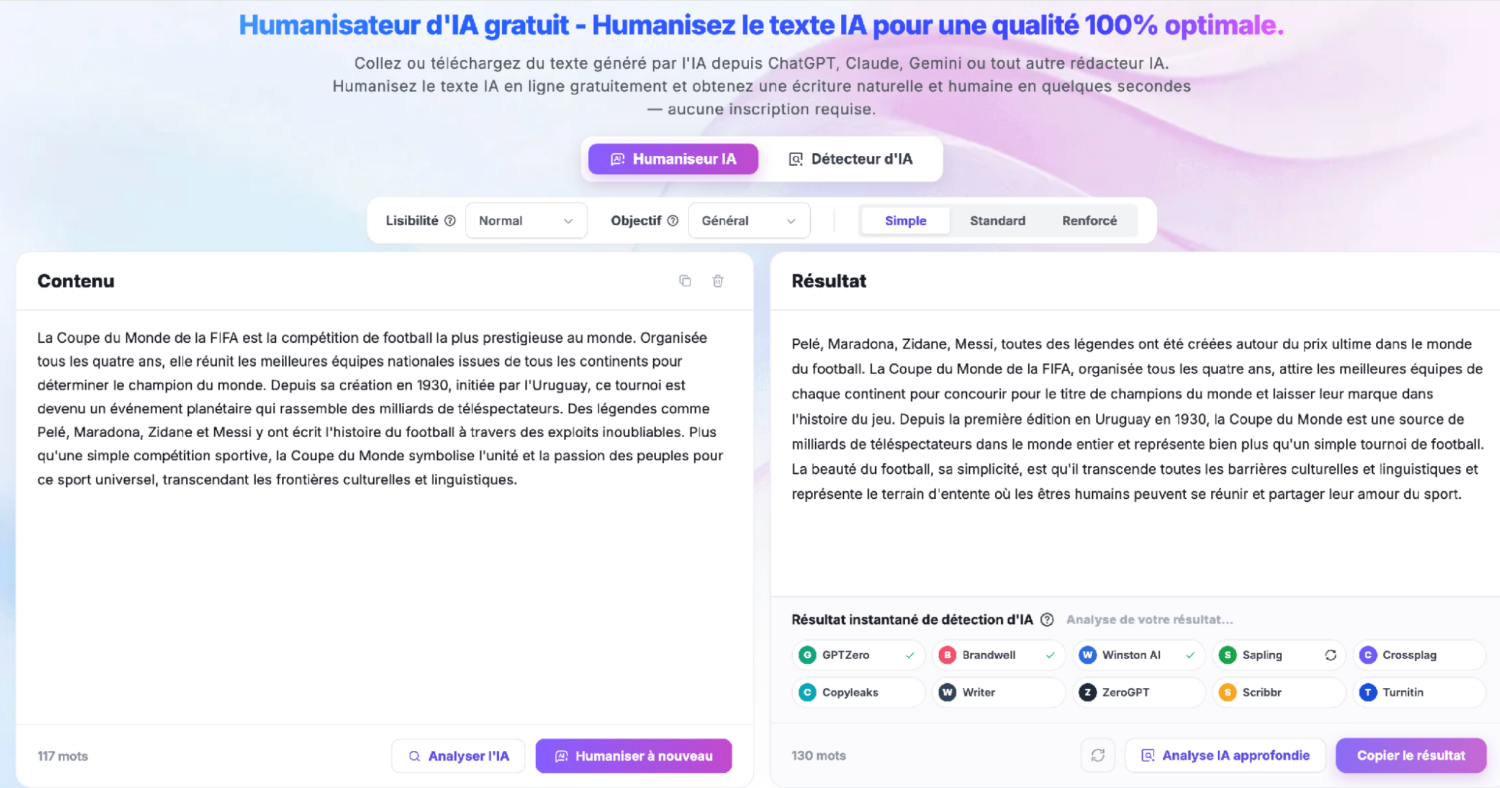
Lynote’s ai humanizer applies this principle across three levels — light for simple tweaks, standard for balanced rewriting, and strong for the most stringent detectors like GPTZero — while preserving the original meaning, the text’s intent, and the targeted SEO keywords. The result is designed to pass plagiarism checks like Copyscape rather than merely looking like recycled content, and it supports more than 80 languages, a useful detail for teams publishing beyond the English-speaking market.
A Tool Built for Both Sides
What sets Lynote’s approach apart is the bringing together of a detector and an humanization tool in a single product, all centered on the same underlying problem: will this text pass scrutiny, and will it read as if a real person wrote it? You run a document through the detector, you see exactly which sentences are flagged and why, then you run those precise passages through the humanizer again before rechecking — all without switching tabs or paying for two separate subscriptions.
None of this resolves the fundamental question: should the use of AI in writing be signaled, cited, or framed according to the context? It remains an ethical and regulatory debate that continues to evolve differently across newsrooms, universities and businesses. What seems settled, however, is that the two sides of this technological race are advancing at the same pace, and that the gap between “a text flagged by a detector” and “a text a human would actually write” continues to narrow. Whether that’s good news or not depends entirely on which side of the desk you sit on.
