
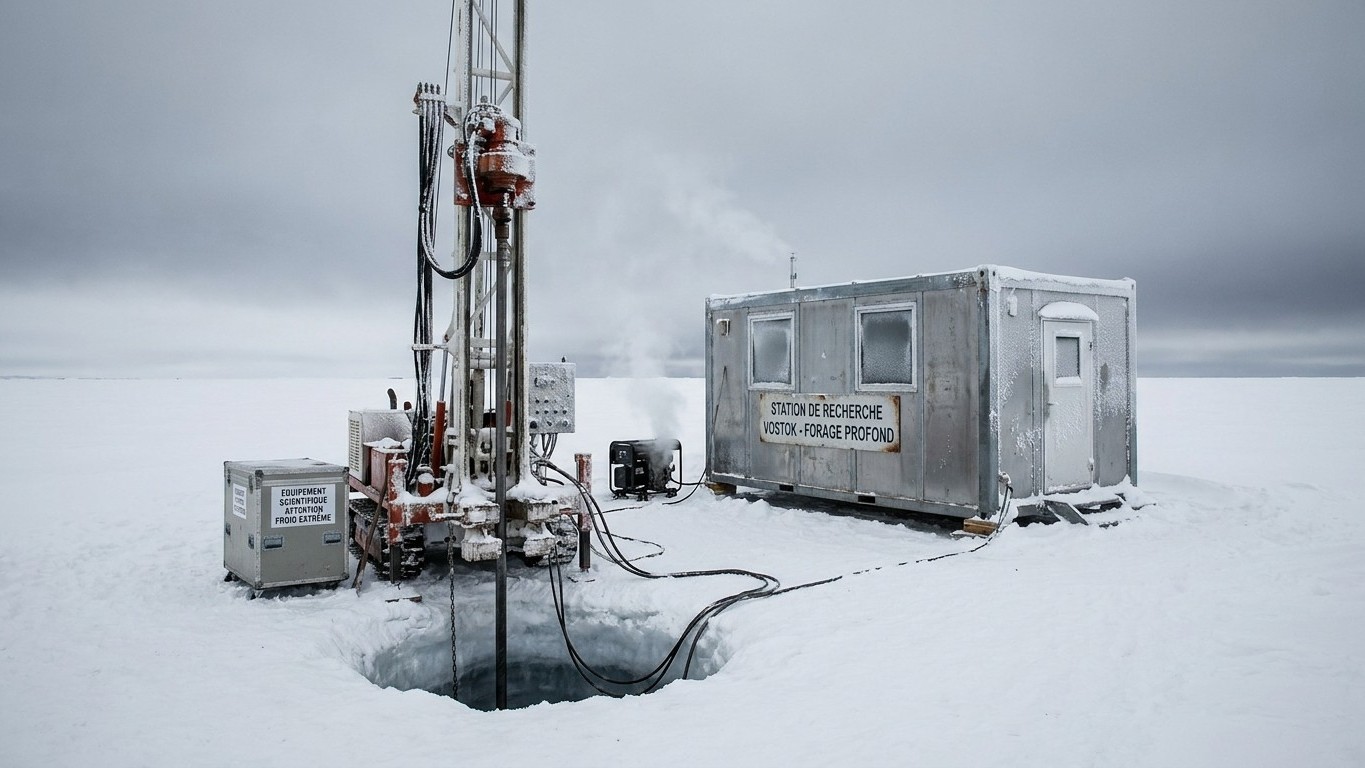
On February 5, 2012, at 22:25 local time, a Russian drilling crew finally punched through the planet’s oldest and most pristine ice. Beneath their feet, at a depth of 3,769 meters, the drill bit breached liquid water. This liquid had slept there, cut off from all contact, since Antarctica had been covered by ice millions of years ago. No one, before that precise moment, had ever touched this water.
Lake Vostok is not some forgotten puddle. It is one of nearly 400 subglacial Antarctic lakes, and the largest among them, stretching roughly 250 kilometers in length and 50 kilometers across. It is big enough to swallow several French departments under a mantle of freshwater that no one had ever seen. And this water has not been static for mere decades or centuries: scientists estimate it has been isolated from the rest of the world for probably 15 million years, since Antarctica first became encased in ice. Fifteen million years without a single sunbeam, without any contact with Earth’s atmosphere.
Key takeaways
- Why did the Soviets drill for twenty years without knowing what they were approaching?
- What ecological risk halted the drilling for eight years?
- What does this millions-of-years-old water actually contain?
A discovery that preceded its own identity
The story begins long before anyone knew what lay beneath Vostok Station. The Soviet drillers were at work there as early as 1970, but not to hunt for a lake: their objective was purely climatic. Deep ice-core drilling at Vostok Station began in 1970 with cable-suspended thermal drilling systems, initially aimed at retrieving ice cores for paleo-climate research rather than direct access to the lake. They wanted to read the history of Earth’s climate in the ice, not guess at what might be bubbling below.
The first hints of an anomaly date back even earlier. Soviet pilots had noticed, in the early 1960s, a strangely flat region near the station, as if the ice were floating on something beneath. It would be British radar in the 1970s that confirmed the hunch, recording a “flat” return signal from under the ice precisely at the Soviet station’s location. Yet it would take the 1990s and satellite imagery for the scientific community to officially acknowledge the existence of Lake Vostok. The Soviets drilled for twenty years without knowing precisely what they were brushing against.
This temporal lag is dizzying. Imagine digging a tunnel for two decades without ever realizing that it opens onto an underwater ocean. That is precisely what happened here, in the absolute stillness of the Antarctic plateau, more than 1,300 kilometers from the South Pole.
The fear of contamination
Once the lake was identified, the real challenge began: how to reach it without tainting it? The drilling employed a mix of kerosene and Freon to prevent the borehole from sealing shut under the pressure of the surrounding ice. The problem: this chemical cocktail is exactly what must not be released into a water body that has remained pristine for millions of years. In 1998, the Russians halted everything, just 188 meters above the lake’s surface, for fear of an ecological disaster and the contamination of the lake by kerosene and other substances used during the drilling.
It would take until 2006 for the Russian Institute of Polar Research to deem the method sufficiently safe to resume operations. The technique chosen is almost elegant in its simplicity: let the lake’s natural pressure do the work. When the drill finally reached the liquid surface, the water rose spontaneously into the borehole, pushed up by the pressure, before freezing almost instantly on contact with the extreme cold. This plug of ice seals the hole and prevents any new contamination, glaciologists explained at the time. A trick that owes as much to physics as to twenty years of patience.
What the water revealed, and what it hid
The initial analyses in 2012 proved disappointing for those hoping to find extraordinary life forms: the samples retrieved were sterile. But the story did not end there. In 2013, American researchers published results in PLOS ONE that were more unsettling: according to them, half a liter of this vast water pocket could contain as many as 3,500 DNA sequences belonging to as many organisms, though the scientists remained cautious and did not rule out contamination from earlier drilling operations.
The most astonishing anecdote among the stories is perhaps this: during the 2013 sampling, a portion of the water extracted was served to Vladimir Putin, who was Prime Minister of Russia at the time. A detail that speaks volumes about the symbolic reach of the project for Moscow, seen more as a national triumph than a mere scientific operation.
Lake Vostok continues to draw the interest of space agencies for reasons that extend far beyond Antarctica. Its extreme conditions—complete darkness, crushing pressure, millennial isolation—make it a terrestrial model for studying what might exist beneath the ice of the frozen moons in the solar system, such as Europa orbiting Jupiter or Enceladus orbiting Saturn. Probing this water aged by millions of years is also training to search for life elsewhere, without ever risking the cleanliness of the gesture.
Sources: montana.edu | greenarea.me | les-cris.overblog.com
