
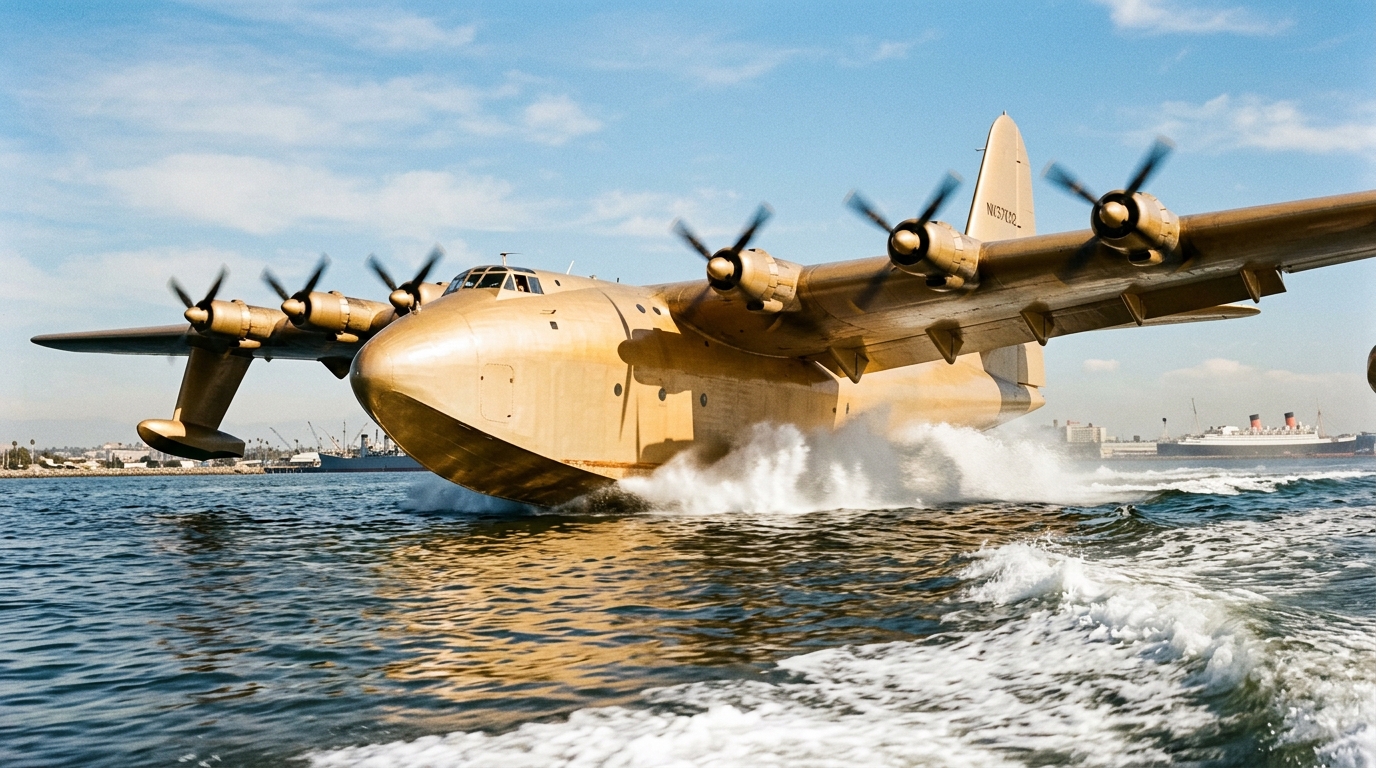
Imagine a plane so vast that its wings would span beyond a football field on either side, yet entirely carved from wood, like a colossal children’s model pushed to industrial scale. This isn’t fiction, but the real story of an aircraft that lay hidden for decades in a hangar, out of sight, before becoming today’s flagship attraction of an American museum. A sleeping giant that few French people know, and whose fate deserves attention this season as history and aviation enthusiasts continually seek fresh gems to discover.
- Built by Howard Hughes in laminated birch (not spruce) to bypass aluminum rationing during World War II, the Spruce Goose features a wingspan of 97.5 meters and a cost equivalent to about 400 million dollars in today’s money.
- On November 2, 1947, the aircraft flew only once, rising to about 21 meters in altitude for 26 seconds before never taking off again.
- Purchased in 1992 for a symbolic dollar, it was transported over 1,600 kilometers to McMinnville, where it now forms the centerpiece of the museum housing more than 200 aircraft.
- A California hangar had hidden the largest wooden airplane ever built since 1947
- Why Hughes constructed a 97-meter giant… using birch
- $23 million and eight engines for a bet no one believed possible
- 26 seconds of flight, 21 meters of altitude: the Spruce Goose’s only takeoff
- A giant that never took off again but that no one has forgotten
A California hangar had hidden the largest wooden aircraft ever built since 1947
For more than thirty years, a heavy secret slept in Long Beach, California, inside a climate-controlled hangar where temperature and humidity were watched as if it were an invaluable work of art. And in a sense, it was. The aircraft in question, an oversized seaplane, had been rushed into existence during World War II, only to end up at the end of its career without ever truly fulfilling its wartime promise. Its owner, the eccentric billionaire Howard Hughes, cared for this machine so much that he continued to finance meticulous maintenance long after the project had lost its strategic importance. Then came the Summa Corporation, which took over to safeguard this wooden monster out of public view.
It wasn’t until 1992 that a museum in Oregon bought the aircraft for the nominal sum of one dollar. What followed was a sequence as spectacular as its lone flight: transporting the world’s largest wooden aircraft over more than 1,600 kilometers to McMinnville, where it now rests within the Evergreen Aviation & Space Museum, a site recently renamed the North American Aerospace Museum.
Why Hughes built a 97-meter giant… using birch
The name that has crossed decades to designate this airplane, the Spruce Goose, literally “the spruce goose,” is, in truth, misleading. A museum guide playfully reminds visitors that there is almost no spruce in the craft. The structure is in fact composed of more than 90% laminated birch, a choice that had nothing aesthetic or romantic about it. During the war, aluminum was a strategic material, rationed and reserved for the most urgent military needs. It was therefore necessary to find a substitute capable of supporting a machine of such extraordinary size, and wood, properly worked and laminated, proved to be a viable technical solution.
The result remains impressive to this day: a wingspan of 319 feet 11 inches, or about 97.5 meters, making it a machine wider than any airplane currently in service, with the exception of the colossal Antonov An-225. A number that makes one’s head spin, knowing that this behemoth was conceived and assembled in a time when computation did not exist to model the aerodynamic constraints of such a structure.
$23 million and eight engines for a bet that no one believed possible
Funding such a project represented a colossal financial gamble. The bill came to $23 million at the time, the equivalent of roughly $400 million today. A staggering sum invested in a machine about which many, including some in the American administration, doubted it would ever leave the ground. To push this wooden mass, eight engines were installed, each expected to deliver substantial thrust to lift a structure of such magnitude.
Yet the surrounding skepticism never deterred Howard Hughes, renowned for his obsessive perfectionism and taste for technical challenges. It is worth noting that the wartime context initially justified the project: the idea was to transport troops and materiel by air, avoiding submarines that haunted the Atlantic. But the development time was so long that the conflict ended before the aircraft was completed, turning this seaplane into a symbol of a technological gamble rather than a military necessity.
26 seconds of flight, 21 meters of altitude: the Spruce Goose’s only takeoff
On November 2, 1947, the aircraft experiences its single moment of airborne glory. In a test that was initially meant to stay grounded, Howard Hughes decides to unleash the engines and have his wooden giant take off. The airplane rises to about 21 meters in altitude, for a mere 26 seconds, before settling on the water. A flight of almost ridiculous brevity in light of the years of development and the sums expended, yet enough to prove that the machine could indeed fly.
That flight would forever be its only one. After that demonstration, the aircraft never took off again, beginning a life entirely devoted to preservation and memory. A fate that is almost poetic for a machine born to fly, yet etched in the collective American memory for those few seconds suspended above the water.
A giant that will never take off again but that no one has forgotten
Today, the Spruce Goose stands proudly within a museum that has grown considerably since its modest beginnings. It all began with a passionate project, that of Michael King Smith, a former United States Air Force captain and son of the founder of Evergreen International Aviation, who opened the museum in 1991 with a small collection of vintage aircraft. The site, facing McMinnville Municipal Airport just across Oregon Route 18, is now home to much more than a dusty hangar.
Today you can find more than 200 aircraft, spacecraft, and historical exhibits, alongside other legendary pieces such as the SR-71 Blackbird and the Titan II SLV missile. A way of reminding us that the Spruce Goose, despite its definitive immobility, is not merely a relic frozen in time, but the beating heart of a place that continues to tell the epic of American aviation in all its forms.
From this wooden giant born out of wartime urgency, we ultimately remember less the apparent failure and more the technical prowess and stubbornness of a man convinced that the impossible deserved to be attempted. One lingering question still echoes through the corridors of the McMinnville museum: how many other projects, deemed too crazy in their own time, lie asleep somewhere, waiting for someone to rediscover their story?
