
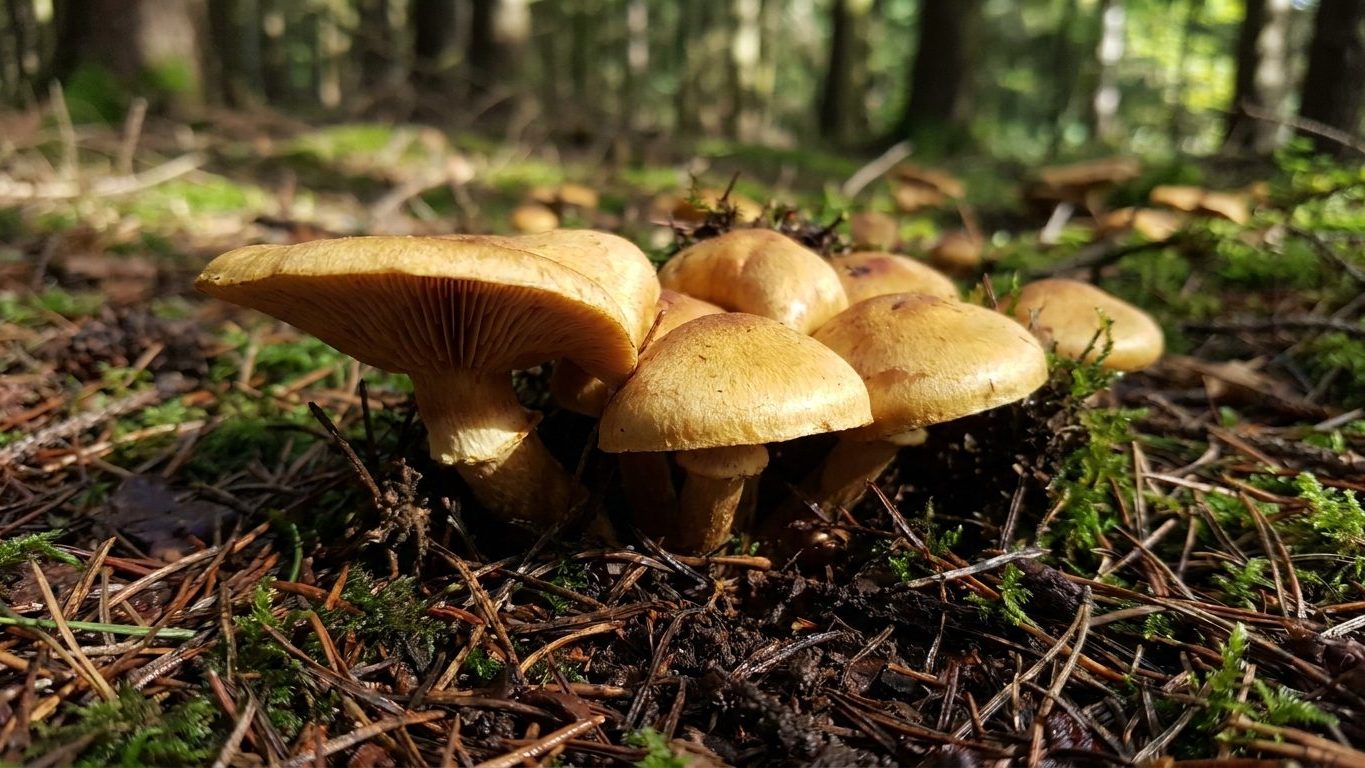
A single living organism, invisible to the naked eye for most of the year, occupies 965 hectares of forest soil in eastern Oregon. What hikers mistake for mushrooms scattered through Malheur National Forest is, in fact, only the visible above-ground portion of a unique underground network — a single genetically identical organism rooted in the soil at its edge. It is familiarly known as the “Humongous Fungus,” and it covers an area equivalent to 1,350 football fields.
- A single Armillaria ostoyae mushroom occupies 965 hectares of forest soil in Oregon as an underground network of microscopic filaments called mycelium
- What emerges from the ground is only the carpophore, the temporary fruiting body used to disperse the fungus’s spores
- The organism slowly spreads by about a meter per year via mycelial cords called rhizomorphs that can traverse several meters underground
- Scientists proved it is a single individual by testing genetic compatibility among samples taken from 112 dead trees
What emerges from the ground is only the visible portion
A mushroom, in the sense understood by the general public, is never the entire organism. It is a carpophore, the temporary fruiting body produced to release spores, comparable to a apple on an apple tree. The organism itself lives underground or in wood, in the form of a mycelium: an interwoven network of microscopic filaments called hyphae that explore the substrate in search of food.
In Armillaria, this mycelium also takes a form far more visible than its usual filaments. The species produces rhizomorphs, dark mycelial cords 1 to 4 millimeters wide that allow the fungus to cross food-scarce zones to reach a new source. These black structures, tucked under the bark of roots, look almost exactly like shoelaces, hence the nickname “shoestring fungus” given by American foresters.
It is these rhizomorphs that explain the organism’s enormous size. They can grow by about one meter per year and traverse several meters underground in search of a new host. Meter after meter, year after year, the fungus has gradually colonized an entire mountain area.
How to prove it’s a single individual
At first glance, nothing distinguishes one Armillaria strain from another. The proof that it is one and the same organism rests on a precise scientific protocol conducted by Catherine Parks and her colleagues at the U.S. Forest Service. In 1998, a team from the U.S. Forest Service investigated widespread tree decline in Malheur National Forest, identifying affected areas on aerial photographs and sampling roots from 112 dead or dying trees.
The tests then involved bringing the samples into contact with one another. When genetically identical Armillaria mycelia meet, they can fuse to form a single individual; the researchers exploited this by growing the samples in pairs on Petri dishes. A fusion indicates compatibility, i.e., direct kinship. The result was confirmed by identical genetic markers found across the entire studied area, discounting the hypothesis of a mosaic of separate colonies.
This work also revealed an important nuance. There are five distinct, genetically separate occurrences of Armillaria in this part of the forest, non-contiguous, each covering 20 to 965 hectares. The 965-hectare individual remains the largest of the five, but it does not alone constitute the entire fungal population of the region.
A parasite that kills trees
Armillaria is not a quiet resident. It is a parasite that attacks the roots of conifers, particularly firs, and eventually kills its host. It creates sheets of mycelium beneath the bark that strangle the tree by forming a ring around the trunk, feeding on living wood.
Death is never immediate. It can take twenty to fifty years for the fungus to kill a tree, and it then continues to feed on the dead wood. The visible result from above: circular clearings in the canopy, where trees turn yellow and then topple in concentric rings that widen year by year. Researchers had spotted ring-shaped openings in the canopy from the air, a classic sign of root disease caused by Armillaria, which many initially interpreted as distinct fungal individuals.
As for its rate of progression, it remains slow on human timescales. The fungus spreads only 0.7 to 3.3 feet per year, at best just over a meter. It is precisely this slowness that allows researchers to look back in time.
An ancient creature that glows in the dark
By dividing the total area by the annual growth rate of the filaments, scientists obtain an age estimate. It remains broad, and deliberately cautious. Based on its current growth rate, the fungus is estimated at 2,400 years old, but could reach up to 8,650 years. A huge range, but enough to place it among the oldest living organisms on the planet.
The mass follows the same logic of indirect estimation. The weight of this gigantic Armillaria ostoyae specimen is estimated between 7,500 and 35,000 short tons, a range spanning from slightly more than the weight of a building to tens of thousands of tons. No direct weighing is possible: no one has ever excavated an organism this vast; the estimate relies on the known density of mycelium relative to the surface it colonizes.
One final characteristic of this underground creature: it glows in the dark. Its mycelia and rhizomorphs exhibit bioluminescence that creates a faint green glow known as “foxfire.” This phenomenon, long attributed to will-o’-the-wisps or fairy lights by mountain inhabitants, is most often observed on infested dead wood at night, when moisture and darkness converge. A subtle glow for an organism that remains, for the most part, entirely invisible.
Sources: mygeoquest.com | allthatsinteresting.com
