
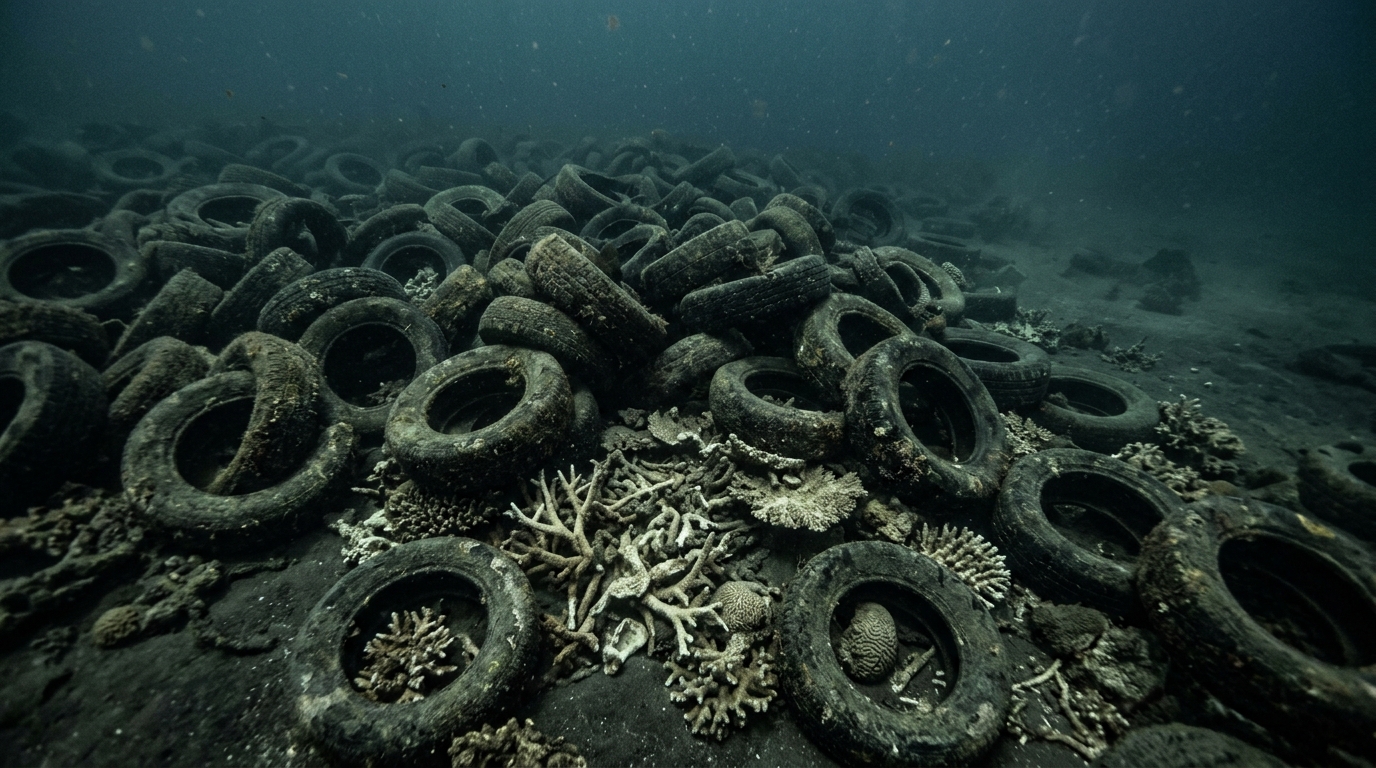
We often imagine that simply tossing old objects into the ocean will be seized by nature and transformed into an underwater paradise. It is precisely this alluring yet misleading belief that guided one of the twentieth century’s most high-profile environmental efforts. In 1972, off Fort Lauderdale, Florida, local authorities submerged nearly 2 million used tires in the hope of creating the planet’s largest artificial reef. Fifty years later, the verdict is unequivocal: far from multiplying the corals, this operation literally cleared 14 hectares of natural reefs. A look back at an ecological disaster that continues, to this day, to haunt the American seabeds.
- The nylon straps binding the tires together腐 broke due to corrosion, turning the tires into projectiles during tropical storms
- Only about 10% of the structures were colonized by marine life, while the tires obstructed the growth of nearby natural corals
- The cost of removing the tires is estimated at between $40 and $100 million, with only 10,000 tires recovered during a 2007 campaign
- An ecological bet that looked great on paper
- When the ocean turns tires into projectiles
- Centuries-old corals wiped out by human error
- The most expensive decontamination project in marine history
An ecological bet that looked great on paper
It all began with a local fishing association, the Broward Artificial Reef Inc., which secured the go-ahead from the Army Corps of Engineers to launch a project as ambitious as it was economical. The idea appeared bright: recycle the mountains of tires piling up across the United States by turning them into habitats for marine life. The tire giant Goodyear actively backed the initiative, insisting that these structures would provide ideal shelter for fish and would, in time, foster the growth of corals.
Between April 1972 and November 1973, roughly 50,000 tires followed by 190,000 more were dumped on the Atlantic seabed, tied together with nylon straps. Yet the contemporaneous documentation remains astonishingly incomplete, and several estimates suggest the actual total eventually reached 2 million tires, spread over more than 35 acres, about 14 hectares. On paper, the project ticked every box: it repurposed a burdensome waste while boosting local biodiversity, at a low cost to municipalities.
When the ocean turns tires into projectiles
The problem was that no one had really anticipated the ocean’s long-term destructive force. The nylon straps meant to keep the tires assembled in compact blocks snapped during immersion, then yielded to the corrosion of metal fittings. The result: tens of thousands of tires detached from one another, left to drift on the seafloor.
During tropical storms—regular in this Florida region—these now-free tires turned into true underwater projectiles. Tossed by waves and tides, they began striking whatever lay in their path, including the natural reefs located in close proximity to the site. This phenomenon lies at the heart of the tale: the Osborne Reef, intended to protect marine life, fractured under the storms, physically destroying the surrounding seabed it had been meant to enrich.
Centuries-old corals wiped out by human error
By the mid-1990s, the verdict was in: barely 10% of the tire structures had been colonized by the expected marine life. Fish, far from establishing stable populations, gradually deserted areas that had become unstable and dangerous. Worse still, thousands of tires carried by currents were snagged directly into the nearby natural coral reef, mechanically blocking the growth of coral colonies that could take decades, even centuries, to form.
What should have been a gesture in defense of the marine ecosystem had, in effect, become a genuine underwater grindstone. The human error lay not in the intent, sincere and well-supported at the time, but in the complete lack of foresight regarding climatic phenomena and the true durability of the materials used over the long term.
The most expensive decontamination project in marine history
Fixing this monumental mistake comes with a hefty price tag, and the bill is steep. Early estimates for removing all the tires ranged between $40 and $100 million, a figure that has continued to rise with time and the increasing complexity of operations. In 2007, an initial recovery campaign retrieved about 10,000 tires, a drop in the bucket compared with the millions still scattered across the ocean floor.
France is not entirely unfamiliar with this kind of risky experimentation either. Between 1980 and 1989, 25,000 tires were submerged in the protected marine area of Vallauris Golfe-Juan, on the Côte d’Azur, following a similar logic albeit on a far smaller scale. A reminder that the temptation to tinker with nature using industrial waste has never been the exclusive province of the Americans.
This tale of sunken tires alone captures the limits of well-intentioned efforts lacking rigorous impact studies. Wanting to help the ecosystem by relying on industrial waste may seem clever in the short term, but the ocean’s forces never compromise. Fifty years after the Osborne Reef project’s launch, teams continue to patiently retrieve these remnants of an ecological dream turned logistical nightmare. The broader question remains: how many other well-intentioned initiatives lie somewhere beneath the surface, hiding a similar time bomb?
