
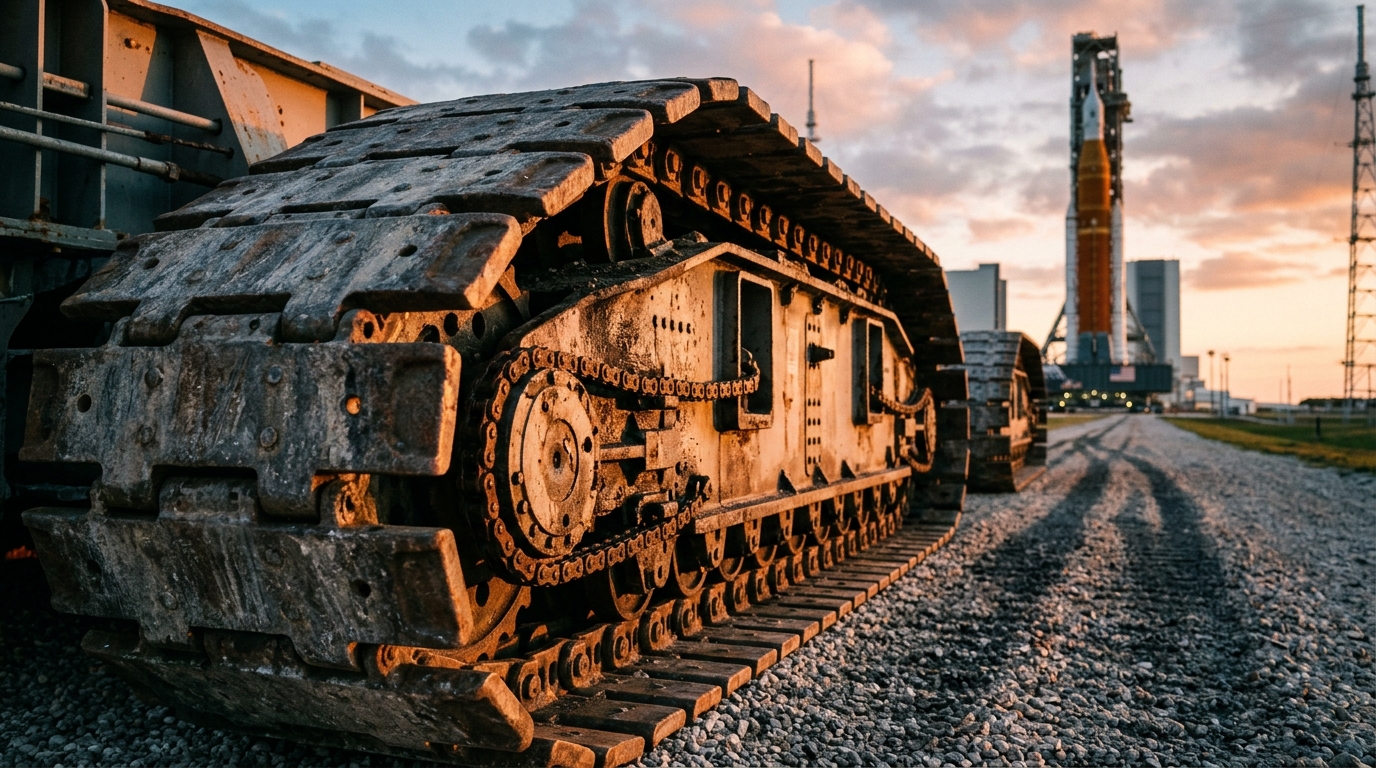
Imagine a machine as heavy as fifteen Statue of Liberty statues stacked atop one another, capable of lifting the weight of twenty fully loaded large commercial aircraft, and moving at barely faster than a Sunday stroller. This isn’t a rocket, nor a shuttle, nor a futuristic vessel: it is a simple crawler-transporter, designed in the 1960s, that NASA still uses today to deliver its most precious spacecraft to the launch pad. As the American agency bets everything on its Artemis program in this pivotal era of space exploration, paradoxically one of its oldest machines continues to carry its most modern ambitions. A look back at the little-known history of a true engineering mastodon, indestructible and incredibly slow.
- The crawler-transporters, designed in the 1960s for the Apollo program, are still in use today by NASA for Artemis missions.
- Each unit weighs about 6.6 million pounds empty and can carry up to 18 million pounds, making it the heaviest self-propelled vehicle ever built according to Guinness World Records.
- The 6.5-kilometer journey from the assembly building to the launch pad takes at least eight hours, at a speed of roughly 1.6 km/h, to ensure absolute stability of the carried load.
- A steel behemoth designed for the Apollo era and still in service
- 1.6 km/h: the speed that hides an engineering feat
- How these giants carried all the major American missions, from Apollo to Artemis
- Why NASA refuses to replace its crawlers after 60 years of service
A steel behemoth designed for the Apollo era and still in service
It all began in March 1963, in Ohio, where the manufacture of two machines started to solve a very concrete problem: how to move a giant rocket from its assembly hangar to the launch pad without damaging it? The answer took the form of two crawler-transporters, tracked vehicles so massive that each one could cover a baseball field. These machines first moved under their own power on January 23, 1965, before receiving their operational baptism on August 26, 1967, when they carried the very first Saturn V to the launch pad for the Apollo 4 mission.
Sixty years later, these same machines still roll at the Kennedy Space Center. They have crossed the Apollo era, the space shuttle era, and today the Artemis era. A nearly unique trajectory in the history of space technology, where most equipment is replaced or becomes obsolete after only a few decades. Here, it’s the opposite: the robustness of the original design has allowed these mechanical dinosaurs to traverse eras without aging, or almost.
1.6 km/h: the speed that hides an engineering feat
At first glance, a vehicle that travels at about 1.6 kilometers per hour, the pace of a strolling pedestrian, seems unimpressive. But that is precisely where the technical feat lies. This deliberately modest pace was never meant to set speed records: its primary purpose is to guarantee perfect stability for a colossal load, held in balance on a moving platform.
Each crawler weighs about 6.6 million pounds empty, roughly the equivalent of 1,000 pickups lined up bumper to bumper. But its real prowess lies in its load-bearing capacity: it can carry up to 18 million pounds, the weight of more than twenty fully loaded Boeing 777s. To bring this Herculean strength to life, the machine is powered by locomotive engines and powerful electric generators, a combination that allows it to lift and hold in horizontal orientation payloads as delicate as a rocket ready for launch. This performance was officially recognized by the Guinness World Records, which certified it as the heaviest self-propelled vehicle ever built.
How these giants carried all the major American missions, from Apollo to Artemis
The story of these crawlers is virtually identical to the story of American spaceflight. After carrying Saturn V rockets to their pads during the Apollo era, and later supporting the Skylab program, these machines never retired. On the contrary: for another thirty years, they transported the space shuttles, fulfilling the same discreet yet indispensable role at every launch.
When the shuttle fleet finally retired in 2011, many could have imagined that these venerable machines would follow the same path to a museum. It did not happen. Crawler-transporters CT-2, nicknamed CT-2, were refurbished to become a central part of Artemis missions, the program aiming to return astronauts to the Moon. In November 2022, it was precisely this same machine, originally designed for the Apollo era, that carried the rocket destined for Artemis I. A dizzying historical loop: the same machine that carried humanity’s first steps toward the Moon now accompanies the return of American astronauts to our natural satellite.
Why NASA refuses to replace its crawlers after 60 years of service
One might legitimately wonder why NASA has never sought to design a more modern replacement for these machines that are several decades old. The answer is contained in one word: reliability. Unlike many space technologies that evolve rapidly, the fundamental need these crawlers meet—carrying a massive and fragile load over a short distance with absolute stability—has hardly changed since the 1960s. Why reinvent a solution that has worked perfectly for six decades?
The journey these machines undertake is itself a real odyssey. From the assembly building, the famous VAB, to the launch pad, the distance covered is a little over 6.5 kilometers. At pedestrian speed, this path requires a minimum of eight hours of uninterrupted rolling, under close supervision, with every turn and every rise anticipated to avoid destabilizing the precious cargo. This slowness, far from a weakness, is actually the keystone of the entire system: it guarantees that nothing is ever left to chance when moving the equivalent of thousands of tons of cutting-edge technology.
As space exploration leans toward distant horizons—first the Moon, then Mars—there is something almost comforting in the idea that at the heart of these futuristic ambitions lies a machine born more than six decades ago, as massive as it is discreet. These crawlers remind us of a simple truth: sometimes, the true technological prowess does not lie in speed or novelty, but in the ability to perform, tirelessly and unfailingly, the same essential task, mission after mission. The question remains: how many more decades will these venerable steel giants continue to accompany American rockets toward the stars.
