
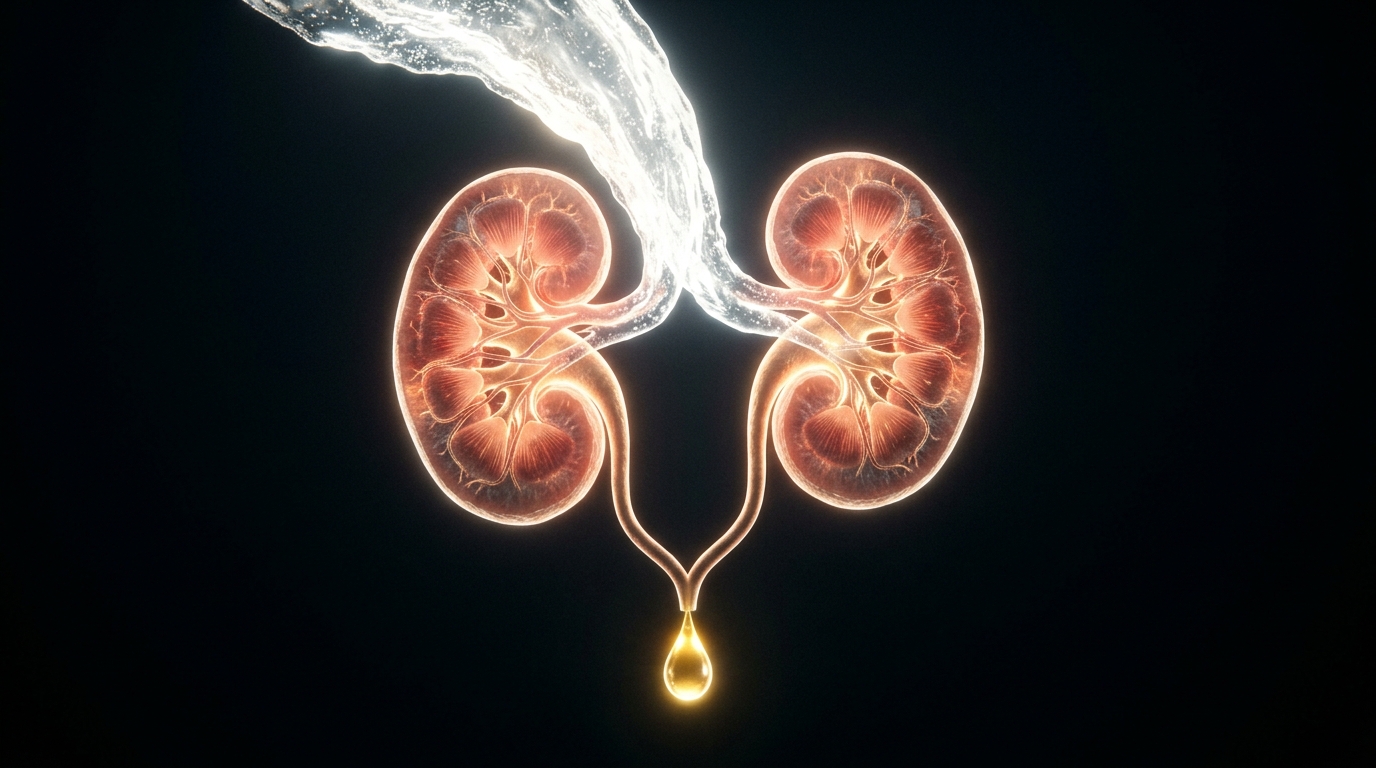
Each day, without you realizing it, a volume of fluid equivalent to more than two hundred bottles of wine passes through your kidneys. One hundred eighty liters, precisely, filtered from your blood plasma. And yet, when you go to the bathroom, you only expel about one and a half liters of liquid over an entire day. Where does the rest go? This seemingly trivial question hides, in fact, one of the most sophisticated mechanisms of the human body, a biological ballet of astonishing precision that plays out in silence, twenty-four hours a day, without ever pausing. As we enter this school year, when people sometimes make health resolutions, it is not useless to pause for a moment on these two discreet organs that work tirelessly to keep you alive.
- The nephrons, about two million in total and non-renewable, filter the blood and then reabsorb more than 99% of water and useful substances.
- The antidiuretic hormone (ADH) adjusts real-time final water reabsorption according to hydration level, concentrating urine more or less.
- Uncontrolled diabetes and obesity, often linked to hypertension, are among the main factors that gradually damage the kidneys.
- 180 liters per day: the number that doesn’t match your urine
- In the nephrons, a factory to sort blood drop by drop
- 99% recycled: the feat your kidneys achieve in silence
- What this filtration machine reveals about your body
180 Liters per Day: The Figure That Doesn’t Match Your Urine
Let’s approach the problem by looking at it the other way around. If your kidneys really filtered 180 liters of liquid per day and everything ended up in the toilet, you would need to urinate every few minutes, day and night, never far from a water source. Yet in reality, a healthy adult produces on average between one liter and one and a half liters of urine per day. The gap is dizzying: barely 1.5 to 2% of the filtered liquid eventually leaves the body. All the rest, more than 178 liters, is entirely reclaimed and returned to circulation in the blood.
This apparent paradox is explained by a simple yet fascinating principle: the kidneys do not merely filter the blood; they sort it. They examine each molecule, every electrolyte, every drop of water, before deciding what should stay in the body and what should be eliminated as waste. This process is not random: it is the result of an architectural biological design of extraordinary finesse, capable of handling large volumes while letting through only the essential.
In the Nephrons, a Factory Sorting Blood Drop by Drop
The secret of this performance lies in microscopic structures called nephrons. Each kidney contains about one million of them, which brings the total to two to two and a half million nephrons for the entire human urinary system. Each nephron measures between 3 and 5 centimeters in length and functions as a small autonomous factory, handling blood filtration, urine production, and the maintenance of the body’s water and electrolyte balance.
Concretely, blood arrives in a tiny tuft of vessels called the glomerulus, where it undergoes an initial coarse filtration: water, salts, glucose, and waste pass through, while large molecules like proteins and blood cells stay in circulation. The filtrate then enters a long winding tube, the renal tubule, where the essential recovery work takes place. It is there, in the proximal convoluted tubule and then in the descending limb of the loop of Henle, that most of the filtered water is massively reabsorbed and sent back to the blood.
It is important to keep in mind a troubling peculiarity of these structures: nephrons do not regenerate, or do so only very slowly, after birth. Each nephron lost over the years is thus permanently gone, which explains why preserving kidney function throughout life is so crucial.
99% Recycled: The Feat Your Kidneys Perform in Silence
Here is the answer to the riddle posed in the introduction. Of the 180 liters of plasma filtered each day by the two million nephrons, more than 99% are reabsorbed and returned to the bloodstream. What remains at the end of the journey is about 1.5 liters of urine intended to expel the true metabolic wastes: urea, creatinine, excess minerals, or medications. This nearly total recycling is not a coincidence but the result of hormonal control with remarkable precision.
The final sorting step takes place at the collecting duct, where the final reabsorption of water is regulated by the antidiuretic hormone, also known as ADH. Depending on your hydration level, this hormone adjusts in real time the amount of water reabsorbed: the more dehydrated you are, the more ADH increases water reabsorption, which explains why your urine becomes more concentrated and darker during hot weather or after intense physical activity.
Another remarkable point: this filtration rate remains surprisingly stable, regardless of fluctuations in your blood pressure. A self-regulation mechanism, driven notably by the myogenic reflex of the afferent arteriole and by tubuloglomerular feedback, maintains a constant filtration rate even when systemic blood pressure swings between 80 and 180 mmHg. In other words, whether you’re stressed, in the middle of a workout, or perfectly relaxed, your kidneys keep filtering at nearly the same pace.
What This Filtration Machine Reveals About Your Body
Reducing the kidneys to a simple filtration system would miss the point. Beyond their cleansing role, these organs actively participate in regulating blood pressure, notably through the production of renin, which triggers the secretion of aldosterone to increase water reabsorption when needed. They also contribute to the acid-base balance of the blood by adjusting the elimination of bicarbonate or hydrogen ions, and they even help manufacture red blood cells by stimulating their production, enabling oxygen transport to all tissues. Finally, they secrete an active form of vitamin D, essential for calcium regulation and bone health.
This machinery of remarkable precision remains vulnerable to certain daily-life excesses. Uncontrolled diabetes is among the leading causes of progressive damage to renal glomeruli: excess sugar in the blood eventually “clogs” the kidneys, forcing them to operate beyond their normal capacity. Obesity constitutes another major risk factor, as adipose tissue exerts harmful pressure directly on the glomeruli, while often accompanying hypertension, itself one of the primary causes of long-term kidney failure.
In sum, what the figure of 180 liters reveals is the scale of the invisible work your kidneys perform continuously, without ever asking for rest. Two million nephrons, tirelessly filtering your plasma to allow only a tiny fraction to pass, sketches a form of biological elegance rarely matched. Taking care of your kidneys, by watching your diet, your weight, and your blood pressure, therefore amounts to preserving one of the most discreet and essential mechanisms of our body. And perhaps from time to time, let us pause to think about all that our body accomplishes without us having to consciously consider it?
