
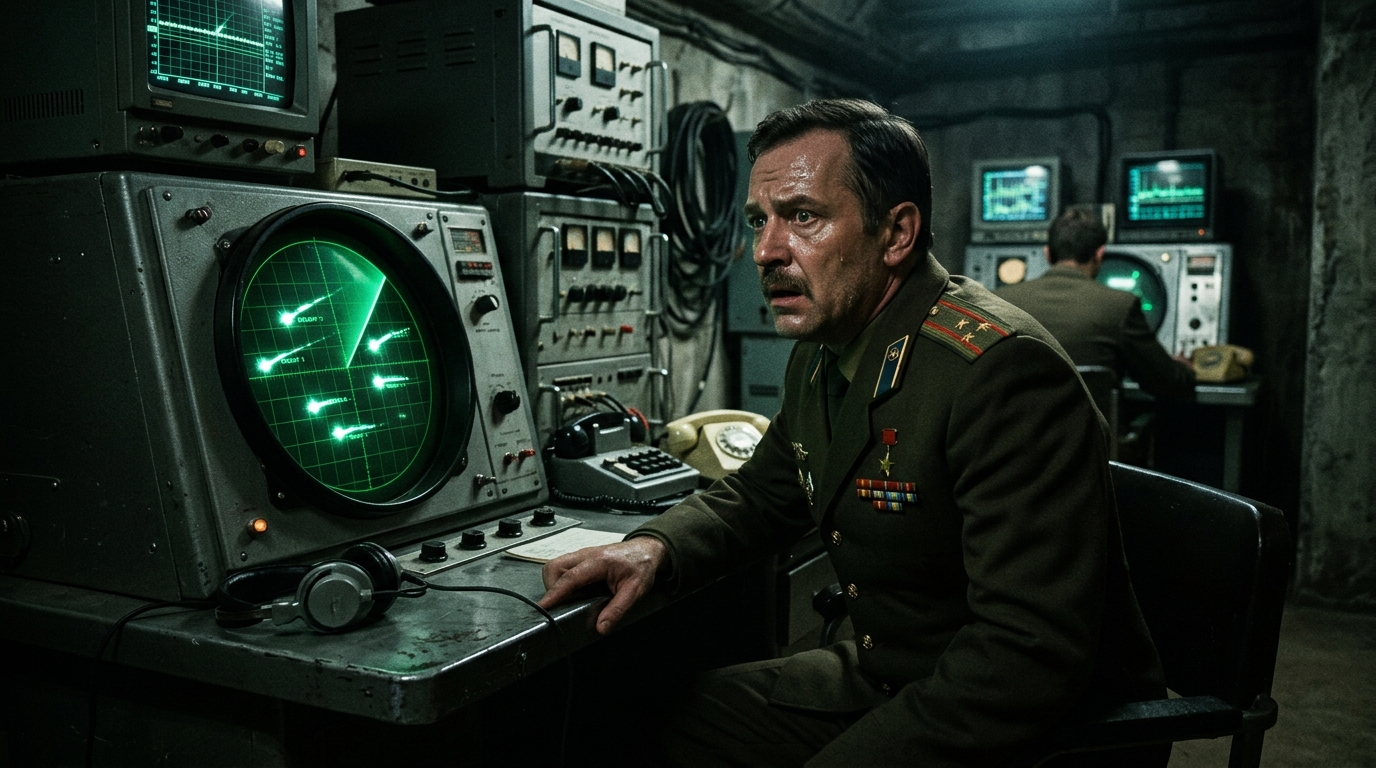
Important note: this episode, now documented and confirmed by declassified Soviet military archives, did indeed unfold on the night of September 26, 1983. It is neither an urban legend nor a work of fiction, even though the tale might read like a Hollywood thriller. In the heat of the Cold War, only weeks before the Soviet air force shot down KAL Flight 007, the tension between Washington and Moscow had reached a fever pitch. It is within this electric mood that a Soviet officer found himself alone in front of a screen, tasked with a decision that could have tipped the planet toward catastrophe. What this man saw that night, and especially what he chose not to believe, deserves our attention.
- On September 26, 1983, a sunlit reflection off clouds led the Oko system to interpret five American missiles as launched.
- Lieutenant Colonel Stanislav Petrov judged the alert to be false, lacking radar confirmation and given the small number of missiles detected, thereby averting a nuclear response.
- Kept secret for fifteen years, his action was revealed in 1998 and highlighted the importance of human judgment in the face of automated systems.
- The day a sun glare almost sparked a nuclear war
- When Soviet technology mistook clouds for the apocalypse
- Why Petrov chose to disobey the protocol
- What this incident changed in the arms race
The day a sun reflection almost triggered a nuclear war
On September 26, 1983, Lieutenant Colonel Stanislav Petrov stood guard at the Serpukhov-15 Strategic Rocket Warning Base, a bunker buried in the Kaluga region, about a hundred kilometers south of Moscow. His mission, that night as on all others, was to monitor data transmitted by Soviet satellites designed to detect potential missile launches from the United States. Suddenly, the Oko early-warning system’s display bleated to life: one intercontinental ballistic missile had been detected, followed by four more. Within seconds, the screen showed a massive strike on its way from American territory.
Yet there was no major technical fault behind this alert, and no missile had actually been launched. The cause was far subtler: a simple sun glare bouncing off high-altitude clouds was enough to fool the most sophisticated sensors in the Soviet arsenal. This purely optical misreading placed the world about forty-five minutes from a full-blown nuclear confrontation, the theoretical time a volley of missiles would need to reach the Soviet homeland.
When Soviet technology mistook clouds for the apocalypse
The Oko system had just been deployed at the time of the events, with the aim of constantly monitoring American launch bases from space. In practical terms, its satellites were equipped with ultra-sensitive infrared sensors able to detect the heat of a rocket’s liftoff. A technological marvel for its era, but with a hidden flaw: no one anticipated that a very precise alignment between the sun, certain high-altitude clouds, and the satellites’ positions could produce a thermal signature almost identical to that of a missile launch.
That night, September 26, the atmospheric conditions precisely matched this improbable scenario. Sunlight reflected off high-altitude clouds above North Dakota, exactly where the Minuteman silos stood. The sensors interpreted this reflection as five separate missile launches. The alert quickly bubbled up to the control center, sirens sounded in the bunker, and every screen appeared to show an imminent nuclear strike on the USSR.
Why Petrov chose to disobey the protocol
Petrov is not simply a functionary who pushes a button. He knows the inner workings—and the potential flaws—of the system he oversees. And something about what he observed that night unsettled him immediately. His reasoning was devastatingly simple: a real American attack would involve hundreds of missiles launched simultaneously in a saturation attempt to overwhelm any Soviet retaliation. Yet the screen showed only five.
He also noted a crucial detail: ground-based radars, which should visually corroborate any missile trajectory, detected nothing. This absence of corroboration became his sole, tangible basis for doubting a system that was supposed to be infallible. Petrov had only a few minutes to decide. Alerting his superiors would almost automatically trigger a Soviet nuclear response. Yet he chose to classify the alert as a false alarm, relying on his instinct, experience, and logic rather than the machine’s assessment.
What this incident changed in the arms race
Stanislav Petrov’s story remained secret for nearly fifteen years, buried in the Soviet military archives and only revealed to the public in 1998 through memoirs by a retired Soviet general. Far from being praised in the moment for his composure, Petrov was even reprimanded for failing to properly log the event in his notebook that night, a comparatively trifling detail given the high stakes of his decision.
Nevertheless, the episode left a lasting mark on thinking about automated warning systems, raising the prospect that such technologies, designed to safeguard humanity, could also generate catastrophically false alarms. It reinforced the notion that human oversight remains essential in the most critical nuclear decisions, regardless of how advanced the supporting technology may be. This story inspired the 2014 documentary Cold War: The Man Who Saved the World, which helped bring Petrov’s role to a wider audience. Petrov passed away in May 2017 in Fryazino, a town northeast of Moscow, never seeking public recognition for his action.
Into this autumn season, when we often revisit the major chapters of history, that September 1983 night reminds us how humanity’s survival has sometimes hung by a thread, or more precisely by the judgment of a single man who questioned a machine deemed infallible. A sober lesson in technological humility that still resonates today, as artificial intelligence becomes increasingly involved in major strategic decisions. Should we continue to trust machines blindly, or must we preserve, at all costs, room for human doubt?
