
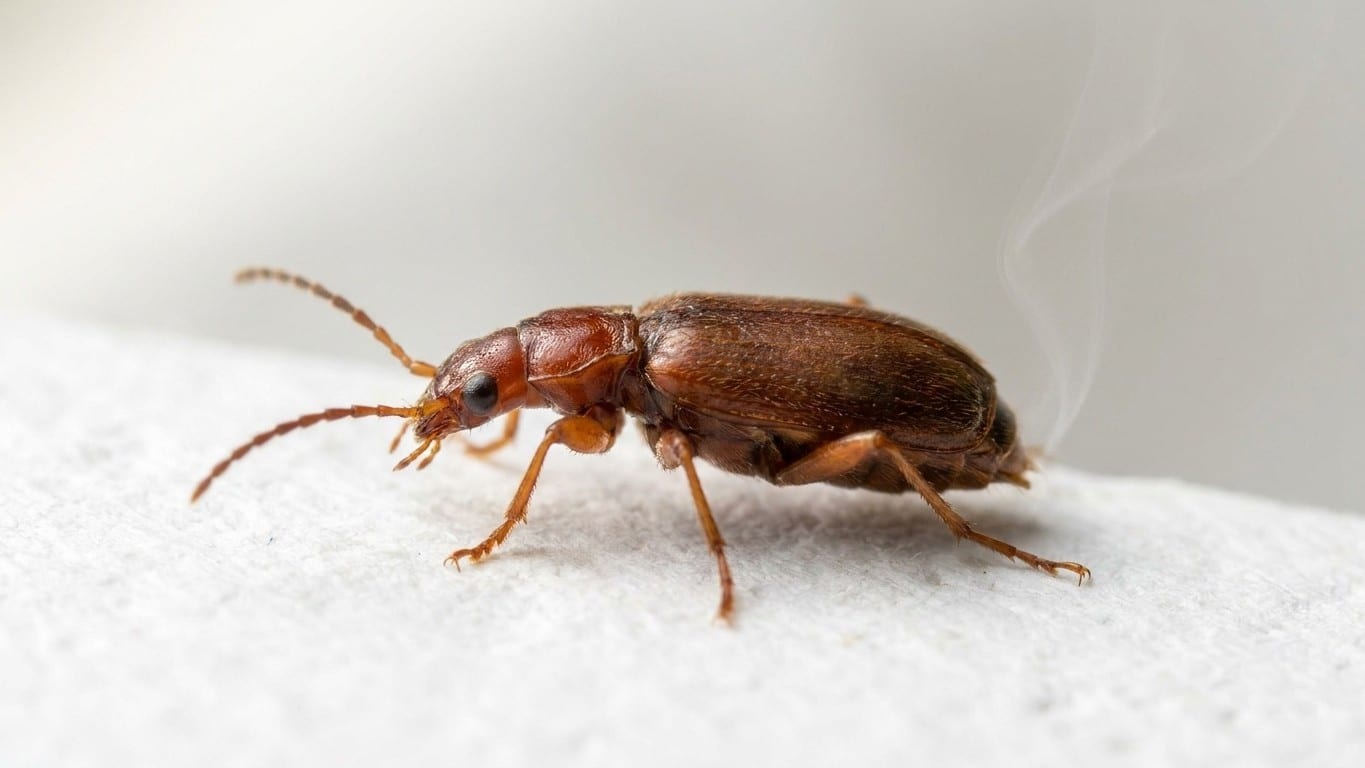
One hundred degrees Celsius—the boiling point of water—spurts from the rear of a beetle under two centimeters long, and it never scalds itself. The bombardier beetle (genus Brachinus, among others) has solved a problem that the chemical industry dreads above all: forcing two substances to react violently without the container holding them exploding along with them.
Key takeaways
- A beetle under two centimeters long manufactures a controlled chemical explosion inside its own abdomen
- Two separate chambers, catalytic enzymes and a system of microscopic valves: how nature solved the equation of self-defense
- Researchers finally uncovered the secret in 2015: 70 pulses at 500 times per second to prevent the flame from returning
Two stable liquids, a detonating mixture
Everything rests on strict separation. The reserve chamber stores an aqueous solution of hydroquinone and hydrogen peroxide, substances that remain stable as long as they stay apart. A study on specimens of the Brachinus genus even specified the proportions: the reservoir contains 10% hydroquinone and 25% hydrogen peroxide, for a reaction heat of 48.5 kilocalories per mole of hydroquinone.
The real feat happens in a second pocket, tiny yet decisive. This reaction chamber, smaller but crucial, is lined with catalase and peroxidase enzymes. Between the two chambers lies a valve controlled by the beetle’s nervous system. As soon as it feels threatened, the insect opens it. The stored chemicals rush into the reaction chamber, where the enzymes instantaneously catalyze a violently exothermic reaction.
Concretely, hydrogen peroxide rapidly decomposes in the presence of catalase, producing water and gaseous oxygen, while hydroquinone oxidizes to benzoquinone, a significantly more irritating compound. The oxygen produced then reacts with the hydroquinone to convert it into benzoquinone, a reaction so highly exothermic that the mixture can reach temperatures of up to 100 degrees Celsius. About a fifth of the liquid vaporizes instantly due to the heat, generating enough pressure to force the entire mixture outward. It’s hard for me to find an industrial equivalent that is as compact: a miniature boiler that triggers and shuts off in a few milliseconds.
The anti-burn secret: impulsive bursts rather than a continuous jet
An amateur chemist trying to reproduce this reaction in a closed tube would likely end up with a ruptured tube. The beetle, however, avoids a continuous explosion thanks to a set of valves that snap shut and reopen in rapid succession. The reaction is intensely exothermic, driving the mixture’s temperature to around 100 °C, vaporizing about a fifth of the liquid. The resulting pressure causes the intake valves of the reagent reservoirs to close, thereby protecting the beetle’s internal organs.
This rapid closure is not trivial: it is what prevents the flame from returning to the beetle’s vital organs. The flow of reagents into the reaction chamber and their discharge occur in a series of roughly 70 pulses, at a rate of about 500 pulses per second, with the entire sequence lasting only a fraction of a second. The insect does not spray a continuous jet that would inevitably cook its own tissues: it fires a volley of micro-explosions, each expelled before the heat has time to travel back up.
For a long time, this mechanism remained a entomologist’s hypothesis, lacking a way to observe the interior of a living abdomen in action. The mystery was solved in 2015, when a research team used synchrotron X-ray imaging to film living beetles as they discharged. With high-speed cameras recording at 2,000 frames per second, the team could document exactly what happens inside a bombardier beetle’s abdomen while it mixes and releases its defensive spray. The images revealed a system of ducts and valves far more sophisticated than imagined, functioning like a mechanical safety valve rather than a simple muscle that contracts.
A limited reserve, but enough to survive a toad’s stomach
This weapon is not limitless. The beetle’s glands store enough hydroquinone and hydrogen peroxide to allow the beetle to emit its chemical spray about 20 times, which is sometimes enough to kill a predator. Twenty discharges, no more, before it must recharge its biological ammunition.
The most spectacular result concerns toads that, believing they have a quiet meal, swallow the beetle whole. Japanese researchers studied this scenario in the species Pheropsophus jessoensis in the presence of the toad Bufo japonicus. After the amphibian swallows its prey, an explosion is audible inside each toad, indicating that the chemical spray had been ejected. The beetle continues to trigger its reaction even inside the predator’s stomach, causing some toads to vomit in a reflex that literally saves the insect from certain digestion.
This mechanism now fascinates far beyond entomology. Engineers draw inspiration from it to design fuel-injection systems or drug-delivery devices capable of releasing a dose in precise micro-pulses rather than as a continuous flow, a line of inquiry actively explored in several recent biomimicry studies. Yet one question goes beyond the insect: how many other elegant protective mechanisms lie hidden in abdomens a few millimeters in size, never filmed at enough speed to be truly understood?
Sources: fr.mahnazmezon.com | gurumed.org
