
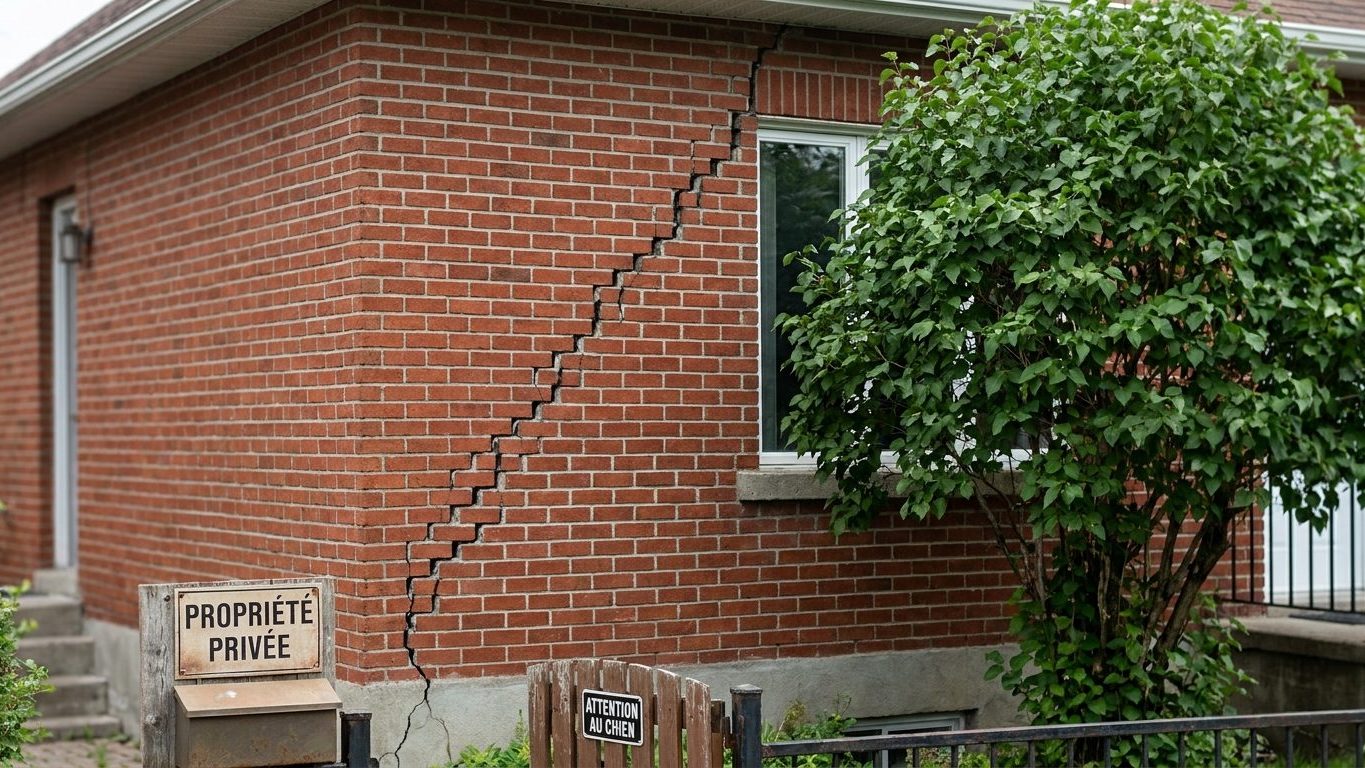
A lime tree planted four meters from a house can, within a decade, cause one of its corners to settle by several centimeters. The reason isn’t the weight of the tree, nor its roots pushing on the masonry. It is its water uptake, which dries out the clay soil beneath the foundations and triggers a settlement that the rigid wall can only absorb by cracking.
This phenomenon is known as the shrink-swell of clays. Some soils contain clay minerals capable of absorbing water between their sheets, somewhat like a microscopic sponge stacked in thin layers. When water enters, these sheets widen apart and the soil volume increases. When water disappears, in summer or due to root pumping, the sheets tighten and the soil contracts.
This movement mainly affects the uppermost meters of the soil, typically between one and three meters deep depending on the nature of the terrain and the presence of vegetation. It is precisely the zone where the foundations of individual houses built before the 1990s rest, often without prior soil study.
Under a house, this swelling and shrinking never occur uniformly. The south-facing façade dries out faster than the north-facing one because of direct sunlight.
A nearby tree markedly worsens the imbalance. Its roots can draw moisture from the soil for several meters around the trunk, drying out the side of the house closest to it. Meanwhile, a leaking gutter or a waterproofing defect can saturate water on the opposite side. The moisture difference between the two sides then creates two rates of soil movement, one downward, the other stable or ascending.
A terrace, a paved driveway, or a tiled surface play a similar role. By preventing rain from reaching the soil beneath part of the foundation footing, these sealed surfaces create a drier zone than the rest of the house’s surroundings. As a result, one corner of the building rests on soil that retracts while the rest of the structure remains stable.
This imbalance has a technical name: differential settlement. One corner of the house sinks by a few millimeters to several centimeters, while the rest of the building moves little or not at all. The masonry, unable to bend, eventually yields at the most stressed point.
- Tree roots dry the clay soil beneath the foundations and cause differential settlement.
- The characteristic crack follows the joints between bricks or blocks, drawing a diagonal across the wall in successive steps.
- Old houses without crawl spaces and located in high-risk areas are the most exposed to the danger.
A crack that traces the joints, never by chance
The most characteristic sign of this foundation movement is the stair-step crack. It follows the joints between the hollow bricks or concrete blocks, drawing a diagonal that rises or falls in successive steps rather than a straight line.
Its width varies depending on where you observe it. A crack wider at the top than at the bottom indicates a different movement than one that widens downward, and this reading provides clues about the direction of settlement under the foundation.
Other signs often accompany wall cracking. Doors or windows that stick during dry periods and then loosen in winter when the soil re-swell betray a seasonal reversible movement. A garage slab that lifts away from the load-bearing wall, or a step that gradually hollows out between a terrace and the doorway, often confirms the same diagnosis.
These signs alone are not sufficient to identify the exact cause. Only a building expert can confirm that a given crack indeed results from clay shrink-swell rather than another foundation disorder.
Old foundations, more vulnerable
Some characteristics of the construction make a house more susceptible to this phenomenon. Homes built with shallow foundations, often before geotechnical studies became common, anchor their structure precisely in the soil layer most sensitive to moisture variations.
The absence of a crawl space also worsens the risk. A house laid directly on a slab without a buffer space exposes its foundations to the same moisture variations as the surrounding soil, with no intermediate protection.
Soil drainage plays an equally determining role. A poorly oriented slope, a gutter that always dumps water on the same side, or a drainage system that concentrates moisture on a single façade creates the perfect conditions for asymmetric settlement.
This risk is not a local anomaly. The state maps this phenomenon commune by commune, as a hazard level ranging from low to high, accessible on the Géorisques site. Millions of individual homes in France today lie in medium- or high-risk zones, making clay shrink-swell one of the main causes of damage to houses in the country.
Planting a high-water-demand tree just a few meters from an old house, without a crawl space and on clay soil, therefore combines several risk factors at once. The recommended planting distance depends on the species and the tree’s mature height, a point that soil diagnostics and local planning guidance typically clarify before any planting.
Sources: loire-atlantique.gouv.fr | brgm.fr
