
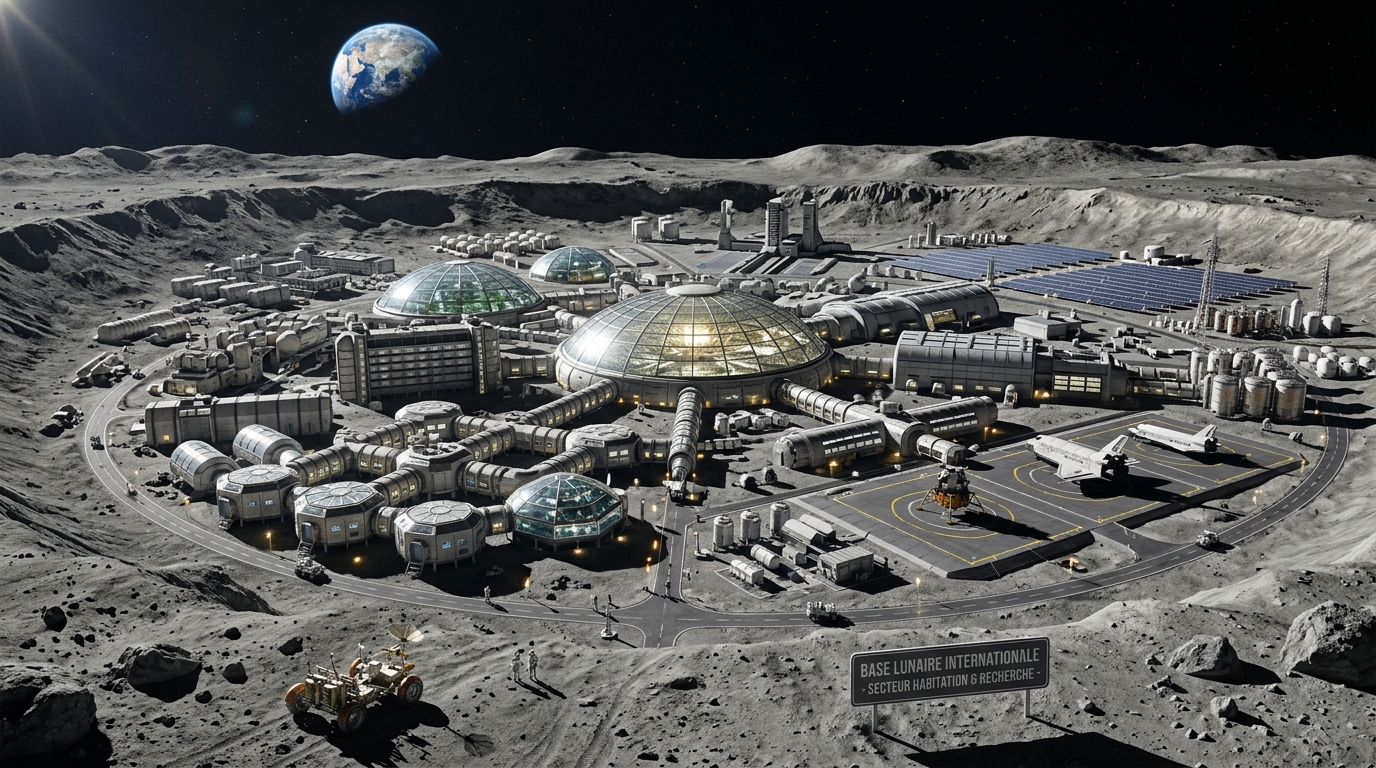
One million inhabitants, a century, and then not a drop more. That is, in a single sentence, the verdict two Harvard astrophysicists have delivered about the future of lunar colonies. As plans for Moon bases proliferate and grand visions of entire cities perched on its gray surface take hold, this study serves as a reminder of a reality too often brushed aside in futuristic fantasies: without water, no city withstands the test, no matter how ambitious. And on the Moon, water, precisely, is a scarce resource.
- Even in the most optimistic scenario (1 billion tonnes of water, 98% recycling), a lunar city of one million inhabitants would exhaust the reserves in just over a century
- The estimate of one billion tonnes of water is considered too optimistic; the actual reserve could be about thirty times lower, shrinking survival to a few years
- Beyond water, the near-total absence of carbon on the Moon and legal questions about resource allocation further complicate the viability of a durable colony
- One billion tonnes of water, and yet that isn’t enough
- The countdown begins as soon as the first faucet is opened
- The larger the city, the faster the Moon empties
- There are avenues, but none are guaranteed to win
One Billion Tonnes of Water, and Yet It Isn’t Enough
On paper, the figure is impressive. The researchers adopted the most generous assumption possible: one billion tonnes of water would lie in the permanently shadowed regions near the lunar poles. To visualize this amount, imagine 400,000 Olympic-sized swimming pools filled to the brim, or the equivalent of Niagara Falls’ flow for only seven minutes. This water would have remained intact for about four billion years, frozen in craters that the Sun never touches.
But no matter how dizzying a number may be, it means little without context. That is precisely what the two researchers did: juxtapose this theoretical reserve with the real needs of a human population living there sustainably. And the result immediately cools the initial enthusiasm: even in this most optimistic scenario, the leeway remains incredibly narrow.
The Countdown Begins as Soon as the First Faucet Is Opened
To refine their estimate, the researchers added a second equally favorable assumption: a water-recycling system operating at 98%, comparable to the system that has equipped the International Space Station for twenty-six years. In other words, almost nothing would be wasted; every drop would be purified and reinjected into the loop. An ideal technological feat difficult to achieve at such scale, but the authors deliberately chose it to avoid darkening the picture more than necessary.
Result: even with this near-perfect recycling, a lunar city of one million inhabitants would have drained the reserves in just over a century. A hundred years is long in the span of a human life and trivial in the scale of a colonization meant to endure. Worse still: this estimate of one billion tonnes is itself thought to be too optimistic. The real exploitable amount of water is likely to be about thirty times lower, which would shrink the city’s survival to only a few years.
The Bigger the City, the Faster the Moon Empties
The size of the settlement obviously changes the equation. A small lunar village of a thousand inhabitants, or even a city of ten thousand, could theoretically endure for centuries before exhausting the reserves. But that is only a postponement: in time, all configurations collide with the same barrier, a resource that does not replenish itself on the Moon the way it does on Earth.
That is the paradox of these grand, multi-billionaire-backed projects that have been touted in recent years. They imagine lunar cities capable of indefinite growth. The larger the population, the greater the water demand, and the faster the hourglass runs out. The Moon, despite its striking size—roughly one and a half times the area of North America—has only a limited water stock concentrated in a few polar pockets. A vast territory does not equate to abundant resources.
There Are Avenues, but None Are Guaranteed to Succeed
Faced with this reality, several solutions are being contemplated, with none standing out as obvious. The first would be to drastically improve water recycling efficiency, a move that would also have immediate and tangible benefits for people left on Earth, notably in the fight against droughts. The second avenue would be to locate new pockets of water deeper beneath the lunar surface, or even to turn to asteroids and comets—potential reservoirs still largely unexplored.
Water, though, is not the only obstacle. To feed a population, you would also need to grow crops, which requires carbon, an element virtually absent on the Moon. Notable traces so far come from meteorite-delivered organic materials and, more anecdotally, organic waste left by Apollo mission astronauts. A resource utterly insufficient in the face of a real city’s needs. There are also thorny legal questions: lunar water is a finite resource that international law could allocate under the first-come, first-served principle.
Between the excitement of space announcements and the cold reality of calculations, there is thus a gap this study fills with method. Building a city on the Moon is not merely a technical feat or a symbol of conquest: it is above all a plumbing problem on a cosmic scale. The question remains whether humanity will turn the taps with the frugality that this eighth continent demands, or if it will, hundreds of thousands of kilometers away, repeat the same excesses it already practices on Earth.
