
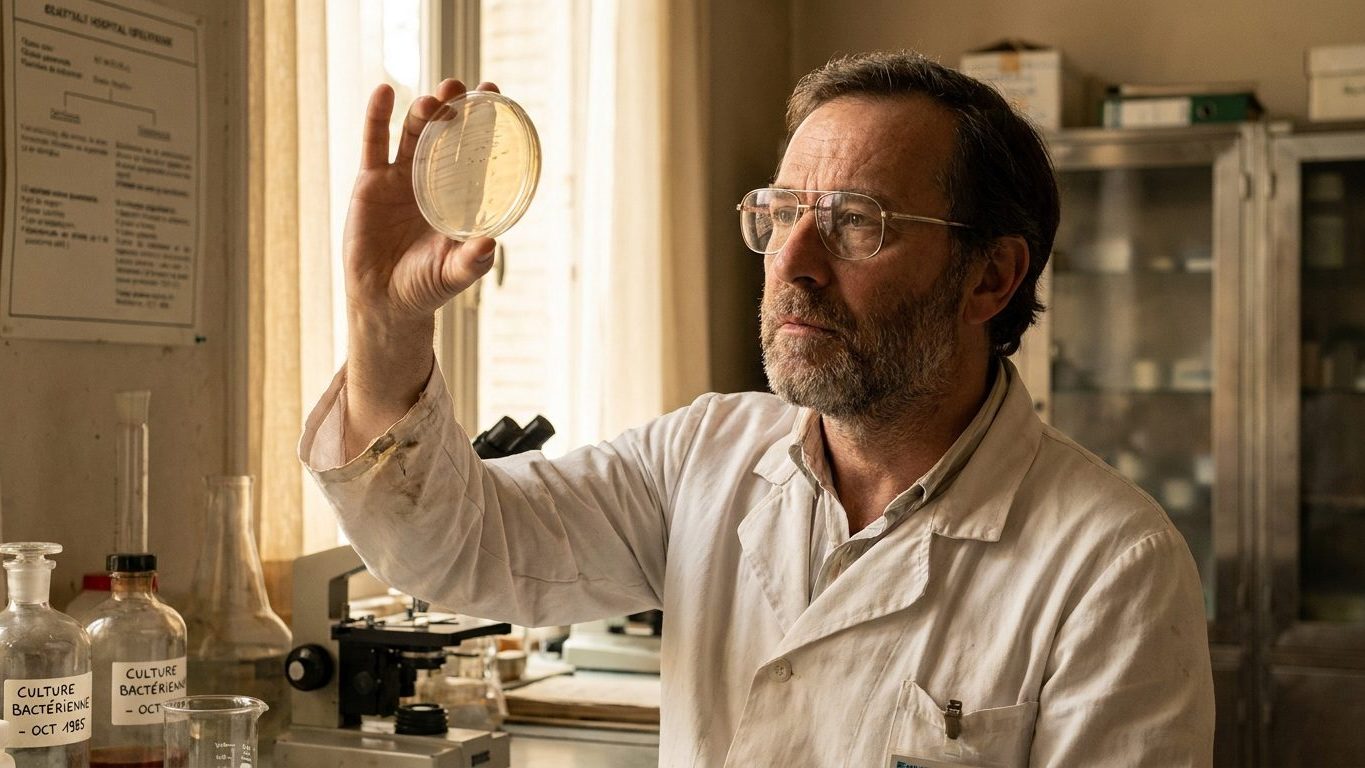
In July 1984, at Fremantle Hospital in Australia, gastroenterologist Barry Marshall swallowed a murky beef broth in one gulp, a mixture prepared by a laboratory technician. The assistant had scraped the contents of two Petri dishes teeming with bacteria into a bit of beef broth, which Marshall gulped down. Simultaneously, surgeons around the world were removing portions of stomachs from ulcer patients, convinced they were fighting stress and excessive acidity.
- Barry Marshall drank a culture of Helicobacter pylori in 1984 to prove that the bacterium causes gastric ulcers, not stress.
- Helicobacter pylori secretes an enzyme that neutralizes stomach acid and creates a shielded environment beneath the stomach’s mucus.
- For decades, surgeons performed gastrectomies and vagotomies that left lasting complications, while antibiotics would have sufficed.
The bet of a doctor whom others refused to listen to
Before swallowing the mixture, Marshall undergoes a follow-up endoscopy. It confirms a perfectly healthy gastric mucosa, with no trace of inflammation.
Three days later, nausea and achlorhydria set in.
His mother points out that he has bad breath, a detail that betrays the ongoing infection. Vomiting follows. On the eighth day, a new endoscopy and biopsy reveal marked gastritis, with a positive culture for Helicobacter pylori. Marshall nevertheless waits several more days before starting the antibiotics intended to eradicate the bacterium residing in his own stomach.
Only on the fourteenth day does he begin treatment, combining antibiotics with bismuth.
Why no one believed a bacterium could survive in acid
The skepticism of his colleagues was not mere stubbornness. In the 1980s, the prevailing theory attributed gastric ulcers to stress and excessive acidity, not infection. Patients were treated with tranquilizers, antidepressants, psychotherapy, or just antacids.
The notion that a microorganism could colonize such a caustic environment seemed ridiculous. Yet Helicobacter pylori produces an enzyme, urease, which splits urea into ammonia and bicarbonate, assembling a neutral bubble around itself. The ammonia acts as a base and neutralizes the acid in its immediate surroundings. In this way the bacterium crafts its own chemical shield, invisible to researchers studying the early biopsy samples.
It then breaches the mucus layer that lines the stomach and attaches to the cells lining its wall. Beneath this mucus, the acidity drops markedly, a refuge that 1970s gastroenterology had simply failed to seek out.
This hypothesis took years to win over anyone.
The price of decades of error
In the absence of a bacterial diagnosis, the chronic ulcer was treated as a purely mechanical inevitability. Surgeons performed vagotomies, severing the nerves that stimulate acid secretion, or partial gastrectomies, removing a substantial portion of the stomach. These heavy procedures left lasting digestive aftereffects: absorption disorders, nutritional deficiencies, and chronic discomfort after meals. All of this for a disease that could, in most cases, be eliminated with a short course of antibiotics.
These surgeries weren’t inherently ridiculous: they reduced acidity and sometimes relieved pain. But they attacked a symptom, never its cause. Stress and anti-inflammatories do play a role in part of ulcers, but the bacterium remains, even today, the dominant cause of the disease.
In 2005, the Nobel Prize in Physiology or Medicine awarded Barry Marshall and Robin Warren jointly for their discovery of Helicobacter pylori’s role in gastritis and peptic ulcers. Twenty-one years separate the broth swallowed in Fremantle and the medal conferred in Stockholm.
It was not until 1994 that a consensus conference of the American Institutes of Health officially stated that the primary cause of ulcers was not stress but the bacterium Helicobacter pylori. Ten more years before the Nobel prize. Today, eradicating Helicobacter pylori remains the standard approach to treating most gastroduodenal ulcers, where whole organs were once removed for no reason.
Sources: mayoclinicproceedings.org | gastrojournal.org
