
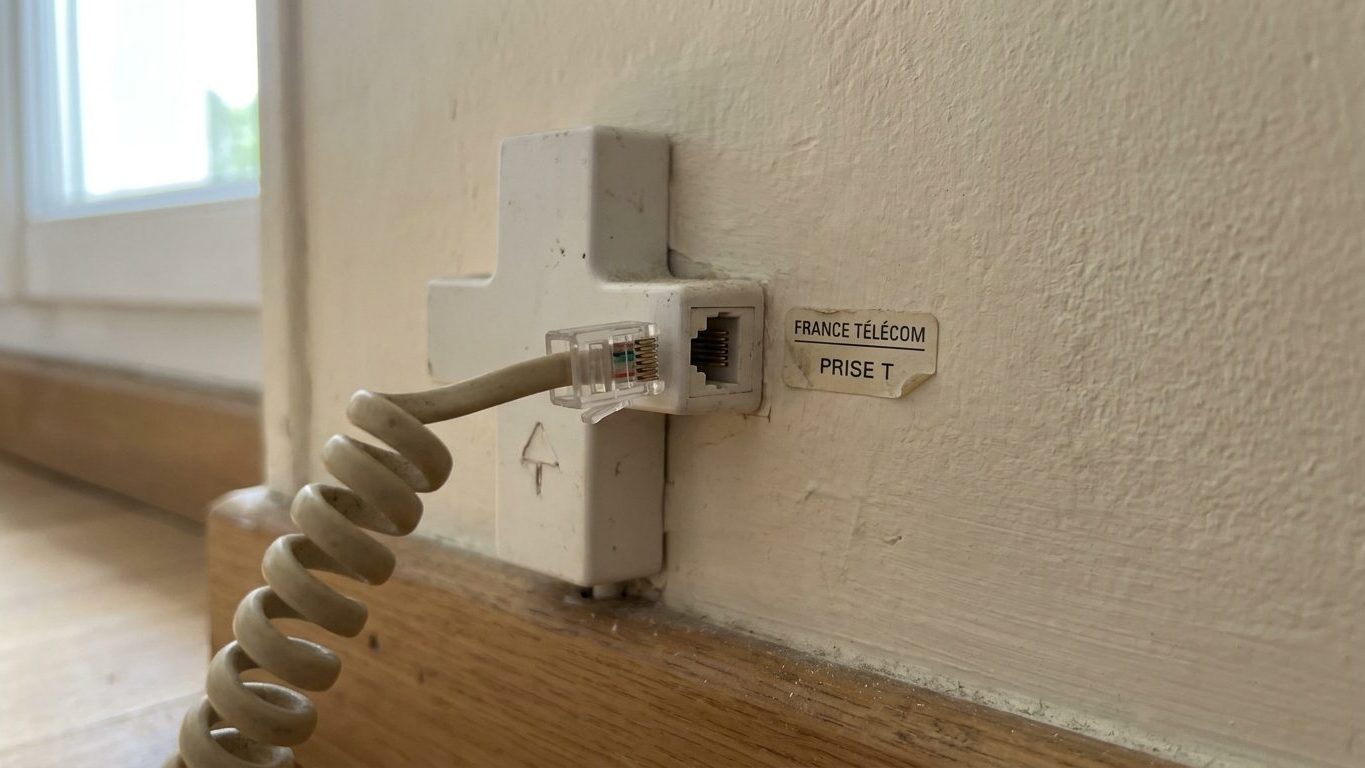
It is screwed into a corner of the entrance, sometimes hidden behind a piece of furniture or tucked in the basement beside the electricity meter. This small white T-shaped outlet, with its locked plug that we’ve never had to unplug, is the last visible link of a cable that often runs several kilometers from a telephone exchange. It is disappearing today, town by town, and with it everything that was still plugged into it without anyone paying attention.
- The copper telephone network is gradually being shut down in France by 2030, removing the T-entry socket and cutting off all equipment connected to it.
- Old alarms, teleassistance systems, elevators and payment terminals continue to operate on copper even in homes that have fiber internet.
- An old analog alarm transmitter is not compatible with fiber optic internet telephone without specific adaptation.
From the splitter to the T socket, a single wire for voice and ADSL
Everything starts at a splitter, the technical room where the copper pairs from an entire neighborhood converge. From there, the cable runs along poles or is buried in conduits, crosses the street, enters the building or the house, and ends at this T-shaped entry socket. A single twisted pair long sufficed to carry the voice, without complex electronics. Since the early 2000s, it has also carried ADSL, internet traveling on the same wires thanks to a different frequency from that used by the telephone.
A single cable, two uses layered on top of each other.
Two steps, a public timetable, town by town
The switch happens in two clearly distinct stages. First the commercial shutdown: no operator, of any kind, can sell a new copper-based subscription in the area concerned. Apart from trials, the commercial shutdown began on January 31, 2024 for a small number of municipalities, then January 31, 2026 across most of metropolitan France and overseas, before continuing January 31, 2027 for the rest of the country. Then comes the technical shutdown, the one that actually cuts the signal for subscribers already connected.
On January 27, 2026, Orange announced that it had completed the technical shutdown of the copper network in 763 municipalities spread across 54 departments and 14 regions, affecting about 900,000 premises. A first, smaller batch had opened the movement by late January 2025 with 162 municipalities. For nearly 8,000 municipalities deemed inadequately fiber-connected, Orange chose to postpone the commercial deadline to avoid any risk of disconnecting subscribers, including in towns almost entirely fiber-connected.
Looking ahead to 2030, copper connections should no longer exist in France. Each year, a new batch of municipalities is added to the list, until the entire territory, including overseas territories, is covered.
There is no single national date.
Alarms, elevators, payment terminals: everything still tied to the copper pair
The classic landline is not the only occupant of this line. A large number of devices quietly share this same analog pair, without daily life giving it a second thought. Alarms, teleassistance, elevators, payment terminals: these everyday devices can still operate on the copper network, even in a home that is already fiber-connected for internet.
- Classic analog landline phones
- Old alarm systems equipped with a telephone transmitter
- Teleassistance devices for the elderly
- Elevator remote monitoring
- Payment terminals, automatic gates, and some meter-reading automata
The phenomenon is far from anecdotal on the professional side: more than half of the analog telephone lines used by businesses still carry elevator alarm transmissions, the operation of telemonitoring systems, remote reading, or electronic payments. The issue gained enough prominence that the French Telecom Federation published in October 2025 a FAQ on connectivity solutions for these specific devices in light of the copper network shutdown. So an isolated individual is not the only one affected.
Why it doesn’t switch over by itself
A alarm transmitter or a teleassistance box is not a smart device. It dials a telephone number on an analog line, exactly as a rotary phone did, sending precise tones that a monitoring center knows how to interpret. Plugging this same device into a fiber box changes the situation: Voice over Internet Protocol splits the voice into digital data packets, and an old alarm transmitter sends analog tones that the box may misinterpret, delay, or lose.
The box may think the call went through, when it never did.
The copper line had a subtle advantage: it was electrically powered from the telephone exchange, not from the subscriber’s wall outlet. A basic landline phone would thus continue to work even during a power outage at the subscriber’s home. A fiber installation, by contrast, depends entirely on the home’s power supply: without power, neither the box nor the connected phone will work, unless a dedicated backup battery is available. It is this difference, invisible while everything works, that becomes tangible on the day of an EDF outage.
Recognizing an active copper line, and what happens to the cable
The simplest visual indicator remains straightforward. If the landline phone or the box is plugged into a wall-mounted T outlet, the home is on the copper network. Conversely, a wall-mounted optical box with a fiber entering it signals that the switch has already been made.
Several tools allow you to check the timeline specific to your municipality, such as Orange’s interactive map, the Ministry of Economy’s search tool, or treshautdebit.gouv.fr. These platforms display the scheduled date, batch by batch. Orange allows a three-year lead time between the announcement of the shutdown in a municipality and its actual implementation, which provides time to organize the migration.
Once the technical shutdown is announced, the fate of the cable follows suit. This step marks the termination of all existing access on the copper network and, if applicable, the removal of the network, cables and conduits, or its reuse for the fiber optic network. The conduit that ran along the street for decades then serves as a guide to an optical fiber cable, or simply disappears during subsequent works.
A trap awaits those who think they have settled everything once the fiber is installed. The copper shutdown schedule is paired with the gradual extinction of 2G and 3G mobile networks, and ignoring this second deadline leaves some equipment exposed to another outage a few years later. The alarm box that today bypasses copper using a 2G SIM is therefore not safe from this either.
Sources: charente-maritime.gouv.fr | cercle-des-seniors.fr
