
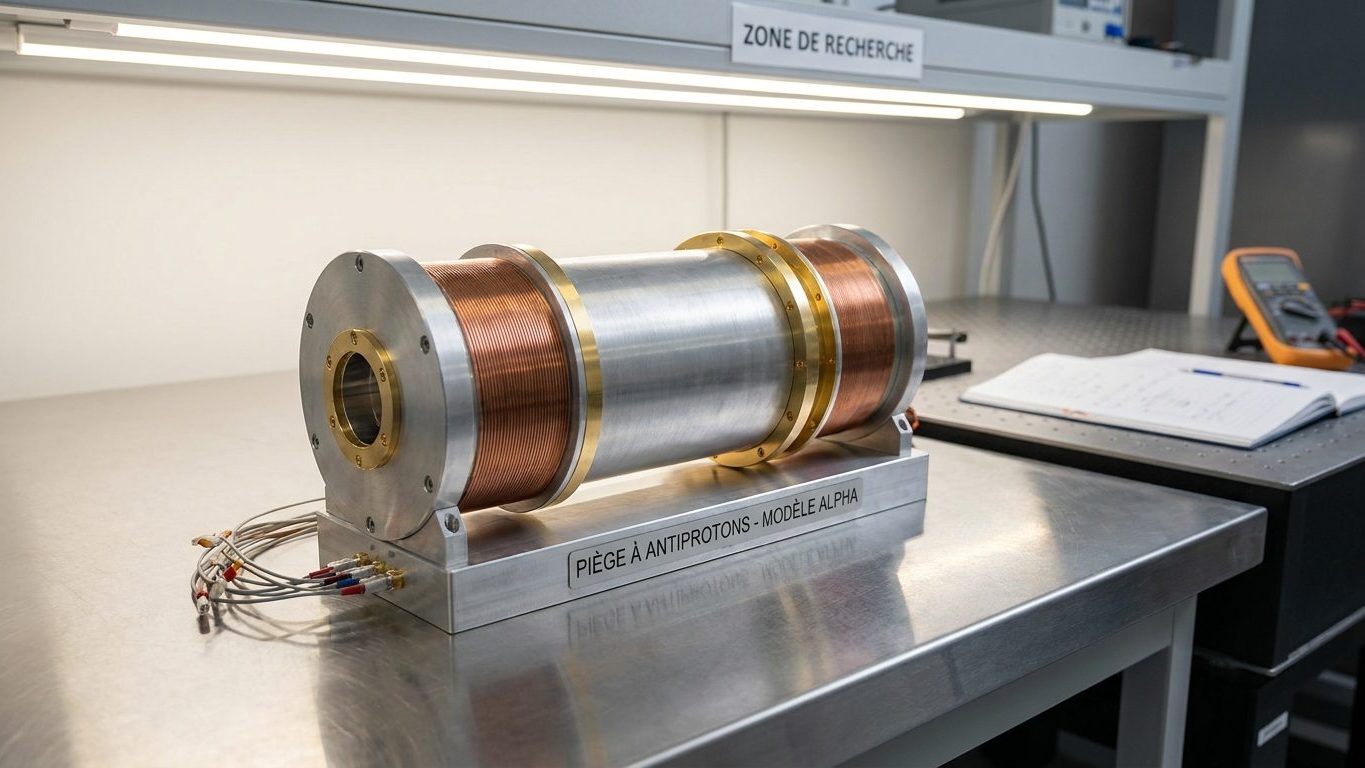
The CERN has been producing antimatter since the 1980s, when the Low Energy Antiproton Ring began slowing antiprotons so they could be captured in electromagnetic traps. The milestone demonstrating that antiproton beams could be slowed and trapped at energies ten orders of magnitude lower than previously possible dates back to 1986. Since then, despite decades of uninterrupted experiments, the total amount accumulated remains so small that it hardly weighs on the scale of a rushed physicist.
Antimatter is the exact mirror of ordinary matter: the same mass, but with an inverted electric charge. When a sufficient amount of energy is concentrated in a small space—such as during high-energy particle collisions—particle–antiparticle pairs spontaneously appear in equal parts matter and antimatter. The problem arises as soon as this mirror meets the real world.
All the antimatter produced in laboratories over the past thirty years would not warm a cup of tea.
- The CERN has been producing antimatter since 1986 at such a slow pace that thirty years of accumulation would not warm a cup of tea.
- Antimatter annihilates instantly upon contact with ordinary matter, releasing energy roughly fifty times more efficiently than nuclear fusion.
- Scientific experiments seek to understand why the universe contains almost only matter, despite a symmetric Big Bang.
A matter that vanishes at the slightest contact
As soon as an antiparticle encounters an ordinary atom, the two annihilate instantly, releasing pure energy in the form of photons and secondary particles. This process is not wasteful: its efficiency is nearly perfect since almost all the mass of the annihilating particles is converted into energy, making it a mechanism roughly fifty times more efficient than nuclear fusion. It is precisely this extreme reactivity that makes antimatter so difficult to preserve: the slightest surface, the tiniest bit of air is enough to destroy it all.
That is why CERN physicists never store antimatter in a jar. It floats, suspended in a high-vacuum, kept away from any surface by carefully tuned magnetic and electric fields, in devices known as Penning traps. An antiproton that touches a wall, even for a tenth of a second, ceases to exist.
Why production remains so inefficient
Manufacturing an antiproton is not straightforward: you must accelerate protons to very high energies, aim them at a target, and then sort the antiparticles that spew out in all directions at speeds close to that of light. The next, most costly step is slowing them down. At the Antiproton Decelerator, the particles must pass through a series of metal foils to shed speed, a process that eliminates roughly 99.9% of the extracted antiprotons before they even reach the experiments. Newer facilities like the ELENA ring have improved the situation: this device cools and decelerates the beam to 100 keV with an efficiency of 80%, and some teams have recently crossed a symbolic milestone with a trapping rate of a record 56% relative to ELENA beam intensity. The progress is real, but it is measured in percentage points snatched one by one, not in orders of magnitude gained at once.
The accumulated result is dizzying in its modesty. If CERN’s antimatter factory ran uninterrupted for an entire year, all the antiprotons produced would amount to barely 500 joules of energy, enough to light a 100-watt bulb for five seconds. This is, as CERN itself notes, equivalent to the energy released if you tap the screen of a smartphone. A year of hard work, dozens of researchers mobilized, for energy that would not even make a smartphone vibrate for more than a moment.
What these antiparticle handles are for
No one at CERN seeks to stack antimatter for storage. The goal lies elsewhere: to understand why the universe, born from a Big Bang thought to produce matter and antimatter in equal parts, now appears to be composed almost entirely of matter. The experiments around the Antiproton Decelerator—AEgIS, ASACUSA, and ATRAP—each pursue a deeper understanding of antimatter, each with its own method. The ALPHA experiment, for its part, poses a question that sounds almost childish in its phrasing: do antiparticles fall upward? A rigorous approach to checking whether gravity treats matter and its mirror identically.
Other collaborations, such as GBAR, which produces antihydrogen from a beam of antiprotons and a cloud of positronium for gravitational studies, pursue the same line of inquiry: to detect any anomaly, any deviation between particle and antiparticle that could explain the current cosmic imbalance. Thus far, no significant difference has been found. Which, in essence, remains one of the greatest unresolved mysteries in modern physics.
The unattainable dream of antimatter fuel
The idea resurfacing again and again is this: what if antimatter became the ultimate fuel, the energy source for future spacefaring vessels? It is so difficult to produce that it cannot even be used as a weapon, much less as a practical energy source. If all antimatter produced in laboratories over the past thirty years were detonated, the effect would resemble lighting a match. The energy yield of annihilation looks stellar on paper, but it never compensates for the astronomic cost of upstream production.
The latest concrete advance dates from November 2025. The BASE experiment at CERN carried out the first attempt to transport antimatter outside the laboratory, trapping antiprotons in a portable device and then loading them onto a truck to move them to another facility. The device weighed around a ton, moved by crane or forklift, to finally transport a quantity of antiprotons that would be invisible to the naked eye. Three decades of patient progress, summarized in this contrast: a ton of steel and cables for a few particles that weigh almost nothing.
Sources: arxiv.org | angelsanddemons.web.cern.ch | letemps.ch
