
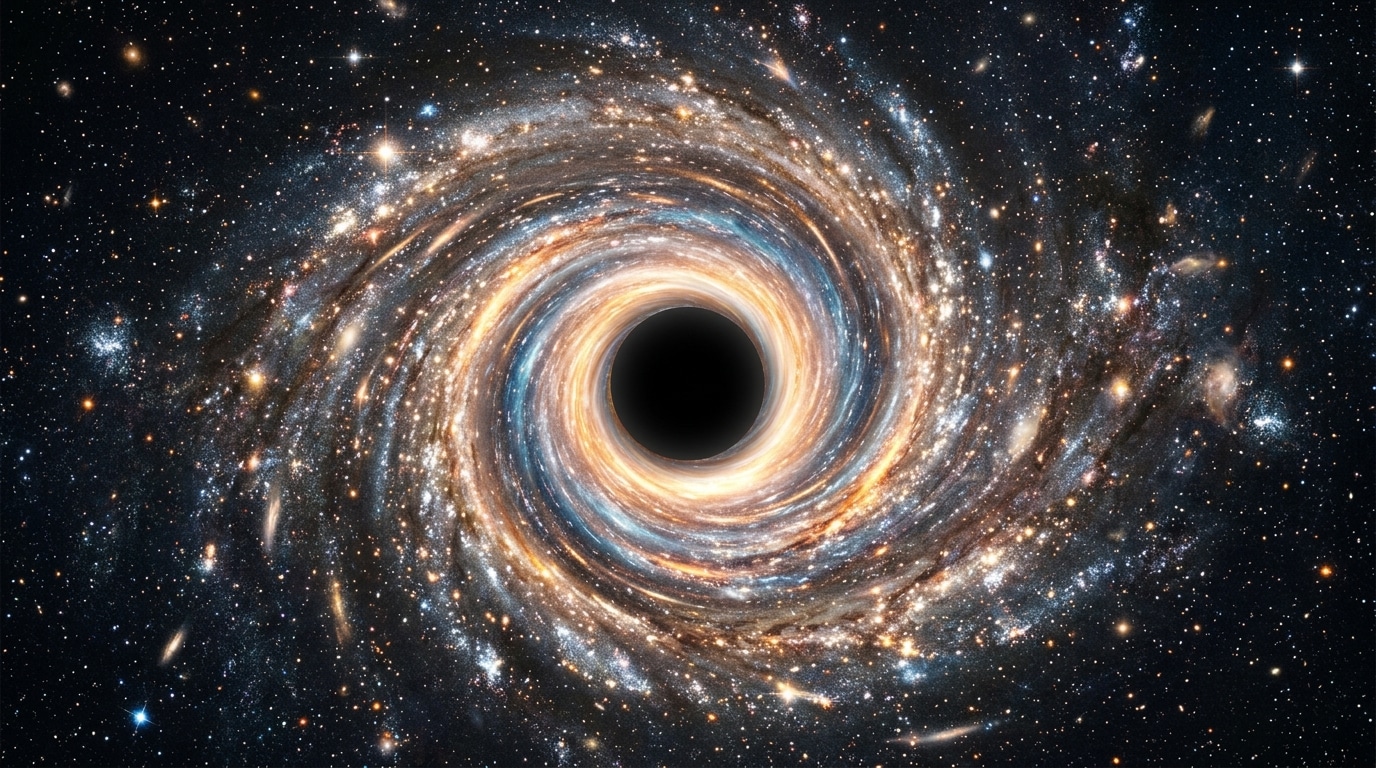
Brace yourself: what you are about to read may upend your perception of the starry sky. Up there, in a region our eyes cannot reach, unfolds a dizzying spectacle: massive stars racing at astonishing speeds around a point that appears perfectly empty. No light, no visible object sits at that exact spot. And yet these bodies whirl as if drawn by an invisible force. This cosmic ballet, located at the heart of our Milky Way, has long resembled an insoluble enigma. But behind this apparent void lies one of the most fascinating objects in the Universe. Its name: Sagittarius A*. Join me in this plunge to the center of the galaxy, where the motion of the stars revealed a colossal secret.
These stars that revolve around nothing: the enigma of the galactic center
Imagine a giant carousel, but without the central pole that makes it rotate. That is exactly the image that comes to mind when observing the center of our galaxy. There, about 26,000 light-years from Earth, several stars describe tight orbits around a point that, at first glance, contains nothing visible. The problem jumps out at astronomers: something keeps these stars captive, like an invisible conductor directing its symphony.
What intrigues the most are the speeds involved. Some stars streak along at thousands of kilometers per second as they skim this mysterious point. For an object to accelerate to such a rate, you need an absolutely phenomenal gravitational mass concentrated in an incredibly small space. And there, no classical star, no known cluster could explain such behavior. The puzzle was posed: what could possibly exert such influence while remaining completely invisible?
Chasing the invisible: how astronomers tracked the stellar orbits
To solve this mystery, one needed Benedictine-like patience. For decades, astronomers directed their most powerful instruments toward this region, meticulously mapping the position of these stars night after night, year after year. The challenge was immense: the galactic center is wrapped in thick clouds of dust that mask visible light. It is impossible to simply “look” with a normal telescope.
The solution came from infrared observation, capable of piercing this cosmic veil. Thanks to cutting-edge optical techniques, correcting in real time the turbulence of our atmosphere, it became possible to track the precise motion of each star. Image after image, a choreography emerged. The astronomers thus reconstructed complete trajectories: true ellipses, similar to those traced by planets around the Sun, but much faster and much more violent.
Proof by motion: when the dance betrays a hidden giant
This is where the magic of physics comes into play. By knowing precisely the trajectory and the speed of a star, one can calculate the mass of the object around which it gravitates. The results were astonishing. The tracking of stellar orbits around Sagittarius A* demonstrated the presence of a supermassive black hole at the galactic center, a giant whose mass amounts to about four million times the mass of our Sun, concentrated in a volume barely larger than our solar system.
The dance of the stars thus clearly betrayed an invisible behemoth. A black hole cannot be seen directly, since even light cannot escape its gravitational grasp. But its influence on its surroundings is undeniable. In short, the astronomers did not see the monster: they watched the puppets dance at the end of its strings. An elegant demonstration where the very absence of light became the most beautiful of proofs.
Sagittarius A* and the future of our galaxy: what this black hole reveals
Far from being a mere curiosity, this supermassive black hole plays a central role in the architecture of our galaxy. Most large galaxies would harbor such a giant at their heart, a true gravitational anchor around which the whole system organizes itself. Sagittarius A* thus forms an integral part of our cosmic history, quietly shaping the structure of the Milky Way for billions of years.
Rest assured, no danger awaits us: our Sun sits at a comfortable distance, far too far to be swallowed. This black hole remains relatively calm, devouring very little matter compared with other monsters more voracious in the Universe. Studying its behavior nevertheless helps us better understand how galaxies are born, evolve and, perhaps one day, merge with their neighbors.
By watching these stars dance around a void, humanity has thus pierced one of the cosmos’ greatest secrets: tangible proof that a supermassive black hole rules at the center of our galaxy. This discovery reminds us of a fascinating lesson: sometimes what we cannot see reveals far more than what we observe. So, the next time you look up at the night sky on a beautiful summer evening, think that at the heart of the Milky Way, an invisible giant quietly orchestrates the ballet of the stars. And if other mysteries, as elusive, still await to be revealed by the sole dance of matter?
