
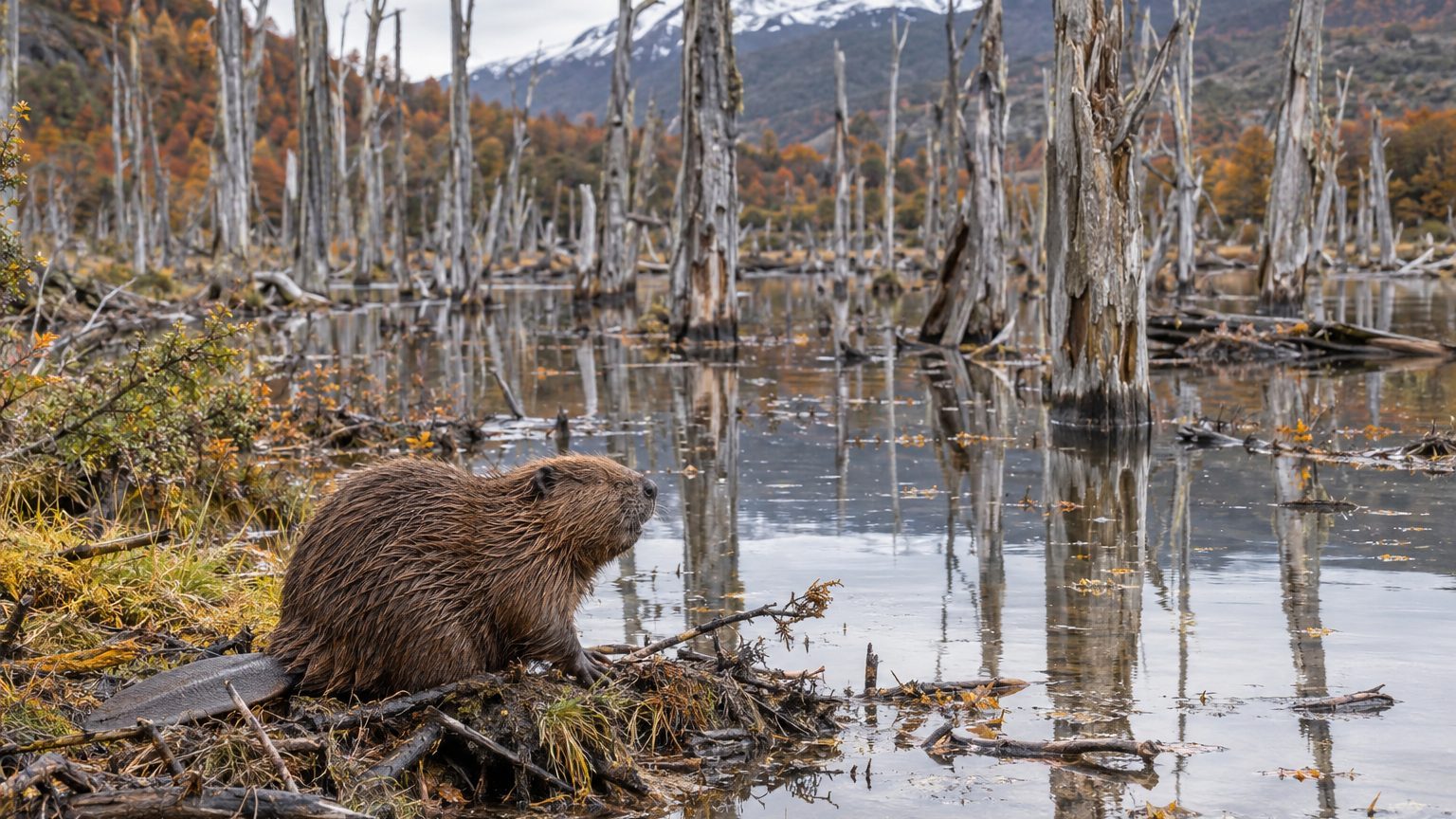
Around twenty pairs of beavers were released in 1946, and today the population exceeds 100,000 individuals. The Canadian rodent (Castor canadensis) has conquered Tierra del Fuego and crossed the border to the Chilean side. Since 2008, Argentina and Chile have signed an agreement to eradicate it from the entire island.
That fur venture, however, never came to fruition.
That year, the Argentine government released the animals near Lake Fagnano, hoping to spark a local industry. Scientific publications talk about 20 individuals rather than 20 pairs, but the outcome is the same. The cold climate, the waterways and the forests evoke Canada, and above all there are no bears, wolves, or pumas to curb the expansion. Beavers now cover roughly 95% of the island’s watersheds, according to Argentine press, and they have crossed the Strait of Magellan.
Counting beavers far from their home continent is inherently an estimate. In 2011, estimates ranged from 100,000 to 200,000 individuals, and in 2013 the Argentine newspaper Clarín mentioned about 150,000 beavers for 134,000 inhabitants.
- Twenty Canadian beavers released in 1946 multiplied to more than 100,000 individuals in Tierra del Fuego
- Beavers created more than 200,000 dams, destroying about 30,000 hectares of indigenous forest
- Eradication would cost $31 million over 17 years with no guarantee of success
Forests Dying Standing
More than 200,000 beaver dams have been identified across the archipelago. They affect around 30,000 hectares of indigenous forest, a surface nearly double the size of the city of Buenos Aires. The fast, clear mountain rivers turn into muddy pools, degrading water quality and pushing some wildlife away.
The principal victims are the southern beech trees, Nothofagus, which can reach up to 30 meters in height. An official in charge of protected areas in the province describes beavers capable of felling a small tree in a few hours, and a large one in a few days, sometimes trees aged 100 to 150 years. Crucially, these South American trees shed far less of their stump than their North American cousins, adapted to the presence of beavers for millennia. Once flooded or cut, the forest does not rebound, and the gray trunks remain standing in the water, hence the name “ghost forests.” Even after dams are dismantled, the soil can take decades to regain its original conditions.
In Ushuaia, fiber-optic cables have already been gnawed through, cutting the internet.
Trapping 100,000 Beavers: The Large-Scale Trial
The 2008 agreement aims to restore habitats affected by the eradication of the species. Between October 2015 and June 2018, ten trappers worked in seven pilot zones on the Argentine side, using jaw traps, snares and sometimes shooting. According to the study published late 2024 in the Journal of Wildlife Management, they operated on 505 colonies and captured 1,012 beavers.
The estimated cost of eradicating the species on the Argentine side stands at $31 million over 17 years.
The figure carries weight because the terrain resists. In the mountains, where beaver density is greatest, an average of 23 trapping episodes per kilometer of watercourse is required. In the western Argentine peatland, isolation simply prevented the team from intervening. And in a zone that had been cleared, cameras recorded beavers that trappers believed to be gone, with no way to tell whether they were survivors or new arrivals.
There are plenty of skeptics. An anthropologist who conducted on-site interviews reported in 2020 that her interlocutors doubted the feasibility of eradication, citing the climate and the lack of continuity in institutions, especially as international funding was waning. Erio Curto, the province’s director of wildlife and biodiversity, responds that success will hinge solely on enduring political will. The challenge extends beyond the island, since beavers have already been observed on the continent and a CONICET biologist, Christopher Anderson, argues that colonization could reach the Bariloche region.
Chile is pursuing its own operations as well, notably on the Brunswick Peninsula and Dawson Island. Official planning now envisions interventions across roughly 75,000 hectares to generate knowledge usable at a broader scale.
Sources: wildlife.onlinelibrary.wiley.com | wildlife.org | rse-magazine.com
