
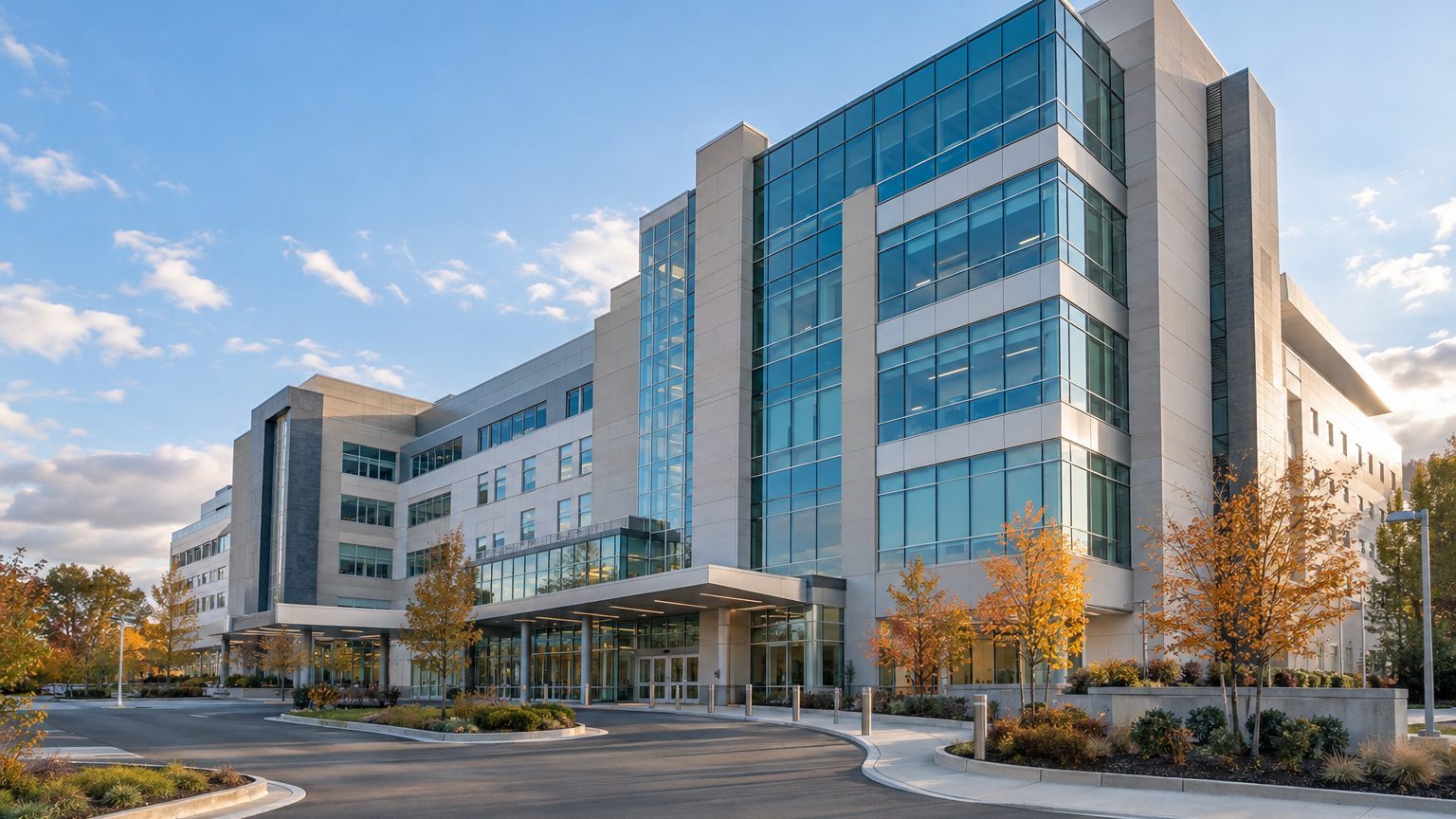
The 8,000 defects identified at the handover of the project in early 2011 made the Centre hospitalier Sud-Francilien (CHSF), in Corbeil-Essonnes, one of the costliest hospital scandals of the decade. The lease signed with Eiffage remained in force, rent included, even though the building was not usable and the hospital’s budget was already in the red. It took until 2014 for the hospital to disengage, at the cost of several tens of millions of euros.
- More than 8,000 defects were found at project handover in 2011
- The hospital paid 40 million euros annually to Eiffage during eight months of waiting before opening
- The lease termination in 2014 cost CHSF and the authorities 171 million euros
A thirty-year lease signed in 2006
The contract dates from July 2006, as part of the Hospital Plan 2007. The project was carried out with Eiffage under a hospital emphyteutic lease signed on July 11, 2006. The group financed the investment (344 million euros at the start), constructed and ensured maintenance. In return, the hospital paid, with the ARS, a rent of around 40 million euros per year for thirty years, on an annual budget of 230 million.
Thirty years at 40 million: more than a billion euros in total.
The exact rent amount varies by source and year. It stood at 38.8 million euros in 2011 and 41 million in 2012, but trade press spoke of about 48 million euros per year at the time of the breach in 2014. Part of the discrepancy stems from maintenance: upkeep works increased the maintenance share of the rent. In total, the global cost to the community is estimated by some at 1.2 billion euros.
Eight thousand defects, and an opening that never arrives
The delivery was scheduled for January 2011. The incoming director, concerned about the apparent non-compliance with sanitary safety standards, requested an independent assessment: it reported more than 8,000 defects. The project then turned into a test of strength. In April 2011, a breakdown stopped the four generators just after Eiffage cut the electricity, the heat-transfer fluids heated up, and firefighters had to intervene.
The hospital opened only on January 23, 2012, eight months late.
During this wait, costs mounted on both sides. The delegated minister Dominique Bertinotti told the Assembly that there was a deficit of more than 40 million euros per year, attributed to the CHSF’s legal status. In June 2011, the supervisory board, chaired by Manuel Valls, adopted a motion calling for renegotiation of the contract or an exit from the lease. Eiffage, for its part, demanded 115 million euros for overruns and an additional 60 million for rent.
2014: the exit, and its tally
The CHSF announced on February 26, 2014 its intention to terminate the partnership with Héveil, Eiffage’s subsidiary. The two parties agreed on a conventional termination for an act of general interest, validated by the supervisory board on March 14, and formalized at the end of March.
The most frequently cited figure is 80 million euros, the indemnity paid to Héveil. Added to transfer costs and VAT, this brought the hospital’s bill to 171 million euros. The agreement also extinguished all disputes related to the lease. The CHSF became owner, inherited the debt from the banks, and resumed maintenance on October 1, 2015.
The administration, on its side, had promised savings of 600 to 700 million euros for the public sector. The former director, in statements reported by Marianne, claimed to have proposed a partial buyout of the lease, as with the Millau Viaduct, to the tune of 70 million euros. That idea was rejected.
A case study for the Court of Auditors and the Senate
In February 2014, the Court of Auditors published its report on the PPPs of the Hospital Plan 2007, which it judged “a procedure poorly managed.” Fourteen operations under the PPP procedure were analyzed. The magistrates noted that CHSF’s management had expressed reservations and that the Regional Hospitalization Agency had shown prudence at the signing.
The Senate took the baton in July.
Information Report No. 733, signed by Jean-Pierre Sueur and Hugues Portelli on behalf of the commission of laws, was submitted on July 16, 2014. Its title poses the question: “Time bombs?” The report denounces a budgetary time bomb, because the rent, financed from the operating budget, prevents the community from committing to other expenditures. The two senators put forward 13 proposals to shield communities and the state from these risks, with the CHSF serving as a case study to illustrate their point.
Without the 2014 exit, the hospital would not have become the owner of its walls until 2041. Nevertheless, it continued to operate: 1,068 beds and authorized places, serving a population of around 600,000.
Sources: documentation.insp.gouv.fr | senat.fr | corbeil-essonnes.fr
