
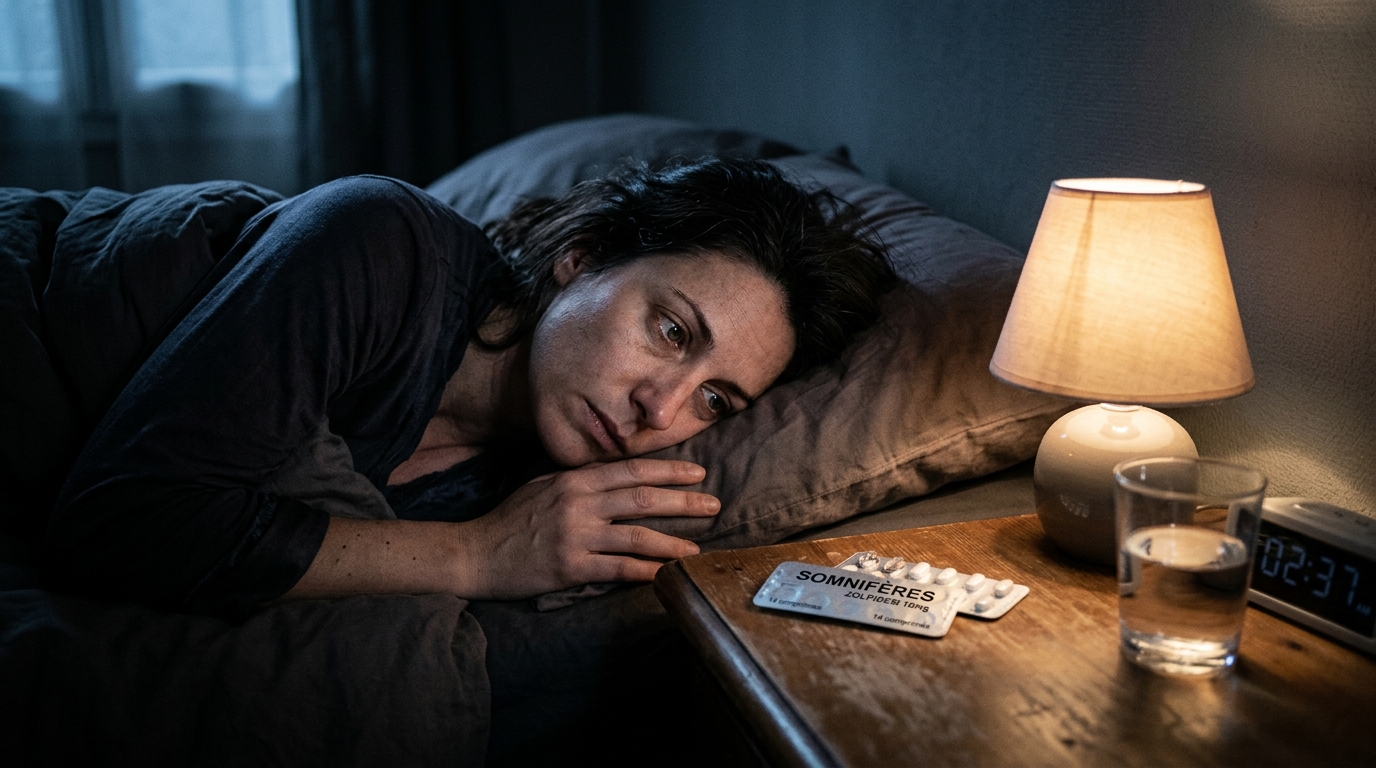
11:47 p.m. The lights go out, but the brain lights up. A shopping list, a forgotten email, that colleague’s remark looping in your head: thoughts intrude uninvited. And if the struggle to fall asleep actually unfolds well before, in the very first seconds after the bedside lamp goes off? Sleep researchers have just highlighted, so to speak, a mechanism that could upend the small bedtime ritual of millions of French people, without swallowing a single pill.
- A bedroom at 18°C promotes melatonin production and improves REM sleep (108 minutes versus 85 minutes at 25°C)
- The 4-7-8 breathing technique (inhale 4 seconds, hold 7 seconds, exhale 8 seconds), repeated 3–4 times after lights out, slows the heart rate and fosters sleep onset
- Lowering heating in the evening and avoiding screens in the last hour before bed effectively complement this rapid-sleep protocol
- The mysterious countdown that intrigues scientists
- 18°C and the 4-7-8 breathing: the duo that fools your biological clock
- Adopting the 19-second ritual tonight: how-to
The mysterious countdown that intrigues scientists
Nineteen seconds. It’s the span that seems to make all the difference between a night-time struggle to drift off and a quick transition into sleep. This figure isn’t magical in itself: it actually corresponds to the window during which the body can engage, or not, the right physiological reflexes once the light goes out. Yet, in recent months, several studies on French sleep have drawn a troubling picture. The average sleep duration appears to have fallen to about 6 h 50 min per night, and a large majority report disrupted nights, especially when the bedroom remains too warm. Because that is where the first obstacle lies: the second half of the night, more fragile and lighter, becomes the stage for untimely awakenings, often around 3 a.m., when the ambient temperature has not fallen enough.
18°C and the 4-7-8 breathing: the duo that tricks your biological clock
It is precisely in autumn, as the first chills settle in and heating restarts timidly, that this protocol gains its full meaning. The first ingredient of the recipe is a single figure: 18°C, the temperature deemed ideal for a bedroom. Below 20°C, melatonin production—this hormone that orchestrates falling asleep—naturally rises more generously. Above that threshold, it stalls, and sleep becomes fragmented. Some specialists even suggest letting the temperature gradually drop during the one to two hours before bedtime to mimic the natural cooling curve of the evening body. The second ingredient lies in breathing. The so-called 4-7-8 technique, popularized under the “military method” label, involves inhaling for four seconds, holding the breath for seven seconds, and exhaling slowly for eight seconds. Repeated several times, this exercise slows the autonomic nervous system and lowers heart rate, creating the conditions for a rapid shift toward sleep. When combined with a cool room, this breathing forms the famous winning duo: the body cools, the nervous system calms, and sleep onset speeds up.
Adopt the 19-second ritual tonight: how-to
concretely, how can one implement this protocol without spending the entire evening at it? A few simple actions are enough to bring you closer to the recommendations, which also align with official guidelines placing nocturnal heating around 17°C in a bedroom, versus 19°C in living areas.
- Lower the bedroom heating at the end of the evening, or crack the window for a few minutes before going to bed
- Turn off the light, then begin the 4-7-8 cycle: inhale for 4 seconds, hold for 7 seconds, exhale for 8 seconds
- Repeat the cycle three to four times, letting wandering thoughts drift by without clinging to them
- Avoid screens in the last hour, as their light naturally delays melatonin secretion
A reference scientific study has in fact measured a notable difference in the quality of rapid-eye-movement sleep according to room temperature: 108 minutes in a cool room, versus only 85 minutes in a room heated to 25°C. A result that could convince even the most skeptical that coolness is not merely a matter of comfort, but a tangible physiological lever.
What these findings reveal goes beyond mere anecdote: by acting simultaneously on body temperature and the nervous system, one could create optimal conditions for express sleep onset. The next step is to test this protocol over several nights and tailor it to one’s own rhythm, in order to reap all the long-term benefits.
