
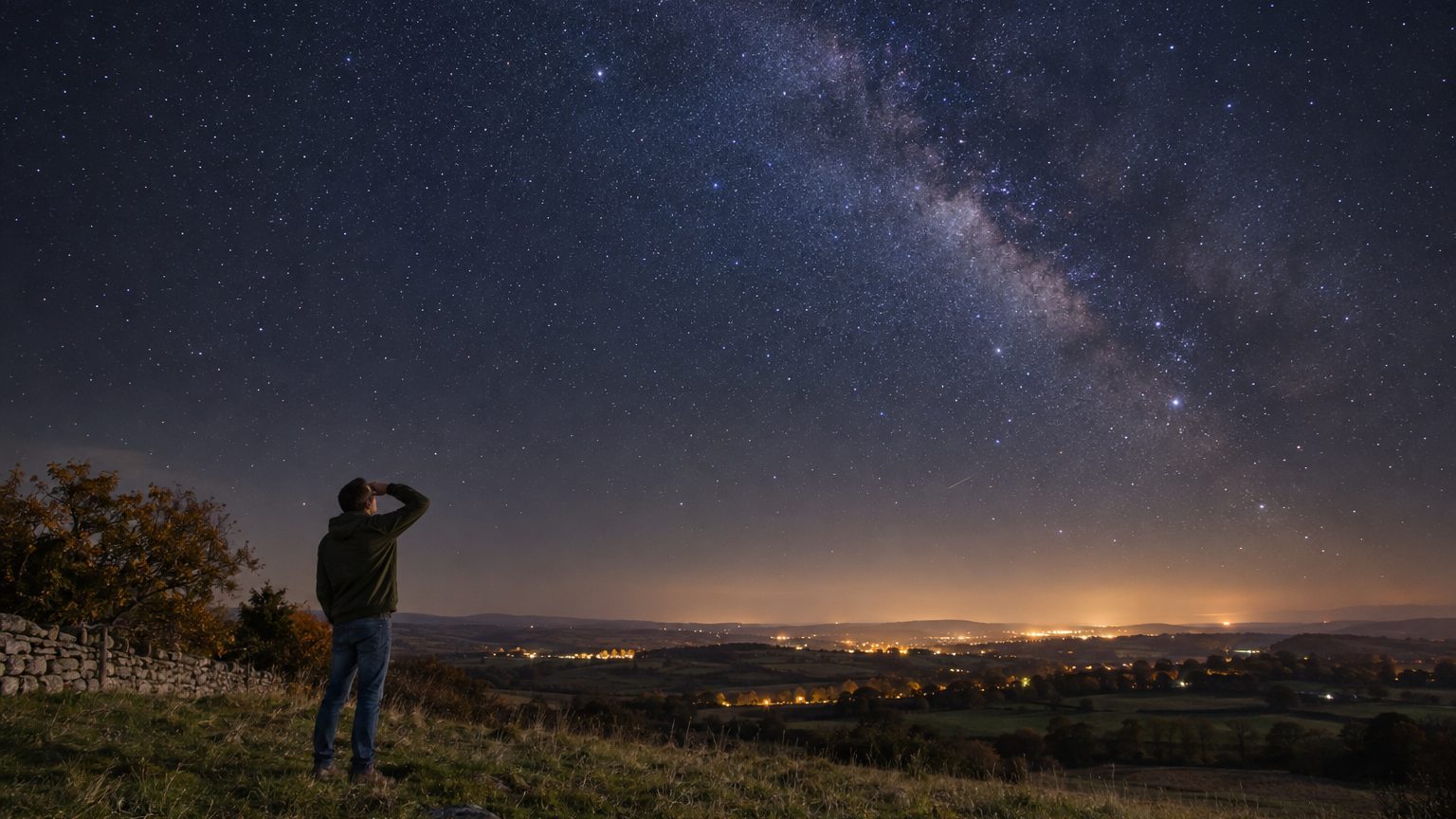
The night sky is brightening by about 9.6% per year. This figure comes from 51,351 stargazing observations made by volunteers between 2011 and 2022, within the Globe at Night program. Satellite measurements, by contrast, showed only about a 2% annual increase, nearly five times less.
At this pace, the brightness of the sky would double in eight years.
- The night sky is brightening by 9.6% per year according to amateur observations, versus only 2% according to satellites
- White LEDs emit in the blue part of the spectrum, a wavelength that satellites do not detect but which amplifies the eye’s perception of the sky
- At this rate, sky brightness would double in eight years and a child would see fewer than 100 stars in adulthood instead of 250 at birth
Thousands of Eyes on an Orbital Sensor
Globe at Night rests on a single act. Participants compare sky maps, corresponding to different levels of light pollution, with what they see with their own eyes. Christopher Kyba, a researcher at the German Research Center for Geosciences, and colleagues converted these choices into variations in sky brightness. Their work appeared in the journal Science in January 2023, with reports collected since 2006.
The global average of 9.6% hides regional differences. Europe shows 6.5% per year, North America 10.4%.
Over 18 years, the span of a childhood, this rate would multiply the sky’s brightness by more than four. A child born under a sky with 250 visible stars would see fewer than 100 by adulthood. The authors add that the sky probably brightens even faster in developing countries, where lighting is advancing more rapidly.
The Blue That Satellites Can’t See
The VIIRS sensor, at the heart of these measurements, does not perceive light below about 500 nanometers.
Yet white LEDs emit their peak in the blue, precisely in this blind spot. The human eye, at night, is more sensitive to these short wavelengths, which magnifies the LED effect on our perception of the sky. Satellites also capture only light emitted vertically, directly or by reflection, whereas the halo that hinders observers arises from scattering in the atmosphere. Kyba draws a clear conclusion: current satellites are not sufficient to study the evolution of Earth’s night.
Therefore the 2% figure is not false; it measures something else. A city that replaces its orange lamps with white LEDs may appear stable from orbit. From the ground, it can gain diffuse light, especially in the blue.
In Science, astronomers Fabio Falchi and Salvador Bará wrote a commentary on the study. Their reading: light pollution is increasing despite measures intended to limit it.
Energy Savings That Light Up Higher
During the 2010s, entire municipalities replaced their sodium lamps, which emitted orange light, with white LEDs. The argument was financial: for the same service, electricity bills drop. Kyba’s team suggests that this shift toward more energy-efficient LEDs may have weighed on the observed trend.
Official nocturnal brightness measurements did not register this shift.
Caution is warranted, however. The researchers interpret the sky’s brightness rather than measuring it directly, based on what participants report seeing. A margin of error accompanies each estimate, hence the 7 to 10% per year range cited in the Science press release. But the trend is clear: fewer stars are visible to the naked eye.
What Could Still Hold Back the Rise
No new satellite is needed to act. Lighting that directs illumination toward the ground, warmer-tinted LEDs, and dimming of lighting during the night are among the levers cited. As for enthusiasts, they can keep contributing to the Globe at Night database from their own backyard by comparing their sky to star maps.
LEDs have dominated outdoor lighting for about a decade, the period covered by the study. Satellite measurements, meanwhile, see only a portion of it.
Sources: science.org | noirlab.edu | accessfixtures.com
