
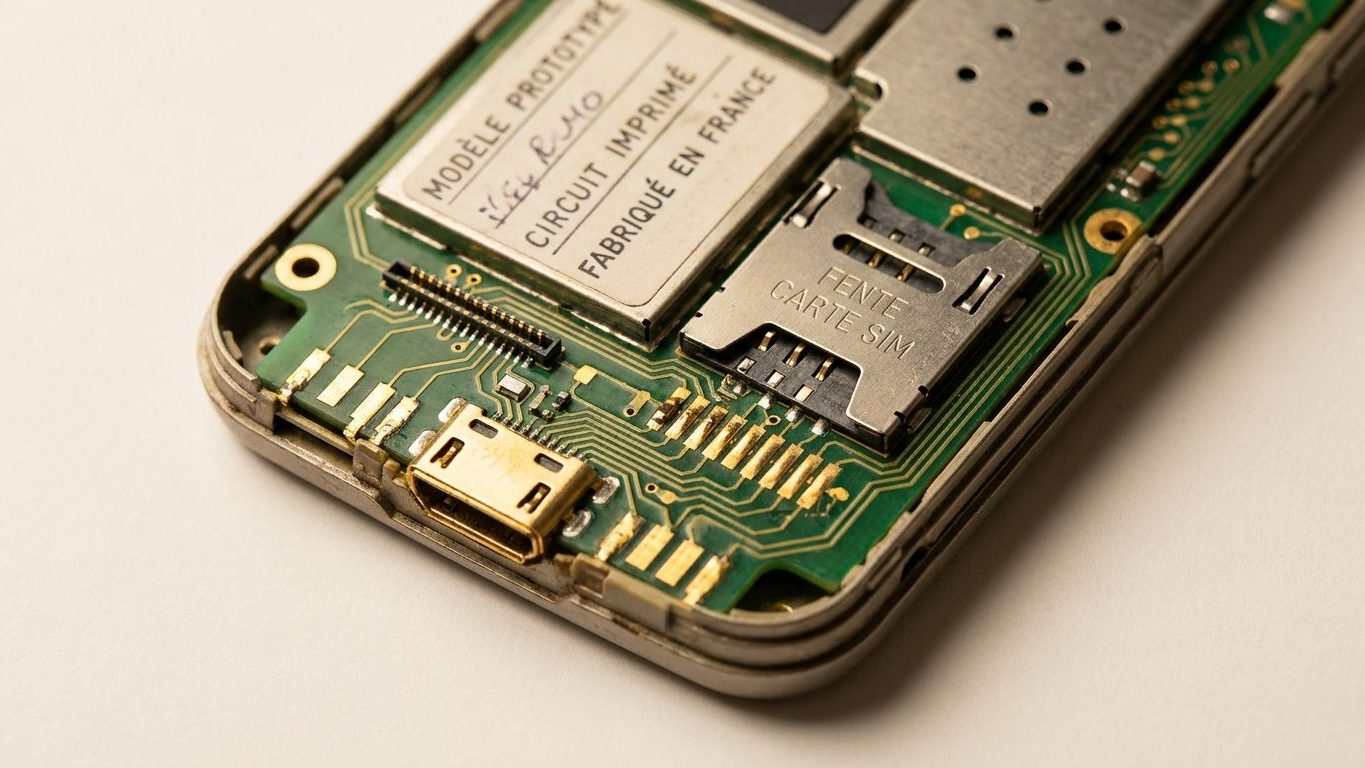
Three phones forgotten at the back of a drawer hold, kilogram for kilogram, more gold than any ore mined from an active mine. The concentration of gold in a very good mine is about 5 grams per tonne of ore, while electronics average 200 grams of gold per tonne of circuit boards. The gap comes from a simple detail: in the device, the gold is not dispersed; it is localized.
That is the whole difference with rock.
- Electronic circuit boards contain 200 grams of gold per tonne, versus 5 grams for the best ore deposits.
- Gold concentrates on connectors, pins and bonding wires to guarantee conductivity and prevent oxidation.
- 46 million French phones remain stored in households and never enter recycling streams.
Under the shell, an organized deposit
Opened, an out-of-use smartphone reveals gold deposits at precise locations: on the gold contacts of the charging connector, on the pins of the SIM tray, and on the bonding wires that link each chip to the rest of the circuit board. This choice is not cosmetic. The electronics industries use gold for its conductivity, but also because gold does not oxidize, which guarantees reliable connections over time.
Measured against the device’s total mass, the presence of the yellow metal is far from negligible. A tonne of mobile phones contains 3,573 grams of silver, 368 grams of gold and 287 grams of palladium. Copper, by contrast, is present in much larger quantities: it provides the coils, the cables and the circuit tracks. Rare earths such as neodymium, dysprosium or terbium populate the speakers, vibrators and sensors, while cobalt and lithium remain concentrated in the battery.
This wealth has a price that is measurable on the recycling market. The value of circuit boards ranges from 6,000 to 15,000 euros per tonne, and can go up to 50,000 euros for the richest boards.
Why ore doesn’t weigh up
In a mine, gold is diluted in tons of rock.
Exploiting a conventional gold deposit means crushing and processing vast volumes to extract a tiny fraction of ore. To obtain, via mining, a quantity of gold equivalent to what is recovered from processing circuit boards, one would have to mine around 800,000 tonnes of ore, with environmental consequences markedly higher. The difference in scale alone explains why the footprint of a mine far exceeds that of an electronics recycling center.
In a phone, the logic is entirely reversed. The gold is neither diluted nor hidden: it sits in known locations, documented by manufacturers for design reasons. A single smartphone, taken in isolation, contains only a trace, on the order of 0.034 gram of gold according to industry estimates. But this trace, multiplied by the hundreds of millions of devices sold each year, changes the scale entirely.
The real obstacle is collection
In France, a Harris Interactive and Credoc study conducted for environmental organizations estimates that 46.4 million phones are stored in households, i.e., 2.4 phones per home. A device left in a drawer never enters a recycling stream, no matter how efficient the system may be.
This volume never reaches recycling channels.
On a global scale, 62 million tonnes of electronic waste were generated in 2022, but less than a quarter of this mass, i.e., 22.3%, was documented as properly collected and recycled, while the total value of the metals it contains is estimated at 91 billion dollars, including 15 billion dollars in gold. Part of what is collected nonetheless escapes regulated circuits: according to a report aired by Arte, two-thirds of this waste vanish abroad, through opaque routes.
The industrial journey, from dismantling to refining
The processing of a recovered phone follows a precise protocol. The devices are first dismantled to separate batteries, screens and casings from the circuit boards, which concentrate the majority of the value in metals. These boards are then shredded and melted at very high temperatures in specialized furnaces, such as those at the Umicore plant in Belgium, which recovers the precious metals contained in mobile phones, before a chemical refining step that isolates gold, silver, palladium and copper from one another. These are industrial processes that use dangerous reagents and are by no means practiced at home.
Worldwide production of electronic waste is rising by 2.6 million tonnes per year and is expected to reach 82 million tonnes by 2030. A parliamentary report also notes that France would still collect only around 15% of the available stock of mobile phones, leaving the rest of this gold accessible to sleep in drawers, within reach of those who still remember it.
Source: masculin.com
