
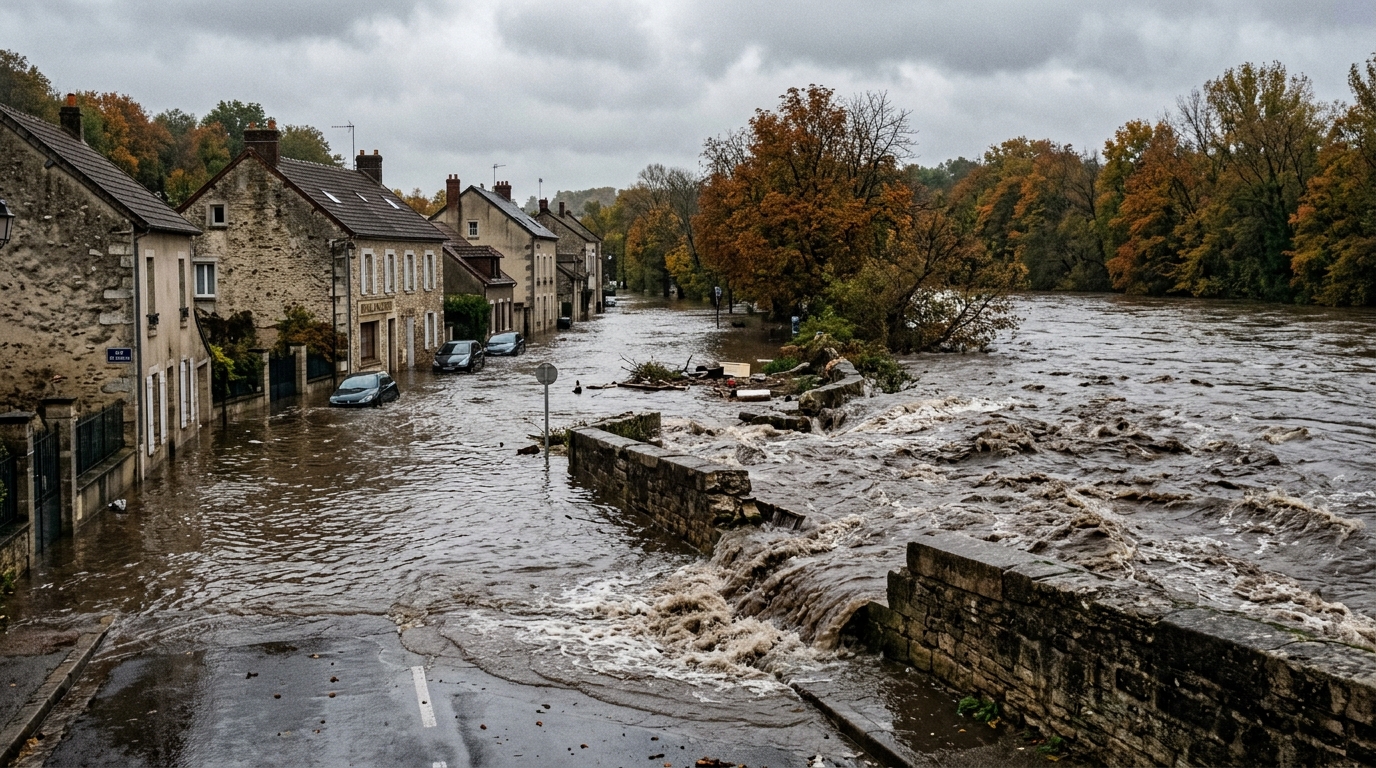
Imagine for a moment that the solution meant to shield you is actually the one that, decades later, intensifies the danger. That is nearly what has unfolded on the banks of the Loire for almost two centuries. Each year, as autumn nears, Loire residents watch the vigilance bulletins with a worry that is hardly irrational. For behind these kilometers of embankments intended to keep them safe lies a little-known history: a river that was supposed to be tamed and which, in return, developed a capacity to cause far more trouble. How could a protective structure turn into a factor that worsens the very floods it was meant to prevent? The answer rests on a hydraulic logic that is both simple and formidable.
- By narrowing the Loire’s channel between levees tied to the highest known floods, 19th‑century developments prevented the river from spreading and increased the height and magnitude of its floods.
- Three major floods in 1846, 1856 and 1866 exceeded 6.7 meters at Orléans, confirming engineer Comoy’s warnings about the dangers of continually raising the dikes.
- A program of 19 spillways launched in 1867 to restore the river’s expansion zones was only partially implemented, leaving today about 700 kilometers of levees along the Loire and Allier.
- A river under constraint that keeps rising
- The silt trap: how the Loire’s bed rose year after year
- Protecting a village, flooding the next: the domino effect of the dikes
- A century and a half of developments that still threaten riverbank residents today
A river under constraint that keeps rising
As early as the 12th century, in the Loire Valley of Anjou, the first inhabitants already had to contend with the Loire’s caprices. They erected turcies, modest, discontinuous, and deliberately floodable works designed to curb the floods without ever claiming to stop them entirely. This sensible approach left the river with a natural margin for maneuver.
But in the 19th century, another project definitively took hold: tightening the river bed, supported by advocates of river navigation and by those who dreamed of winning cultivable land from the floodplains. The height of the embankments was set to the level of the highest known floods, creating the illusion of lasting security. The valley, once subject to the river’s mood, suddenly became amenable to development, to the point of hosting even a railway line.
The silt trap: how the Loire’s bed rose year after year
What the engineers of the nineteenth century had not anticipated is that corseting a river profoundly alters its physics. By narrowing the Loire between two earthen walls, the river was prevented from spreading freely during floods. The result: water, confined in a reduced space, saw its force and its height increase over the years, a phenomenon engineers would soon have to confront.
It is precisely this mechanism that engineer Guillaume Emmanuel Comoy, tasked by Napoleon III with drawing up a flood-defense plan, brought to light in his report. He demonstrates with startling clarity that the continual elevation of the levees only worsens the heights and discharges reached during floods, with potentially dramatic consequences in the event of a dike rupture. The historian Roger Dion, cited by a local heritage site, sums up this inexorable dynamic by explaining that “the most important effect of the levee’s pressure is to intensify the torrent-like character of floods by increasing their maximum discharge.” In other words, by preventing the river from spreading, we have made it faster, stronger, and therefore more violent.
Protecting a village, flooding the next: the domino effect of the dikes
The extraordinary floods of the nineteenth century brutally exposed the limits of this strategy. In 1846, the Loire rose by nearly 5 meters in just 24 hours, reaching a height of 6.78 meters at Orléans. Ten years later, in 1856, the river climbed still higher, reaching 7.1 meters. Then in 1866, another alarm with 6.92 meters recorded. Three major floods within twenty years, which confirmed the warnings of engineer Comoy.
These successive disasters eventually convinced authorities that endlessly raising the dikes was not a sustainable solution, but a losing bet. An alternative emerged: deliberately leaving floodways open in certain valleys by means of spillways, allowing the river to naturally reclaim its zones of expansion. It is a way of acknowledging that total flood control had created a problem that only partial relief could mitigate, even if it meant sacrificing some areas to protect others.
A century and a half of developments that still threaten riverbank residents today
The 1866 flood spurred the launch of a broad program in 1867, envisaging the construction of 19 spillways along the river. Yet by 1911, almost half a century later, only seven of them had actually been completed. This partial implementation illustrates how river management remained, and remains to this day, an incomplete project.
Today, nearly 700 kilometers of levees line the Loire and Allier, a direct legacy of choices made in the Middle Ages and reinforced in the 19th century. An impressive hydraulic heritage, but one that bears the scars of a logic never fully corrected: a river whose bed has been raised without always giving it the space to breathe during major floods.
This history of the Loire’s embankments resonates as a warning that remains relevant each autumn when the first rains raise questions about flood risks in the Loire valleys. It reminds us that protection built on flawed reasoning can turn against those it was meant to defend, and that mastering a river cannot be decreed once and for all: it must be adjusted, corrected, and above all, learned from its own mistakes. Facing a river whose bed still bears the traces of these old choices, the question remains: are we today capable of rethinking this relationship between humankind and the Loire, or are we repeating, perhaps unknowingly, the mistakes of the nineteenth century?
