
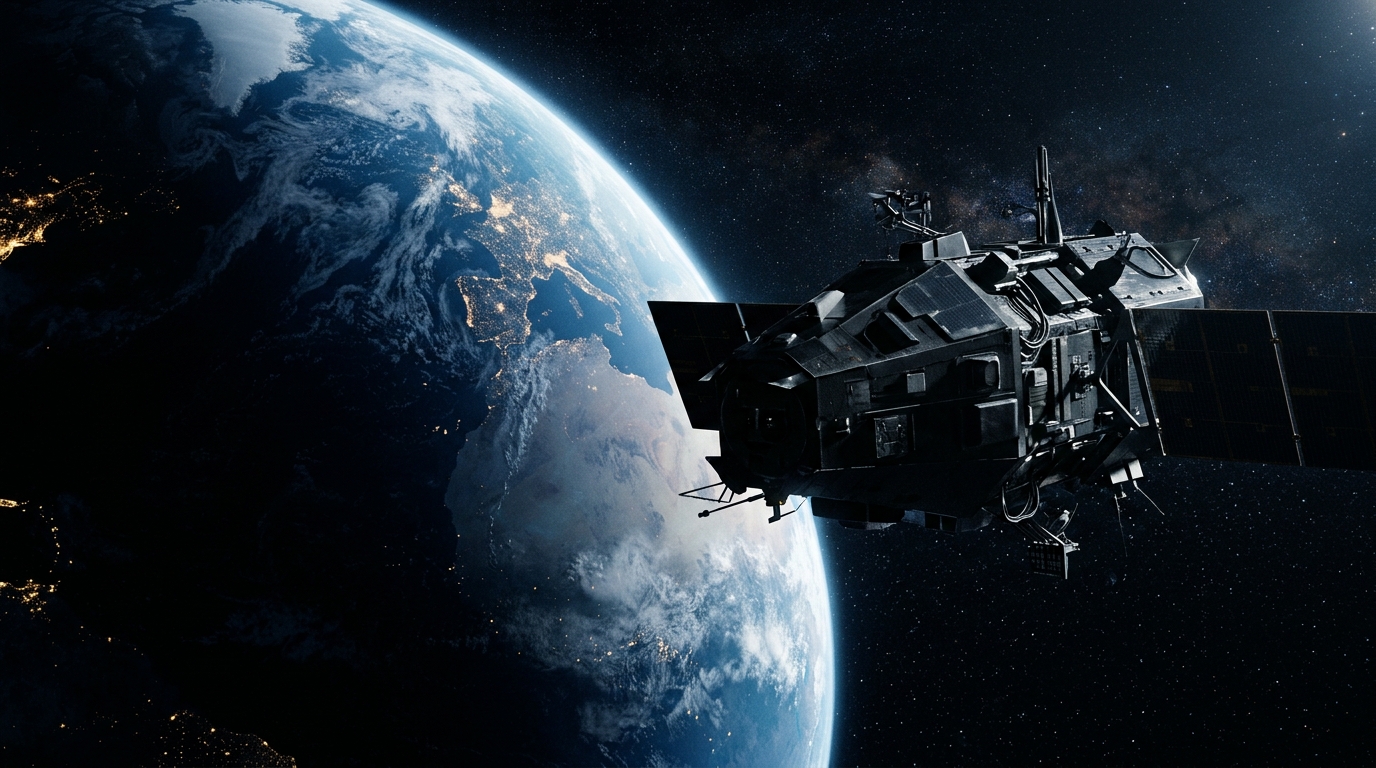
Imagine a covert spy satellite slipping quietly within a few hundred meters of an opposing craft, able at any moment to jam its communications or blind it. This scenario, long the stuff of science-fiction novels, has just received a chilling official confirmation. The U.S. military has acknowledged outright that weapons are already in orbit, ready to defend American interests against potential hostile actions. A statement that changes the game and abruptly calls into question the image of space as a neutral realm reserved for scientific exploration and civilian telecommunications.
- The US Space Force and the Secretary of the US Air Force Troy Meink confirmed the presence of armed space-control systems already in orbit, without detailing how they work or what they look like
- These weapons favor non-destructive methods such as orbital tracking and electronic jamming rather than physical destruction, to avoid creating space debris
- China and Russia reacted by urging Washington to halt this military deployment, arguing for years for an international treaty banning weapons in space, a topic to be addressed at the UN disarmament conference in November
- Space is no longer the peaceful sanctuary we imagined
- Satellites tailing other satellites, a cat-and-mouse game at 36,000 km altitude
- Pentagon against Beijing and Moscow: the silent race playing out above our heads
- A new space age opens, and no one is really ready
Space is no longer the peaceful sanctuary we imagined
For decades, Earth’s orbit carried an almost romantic image: a common domain, dedicated to observing our planet, to communications, and to humankind’s venture toward the stars. That vision has just taken a serious blow. During the Air, Space & Cyber conference, held at National Harbor in the United States, a spokesperson for the US Space Force confirmed that the country possesses armed space-control systems already positioned in orbit. A rare, nearly unprecedented admission in its candor, reinforced by remarks from the US Air Force Secretary, Troy Meink, who also acknowledged the existence of these space weapons.
What stands out is the carefully cultivated ambiguity surrounding the exact nature of these devices. No specifics have been provided about their operation, appearance, or mode of action. We only know they are designed to defend the joint force against actions deemed hostile. This ambiguity, far from comforting, fuels speculation and concerns among rival powers.
Satellites tailing other satellites, a cat-and-mouse game at 36,000 km altitude
The image is striking: devices quietly following other satellites, tens of thousands of kilometers above our heads, in a ballet as discreet as it is strategic. This kind of maneuver, called orbital tracking, allows close surveillance of an adversary satellite’s activity, and perhaps to approach sufficiently to disrupt its operation. We are far from the dramatic explosions one sometimes imagines when thinking about a space war.
In reality, experts agree that armed forces carefully avoid anything that could generate debris in orbit, a danger that would threaten all space infrastructures, including their own. The emphasis thus shifts to non-destructive equipment, such as electronic jammers or tools of electronic warfare, capable of neutralizing a satellite without physically destroying it. A subtler approach, but just as effective for anyone seeking the upper hand in this new space arena.
Pentagon against Beijing and Moscow: the silent race playing out above our heads
This American confirmation obviously did not leave China and Russia unmoved. The spokesperson for the Chinese Foreign Ministry, Guo Jiakun, immediately urged Washington to halt the deployment of its military capabilities, while warning of the risk of a real war in space. Moscow, for its part, reaffirmed its historic position: space should remain free of any arms, a principle Moscow regularly defends on the international stage.
This rivalry is by no means new. It dates back to the launch of the Sputnik satellite in 1957, when Washington and Moscow began exploring ways to arm their satellites and neutralize those of the adversary. In 1967, the Outer Space Treaty aimed to set clear limits, notably prohibiting the deployment of weapons of mass destruction in orbit. Yet this foundational text does not cover conventional weapons or non-kinetic technologies, leaving a gray area in which the great powers today operate with a certain freedom.
For about twenty years, China and Russia have pressed for the drafting of an international treaty aimed at simply preventing the placement of weapons in space. Western powers, by contrast, favor a different approach based on the notion of responsible behavior, a more flexible but also more difficult to enforce concretely.
A new space age opens, and no one is really ready
The question of preventing a space arms race should be addressed at the upcoming UN disarmament conference, scheduled for November. A meeting that promises to be decisive, as tensions mount and each side seems to advance its moves without clearly revealing its intentions. In China, some observers have already warned that the American space strategy could endanger the nation’s security, foreshadowing a Beijing response in the coming months.
What is currently unfolding above our heads is therefore no longer a mere theoretical hypothesis mentioned in confidential military reports. It is a reality admitted, even asserted, by the world’s leading space power. And if autumn settles quietly on Earth, in orbit, it marks the beginning of a different season: a strategic competition where control of space could become as crucial as mastery of the seas or the skies has been in the past.
Between the carefully kept omissions by Washington, Beijing’s warnings, and Moscow’s firm stance, one thing seems certain: Earth’s orbit is no longer merely a backdrop for communications satellites. It is becoming, discreetly but surely, a new theater of operations where the power dynamics of tomorrow are taking shape. The question remains whether diplomacy will manage to frame this race before it becomes wholly unmanageable.
Source: Ars Technica
