
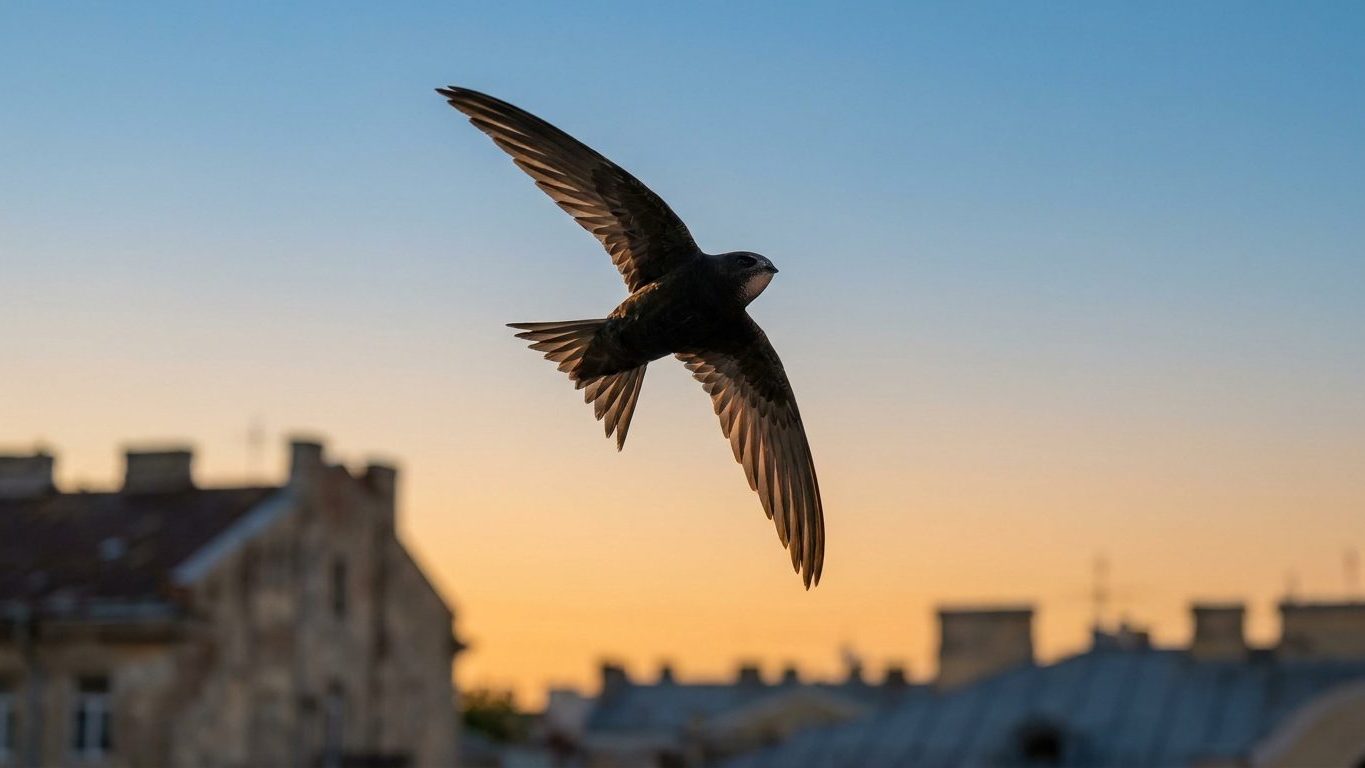
A piercing scream that tears through the air above the roofs, a silhouette skimming façades at full speed: this is the common swift, and it has probably just completed one of the most astonishing feats in the animal world. For nearly ten months, this bird did not land once. Not on a branch, not on an electrical wire, not even on the ground. It fed on the wing, drank on the wing, and, by all accounts, slept on the wing.
- The common swift remains airborne for ten months without ever landing, a feat measured by onboard sensors.
- It likely sleeps while gliding with only one hemisphere of the brain active, much like certain dolphins.
- Renovations to buildings erase the cavities where it nests, causing a 40% decline in ten years in France.
A Measured Record, Not an Estimated One
This performance isn’t the stuff of a shady birdwatcher’s legend. It was demonstrated by a team from Lund University in Sweden, led by biologist Anders Hedenström. By equipping thirteen swifts with small sensors, researchers determined that these birds only landed for two months of the year, during the breeding season. The sensors continuously logged speed, acceleration, and periods of wingless flight. The data showed that some swifts landed briefly at night, sometimes all night long, but they spent more than 99.5% of their ten months of migration and dormancy in flight. And more importantly: other birds in the study did not land once during those ten months.
“Flying for ten months is the longest duration ever recorded in birds; it’s a record,” stated Anders Hedenström when the study was published. A tracked individual interrupted its flight only four nights in a full year. The next year, it stopped for just two hours. By way of comparison, an adult common swift weighs between 35 and 45 grams according to the French BirdLife factsheets, barely more than a handful of coins. It’s hard to imagine such a tiny mass staying aloft for months on end without ever touching the ground.
A Morphology Engineered to Never Stop
Everything about the swift serves this aerial existence. The common swift has a streamlined body and long, scythe-like wings plus a tapered tail. The bird is built for flight. Its legs are very short and reduced. They don’t allow it to perch on a wire or a branch, but only to awkwardly cling to vertical walls. This anatomical detail isn’t incidental. A swift that falls to the ground is literally trapped, unable to take off again from a flat surface, lacking sufficient muscular leverage in its stunted legs.
The cruising flight of the swift costs surprisingly little energy thanks to this slender silhouette. Each evening at dusk and each morning at dawn, the bird climbs to great altitude before descending gently. Each day at dusk and dawn, the common swifts rise to an altitude of 2,000 to 3,000 meters, notes Anders Hedenström. It is precisely during this slow, gliding descent that researchers place the hypothesis of aerial sleep. The number of wingbeats drops drastically during these phases, a strong sign of rest. “They may be sleeping as they glide down, but we’re not sure,” Hedenström himself explained.
Half-Sleeping, a Trick Borrowed from Dolphins
The suspected mechanism bears a scientific name: unihemispheric sleep. One hemisphere of the brain goes offline while the other remains active, ensuring navigation and vigilance against predators. This capability is documented in several bird species and in some marine mammals, dolphins at the forefront, which must also stay in motion to breathe. In swifts, this phenomenon has never been directly measured by in-flight EEG: it remains a strong hypothesis, supported by accelerometer data, but not a physiologically confirmed certainty.
Feeding follows the same “all in flight” logic. The swift hunts what biologists call aerial plankton: a haze of tiny insects, aphids, and spider silk carried by rising air currents. It captures its prey with a broad beak, open in mid-flight, never slowing its trajectory. To drink, it skims the surface of a body of water and brushes the water’s surface with the beak, a motion repeated at full speed, never landing on the banks.
The Real Danger Comes From Renovation Sites
There remains a paradox: this bird, so adept at the air, entirely depends on urban heights to reproduce. The common swift nests mainly in towns and villages, typically in wall crevices or beneath the roofs of old buildings. Without a high cavity, there is no nest possible, since its legs prevent takeoff from the ground. This is where the trouble begins: facade cleaning and repair campaigns, often carried out as part of energy renovations, methodically close these gaps.
Energy renovation of buildings, particularly exterior thermal insulation, leads to the disappearance of cavities used by swifts to nest. The consequence is visible in monitoring data. The common swift is a species in decline in Europe, and its population has fallen by 40% in ten years in France, according to Vigie Nature. Some municipalities are starting to react: cities like Toulon have incorporated preservation clauses into their renovation regulations, including the installation of substitute nesting boxes before work. There is, however, a solution that is simple on paper: preserve existing cavities during renovations, by adapting the insulation or installing a connecting duct.
The Swedish researchers themselves acknowledge that not everything is resolved. The exact duration of continuous flight varies from individual to individual; some touch down briefly in bad weather, others never do. The true energy consumption over such a period, the precise role of these crepuscular ascents, and direct confirmation of sleep in flight remain open research avenues. In the meantime, every spring, this little 40-gram bird returns to screech above the same streets, seeking the same crack in the façade to slide its nest into, if it hasn’t been sealed in the meantime.
Sources: demotivateur.fr | europe1.fr
