
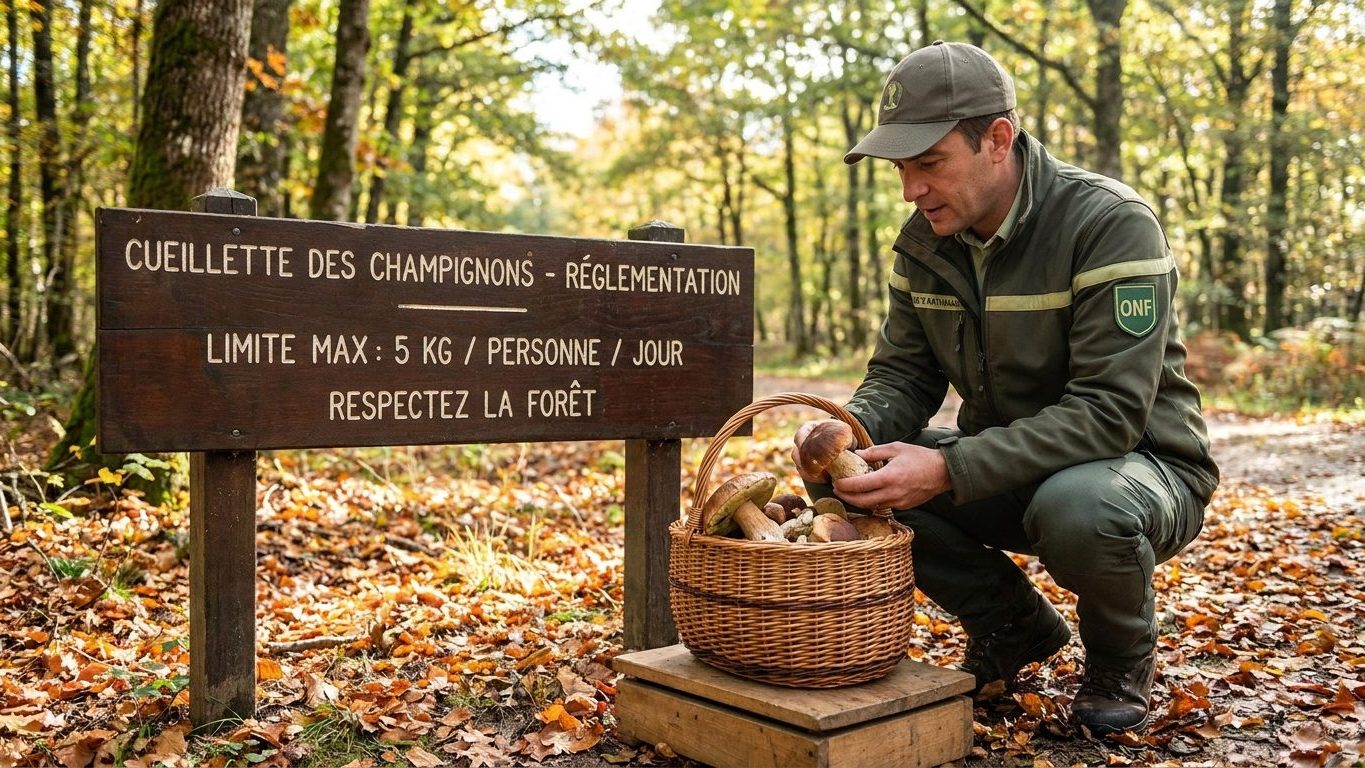
- Harvesting in a state-owned forest is an administrative tolerance, not an acquired right.
- Each forest sets its own threshold: five litres generally, two kilograms in Jura, varying by department.
- Exceeding ten litres without authorization constitutes theft of forest products, punishable by up to three years in prison and a €45,000 fine.
The trunk is opened on the gravel parking lot at the edge of the state forest. A sworn agent of the National Forestry Office weighs the basket, pours its contents into a graduated bucket, notes a number in his notebook. The scene repeats every autumn weekend in the most frequented massifs, from Sologne to the Vosges. This check is nothing arbitrary: it rests on a precise text posted at the entrance to the wood, which most foragers have never read.
What many people do not know is the real status of what they pick. Civil law has long settled this: the fruits of the soil belong to the landowner, article 547. In state-owned forests, that owner is the State. The mushroom is therefore not a free resource waiting to be picked in nature: it is property, just like a timber log of oak or a fallen chestnut.
The autumnal picking we practice rests on a simple administrative tolerance. It is not a right in perpetuity. The Forestry Code provides that, in forests under the forestry regime, the authorization to harvest is presumed as long as the volume does not exceed a locally set threshold, unless otherwise regulated. This mechanism explains why the same act, picking a basket of mushrooms, changes its legal nature depending on the line crossed on the scale.
The basket carries symbolic weight. It bears legal weight, above all.
No single national rule fixes this threshold. Each forest, or each department, has its own decree, and the sign posted at the entrance is what counts. In the state-owned forests of Orne, Manche, and Calvados, picking is allowed only within a family framework with quantities not exceeding five litres per person per day, i.e., about one basket, and it is forbidden on Tuesdays and Thursdays by prefectural order. In the Hautes-Vosges massif, a prefectural order dated June 20, 2024 authorizes the picking of blueberries, lingonberries, and mushrooms up to five litres per person for family use. In Sarthe, the prefectural order of August 28, 1997 specifically governs the state-owned forests of Bercé, Perseigne, Sillé, and La Petite Charnie, where gathering is limited to five kilograms per person per day, or ten kilograms per family group. In Jura, an order set a much more restrictive limit, two kilograms per person per day, following massive commercial harvests that had unsettled local officials. In the Fontainebleau massif, in Seine-et-Marne, the five-litres-per-person-per-day tolerance applies in the absence of a stricter decree.
Five litres here, five kilos there, two kilos elsewhere: the only constant is the obligation to check on-site.
Beyond this tolerance threshold, the scale of sanctions climbs in steps. The Forestry Code, Article R163-5, provides that any harvest under ten litres without authorization constitutes a fourth-class misdemeanor, exposing you to a fine of up to €750, even if local decrees often set a flat rate of €135 for this type of offense. Beyond ten litres, the tipping point is clear: it is no longer a misdemeanor but a crime, described as the subtraction of forest products, akin to theft under the penal code, with penalties that can rise to three years of imprisonment and €45,000 in fines. The volume alone is not the sole criterion triggering this heavier criminal classification. Reselling, regardless of the amount sold, group harvesting, or a truffle harvest beyond the family circle, immediately falls under this regime, regardless of the exact quantity found in the trunk of the vehicle.
There are also aggravating circumstances when the theft is committed by several people, with violence or damage to property: the fine can then rise to €75,000 and the sentence to five years in prison. These cases are rare for a casual weekend picker, but they remind that the penal text makes no distinction between an organized trafficking operation and a family that misread the sign.
Readers often confuse three regimes that have nothing to do with one another. The state-owned forest belongs to the State and benefits from this tolerance bounded by a decree. The municipal forest follows a neighboring regime, that of the forestry regime, with rules set locally by the municipality or the prefecture, to be checked case by case. Private forests, on the other hand, follow a completely different logic: the owner can prohibit any picking, even without a sign, and prior agreement remains legally necessary before gathering anything. In practice, obtaining this authorization is nearly impossible given how fragmented French forest land is, noting that private forests account for about 75% of the national forest cover.
Paths and shoulders do not change the matter: they belong to the land they traverse, state-owned or private depending on the case, and the same rule applies there.
Some actions remain unambiguously allowed. Gathering a modest amount, within the posted threshold, for strictly family consumption, in a state forest or in an equivalent public space, poses no difficulty. Picking outside possible prohibited days, such as Tuesdays and Thursdays in some Norman départements, transporting the harvest in a container that allows spores to breathe, or checking with the town hall about the current decree before departing: these precautions are enough to stay on the right side of the sign. The real risk is not the number of mushrooms tucked into the basket, but the ignorance of the text posted at the entrance to the wood, the one that almost no one takes the time to read before venturing beneath the canopy.
Sources: vosges.chambres-agriculture.fr | le-thillot.fr | sarthe.gouv.fr
