
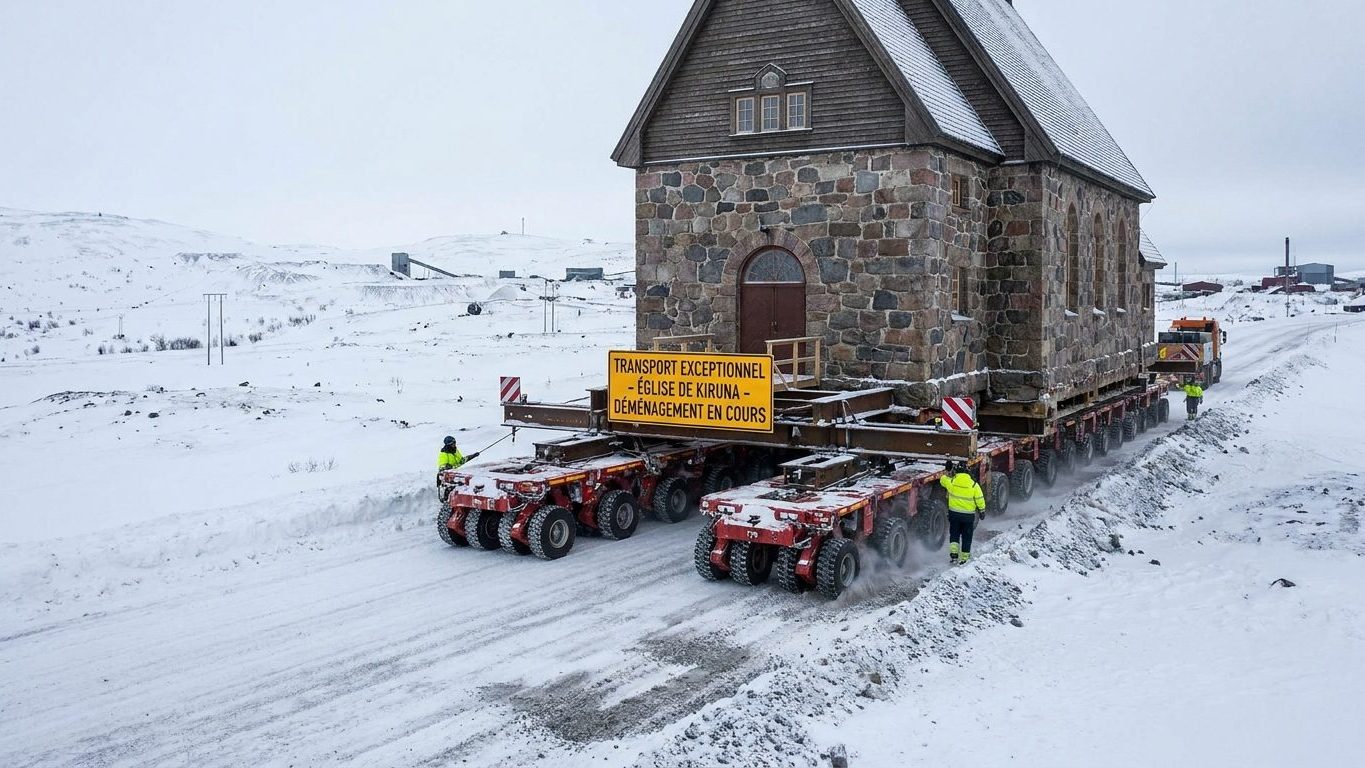
672.4 tonnes. A width of 40 meters. A five-kilometer stretch of road specially widened for the occasion. The church, weighing 672.4 tonnes and spanning 40 meters, was transported in a single block over two days, from August 19 to 20, along a five-kilometer route prepared for the operation. Placed on a cart fitted with 224 wheels, it advanced at a speed of half a kilometer per hour. With the transport frame supporting it, the whole assembly—church and platform included—weighed a total of 1,200 tonnes.
This is not a gratuitous architectural feat.
Since the start of the 20th century, LKAB has been extracting iron ore at Kiirunavaara, a mine that has grown to become the largest underground iron ore mine in the world. The ground beneath Kiruna’s historic center is sinking, cracking, and advancing over the years. Cracks appeared in the foundations of schools, a hospital, and residential buildings, a direct consequence of underground movements triggered by the mine’s growth. The choice faced was to shut down the mine that sustains the town or relocate the town itself.
- La mine LKAB extrait du minerai depuis 1898 et s’étend jusqu’à 2 kilomètres de profondeur sous Kiruna
- La méthode de foudroyage par sous-niveaux provoque un affaissement du sol qui remonte progressivement à la surface
- 3 050 maisons et 200 000 m² de bâtiments publics sont déplacés 3 kilomètres vers l’est
- 41 bâtiments ont déjà été transportés en bloc, dont une église de 672,4 tonnes en août 2024
Why the ground is sinking beneath Kiruna
The iron ore deposit stretches 4 kilometers in length, between 80 and 120 meters in thickness, and plunges up to 2 kilometers deep. Since mining began in 1898, LKAB has extracted more than 950 million tonnes, and only about a third of the original deposit has been touched.
The extraction method changes everything.
LKAB employs sublevel caving: ore is removed in blocks, and the rock above collapses into the void left by the extraction, without any support. This deformation zone mechanically widens as the mine deepens, eventually reaching the surface. LKAB continuously monitors this deformation zone to anticipate when it will reach Kiruna’s residential areas. Unlike an earthquake, this movement progresses slowly and measurably, allowing engineers to plan relocations several decades in advance.
In 2004, LKAB informed the Kiruna municipality that the town center would need to be relocated. The main extraction level currently sits at 1,365 meters below the surface, a threshold that has only accelerated the calculations.
The plan: what’s moved, what’s dismantled, what’s razed
LKAB plans to move 3,050 homes, in addition to nearly 200,000 square meters of commercial, office, school, and public buildings. Property owners receive either 125% of their property’s market value or a new home in the rebuilt city. Buildings deemed too fragile or too large for full relocation are dismantled and rebuilt identically at the new site. Others, lacking particular heritage value, are simply demolished.
Only a few buildings deserve to travel in one piece.
As of July 2025, 25 buildings had already been lifted on beams and rolled east; 16 remained, including the church, still to be moved. The grave of Hjalmar Lundbohm, Kiruna’s founding figure, is also planned to join the new site, alongside the building he had commissioned. The live movement of the church, broadcast on Swedish television, drew thousands of spectators along the route.
A new town a few kilometres away
The new Kiruna center was built three kilometers east of the old one, with the cornerstone of the new town hall, nicknamed Kristallen, laid in 2018. The new district’s shopping center opened on September 1, 2022, eighteen years after the relocation plan was announced.
The project, however, is far from finished.
In August 2025, LKAB announced that the ground was sinking faster and over a larger area than expected, forcing the relocation of 650 more homes and 20 additional shops, affecting nearly 7,000 people. LKAB and the municipality requested stronger financial backing from the Swedish state to cover the expanded scope. The company had already provisioned about 12 billion Swedish kronor for the operation, with a full completion sometimes envisaged around 2100.
The ore deposits beneath Kiruna rank among Europe’s richest, and the two LKAB mines in the region generated 21 billion kronor in profit in 2022, with more than a third returned as dividends to the Swedish state, LKAB’s sole shareholder. LKAB is also exploring Kiruna’s Per Geijer deposit, touted as one of Europe’s largest known rare-earth deposits, which could extend mining well into this century.
The extraction front, meanwhile, continues to descend beneath the new town.
Sources: itascainternational.com | worldkings.org
