
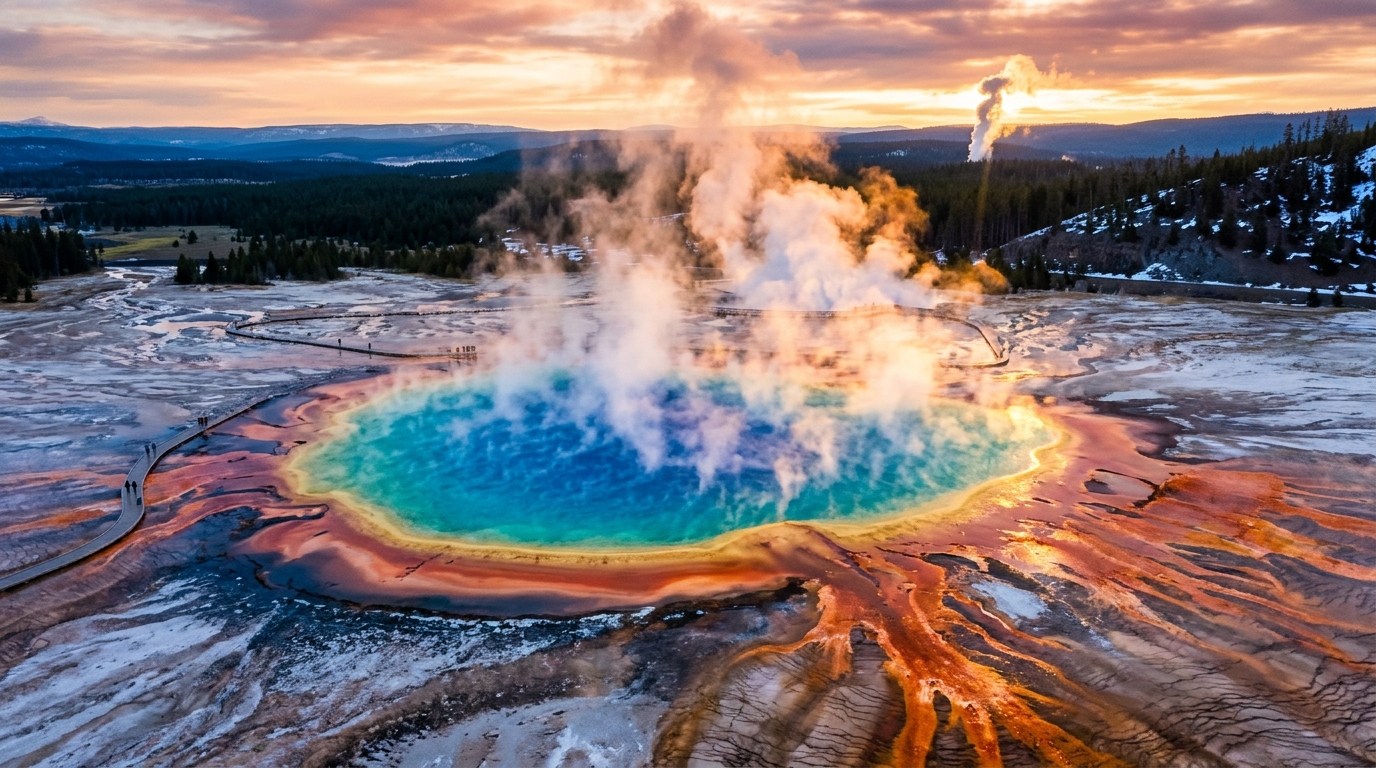
On one side, a palette of orange, turquoise, and yellow that draws millions of visitors every year. On the other, water capable of causing third-degree burns in a matter of seconds. In Yellowstone National Park, Grand Prismatic Spring embodies this constant tension between visual splendor and real danger.
- The Grand Prismatic Spring measures 110 meters in diameter, with water temperatures ranging from 63 to 87 °C depending on the zone of the basin.
- The colors of the basin come from thermophilic micro-organisms that tint the water across different temperature bands.
- Yellowstone experiences unpredictable geological activity, as shown by the hydrothermal explosions of 2024 at Norris and Biscuit Basin, the latter remaining closed to the public.
- A geyser of extraordinary proportions: 110 meters across and otherworldly colors
- 70 °C and 2,100 liters per minute: the colossal flow that forbids swimming
- Extremophile bacteria behind the basin’s chromatic spectacle
A geyser of extraordinary proportions: 110 meters across and otherworldly colors
Impossible to miss Grand Prismatic Spring from the boardwalks of the Midway Geyser Basin in Wyoming. With a diameter of 110 meters, this hot spring sprawls like a lake of surreal hues, visible even from certain aerial viewpoints within the park. The US Geological Survey plainly calls it the largest hot spring in the United States, and one of the largest in the world.
What strikes first are the colors. At the center lies a deep blue, almost hypnotic. Along the edges, concentric rings of orange, yellow, and green give the impression of viewing an abstract painting rather than a geological phenomenon. This chromatic gradient is no accident, a point we will revisit later.
For visitors, the temptation to get closer, or to stray from the marked paths, remains strong. Yet the National Park Service constantly reminds visitors: the ground surrounding these thermal features can look solid, but often it is only a thin crust covering superheated water. A reminder that becomes particularly meaningful when one considers the basin’s actual temperature.
70°C and 2,100 liters per minute: the colossal flow that forbids swimming
The numbers are dizzying. Grand Prismatic Spring continuously pours roughly 2,100 liters of water every minute, at around 70 °C. More precisely, readings vary from 145 to 188 °F, roughly 63 to 87 °C depending on the basin area. In short, swimming is out of the question, even for a few seconds.
That steady flow helps explain why the spring never truly cools. The water originates from Yellowstone’s deep geothermal zones, one of the most active volcanic regions on the planet. It rises, spreads across the surface, and drains away by runoff, never giving the basin time to settle at a temperate temperature.
That reality did not deter two visitors filmed on July 18, 2026, who walked off the boardwalk and onto the microbial mats that fringe the feature. The footage was captured by Tanya Saueressig, a resident of Livingston, Montana, who was on the boardwalk around 7 p.m. that day. A clear violation of park regulations and a risk that few people fully appreciate.
Because Yellowstone is not a static backdrop. On April 15, 2024, seismic and infrasound sensors detected a hydrothermal explosion at Norris Geyser Basin—the first such event ever recorded by instrumentation in the region. It left a crater about 3 meters in diameter on a terrace overlooking Porcelain Basin. A few months later, on July 23, 2024, a similar explosion at Biscuit Basin hurled rock blocks up to 90 centimeters in height to several tens of meters, destroying a boardwalk in the process. The USGS reports that a mineral plug formed within the underground network, driving pressure up until the explosion became inevitable. More recently, on June 13, 2026, a new episode opened vents and a fissure at the same site, before a boiling-water basin measuring 6.5 by 5.3 meters appeared due to collapse a few days later. Biscuit Basin remains closed to the public since 2024, with scientists still detecting ongoing disturbances.
Extremophile bacteria behind the basin’s chromatic spectacle
Back to the colors, for they deserve attention. These are not minerals painting Grand Prismatic Spring, but colonies of thermophilic microorganisms—bacteria and cyanobacteria capable of surviving in water that most life forms would deem lethal.
Each hue corresponds to a temperature band. At the center, where the water reaches its hottest, no photosynthetic microbes can endure: the blue color mainly stems from the optical properties of clear water, which scatters light as if in a deep ocean. Moving outward, as the temperature drops, different species of colored bacteria and archaea take over, forming the orange, yellow, and green rings that define the scene.
We are talking about extremophiles—organisms adapted to conditions that would be hostile or deadly elsewhere on Earth. Their study attracts interest far beyond geology: some researchers view them as models for understanding how life could exist on other planets, in similarly harsh environments.
Grand Prismatic Spring embodies Yellowstone’s most captivating aspect: an open-air laboratory where beauty and danger coexist without cancelling each other out. Between the colors that attract lenses and the explosions reminding us that the subsurface remains in motion, the park continues to prove that it remains one of the planet’s most unpredictable zones.
