
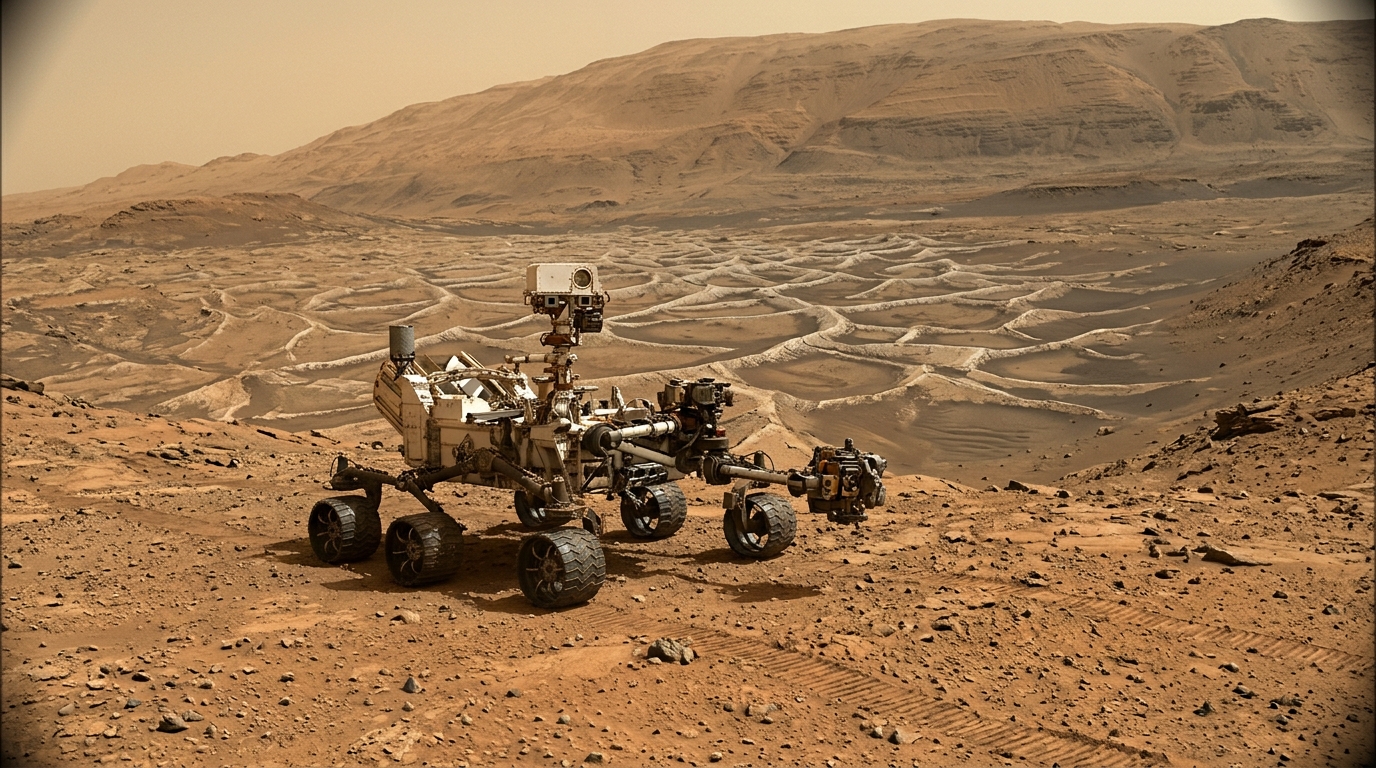
No one at NASA would have bet a cent on such a scenario. Sent to Mars for a one Martian-year mission, Curiosity has just crossed the symbolic threshold of 5,000 sols, more than fourteen Earth years of continuous exploration. An achievement that its nuclear generator, designed for a far shorter duration, was only meant to enable for a time.
- Curiosity, designed for a single Martian year (669 sols), has surpassed 5,000 sols thanks to its MMRTG nuclear power source fueled by 4.8 kg of plutonium-238
- The generator’s power declines slowly with the plutonium’s half-life (87.7 years), forcing teams to manage energy frugally
- The rover has climbed the one-kilometer elevation since landing and now explores the boxwork rock ridges of Mount Sharp, witnesses to ancient Martian water flows
- A Foolish NASA Bet That Should Never Have Lasted
- 4.8 kg of plutonium-238: the nuclear heart that refuses to waver
- Less power, but still alive: Curiosity’s quiet compromise
- What 5,000 sols teach us about the future of Martian exploration
A Foolish NASA Bet That Should Never Have Lasted
Back in the day. In 2011, a rocket departed from Cape Canaveral carrying a rover of a new breed, far larger than its predecessors. After an eight-month journey through the emptiness of interplanetary space, the machine landed with surgical precision in the Gale Crater on August 6, 2012. Engineers rejoiced, but no one at the time imagined the longevity that awaited this machine.
Because on paper, Curiosity’s mission had a clearly written expiration date in its charter: one Martian year, roughly 669 sols, equivalent to 687 terrestrial days. After that deadline, there was no guarantee the rover could continue to function. It was the mission’s designed lifespan, the period for which the entire system had been validated. In other words, anything beyond that would be a bonus, or even a technological miracle.
4,8 kg of plutonium-238: the nuclear heart that refuses to waver
If Curiosity managed to exceed its initial projections so dramatically, it was thanks to a technical decision that, in hindsight, proved visionary. Unlike its solar cousins like Opportunity, the rover did not rely on photovoltaic panels that are sensitive to Martian dust storms. Instead, it carries a radioisotope thermoelectric generator, the MMRTG, powered by 4.8 kg of plutonium-238 dioxide.
The principle is almost poetic in its simplicity: the radioactive decay of plutonium releases constant heat, which is converted into electricity. At launch, this generator produced about 2,000 watts thermal, converted into 120 watts of electricity, giving Curiosity nearly 2.5 kWh per day — three to four times more energy than Opportunity had with its solar panels. That difference explains, in large part, why Curiosity could keep rolling while Opportunity eventually succumbed to a dust storm too thick to overcome.
Less power, but still alive: Curiosity’s quiet compromise
Here is the revelation that shifts the perspective on this feat: the MMRTG is not eternal, and it never was. Plutonium-238 has a half-life of 87.7 years, which means its power declines inexorably, though very slowly, year after year. Practically speaking, that means Curiosity today has less electricity than when it landed on Mars, without being devoid of power.
Precisely this trade-off makes the mission so fascinating. The generator continues to operate, but with progressively decreasing efficiency, forcing ground teams to adjust scientific priorities and the rover’s movements to conserve every watt available. It isn’t a fixed system that has allowed Curiosity to endure more than fourteen Earth years; it’s a fine-tuned management of a resource that is slowly eroding, like a candle that would burn for decades without ever fully going out.
What 5,000 sols teach us about the future of Martian exploration
Beyond crossing the symbolic 5,000-sols threshold this summer, Curiosity also surpassed another milestone: the one-kilometer elevation gain since landing at the bottom of Gale Crater. The rover now traverses the slopes of Mount Sharp, in a region where a spectacular network of boxwork ridges emerges, each ridge ranging from one to two meters wide and stretching for several kilometers. These structures, shaped by ancient groundwater flowing through rock fractures and then hardening, tell a story spanning billions of years—the tale of a Mars once traversed by complex water flows.
This success has, in turn, inspired the next chapter of Martian exploration. The Perseverance rover, which arrived on the Red Planet in 2021 as part of the Mars 2020 mission, carries a MMRTG identical to Curiosity’s. A technological continuity that demonstrates how this energy solution, born from a compromise between power and reliability, has established itself as the reference for long-duration missions on a Mars as unforgiving as ours.
Fourteen years after its landing, Curiosity continues to move forward, sol after sol, sustained by an aging but still valiant nuclear heart. This unexpected longevity raises questions about the true margin of maneuver our machines have when they are well designed, and about what future space exploration might still achieve if we dare, once more, to push beyond the limits laid out on paper.
