
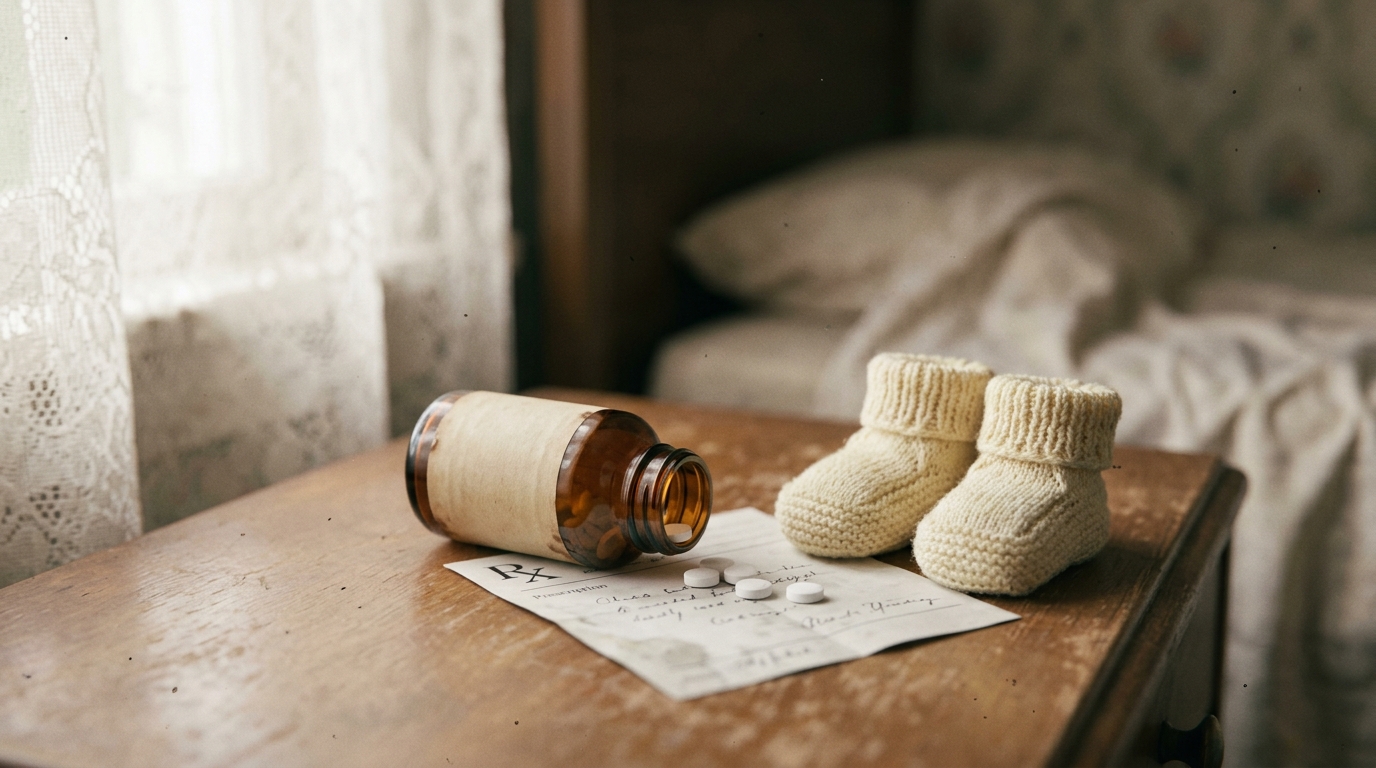
Two numbers are enough to set the scene: 200,000 pregnant women in France took this medication, exposing 160,000 children before birth. A drug designed to protect pregnancy and prevent miscarriages turned out, years later, to be the very source of the complications it was meant to prevent. The story of Distilbène, that name that still echoes today in some French families, is one of those dizzying tales: how could a treatment prescribed in full confidence by generations of doctors silently transmit a risk of malformations and cancers to children who had done nothing to deserve it? In this autumn when people like to look back at lessons from the past, this little-known health scandal deserves time to be told, unfiltered.
- Prescribed between 1948 and 1977, Distilbène exposed in utero 160,000 children among 200,000 treated women, crossing the placenta to alter the development of their genital organs.
- Exposed girls show uterine malformations, repeated miscarriages and a rare risk of vaginal cancer (about 1 in 750), while boys developed testicular or urethral anomalies.
- Despite warnings as early as 1975–1977, the actual halt to prescription took time, and this scandal, classified as a definite carcinogen by the IARC, affected millions worldwide (United States, the Netherlands, the United Kingdom).
- Un médicament censé sauver les grossesses, une bombe à retardement pour des générations
- Malformations, cancers, fausses couches : le corps des filles distilbène paie la facture
- Des médecins qui savaient et qui ont continué : l’histoire d’un aveuglement collectif
- Cinquante ans après, ce que le scandale du Distilbène nous oblige encore à regarder en face
A drug meant to save pregnancies, a time bomb for generations
In the 1950s, the promise rested on a few simple words: to give diethylstilbestrol, a synthetic hormone marketed under the names Distilbène or Stilbestrol-Borne, to pregnant women threatened with miscarriage or complications, to secure their pregnancy. Between 1948 and 1977, this molecule was widely prescribed in France, driven by a strong medical conviction and by the absence, at the time, of serious doubts about its safety. It was imagined that a remedy had been found against one of the most painful tragedies of pregnancy.
The problem was that this drug did not merely cross the mother’s body: it also crossed the placenta and deeply modified the development of the fetus’s genital organs. What was believed to be a simple hormonal support actually acted as a disruptor capable of silently reprogramming forming tissues. Today, those exposed in utero are between 48 and 77 years old, meaning this scandal is not part of a distant or abstract past, but concerns living adults, sometimes without knowing precisely what they were exposed to before birth.
Malformations, cancers, miscarriages: the Distilbène body pays the price
This is perhaps the hardest part to hear: diethylstilbestrol causes, in utero-exposed girls, uterine malformations, repeated miscarriages and, in some cases, vaginal cancers. This phrase, almost clinical in its wording, sums up decades of physical and psychological suffering for what has been called the “DES daughters.” Among the 80,000 women affected, about one in 750 develops a clear-cell adenocarcinoma, a rare cancer of the vagina or cervix, with the average age of onset around 24.5 years, though it can also appear much later, sometimes after 40 years.
The boys exposed were not spared either: testicular or urethral anomalies were also documented in them. This drug, intended to prevent pregnancy complications, ended up provoking new ones a generation later, in organs that did not yet exist at the time of prescription. The International Agency for Research on Cancer (IARC) has classified diethylstilbestrol as a definite carcinogen, an official recognition that, for many affected families, arrived well after the first diagnoses and the initial fears.
Des médecins qui savaient et qui ont continué : l’histoire d’un aveuglement collectif
What makes this case particularly troubling is the temporal gap between the first warnings and the actual cessation of prescription. The first French case of vaginal adenocarcinoma in a young girl exposed to DES was published in 1975, and it was only in 1977 that researcher Kauffmann produced the first detailed description of uterine abnormalities suspected to be tied to this exposure. Between the moment warning signals appeared and when medical practice truly changed, several years passed during which pregnant women continued to receive this treatment.
Yet it would be simplistic to reduce this story to isolated negligence or a handful of careless doctors. It is more the symptom of an era in which pharmacovigilance was still rudimentary, where people trusted drugs without always having the hindsight necessary to measure long-term effects, particularly transgenerational ones. France was not an isolated case: comparable estimates exist internationally, with about 4 million women affected in the United States, 300,000 in the Netherlands and 8,000 in the United Kingdom. This finding does not absolve anyone, but it recalls that this scandal unfolded on a scale far broader than France’s health system alone.
Fifty years later, what the Distilbène scandal still asks us to face
Even today, Distilbène continues to exert its effects in the bodies of those who were exposed before birth. Women over 40 sometimes discover a rare cancer whose origin traces back to a prescription given to their mother, decades earlier. This extended timeline, almost incomprehensible within the span of a human life, illustrates how the consequences of a drug can unfold across several generations, long after people thought all lessons had been learned.
This scandal has also profoundly changed how medicines prescribed during pregnancy are evaluated today, with heightened vigilance for long-term effects and what we now call endocrine disruptors. Yet one question remains on many minds: how long must it take in medicine to turn emerging scientific doubt into an accepted public health decision? Perhaps this is the true lesson of Distilbène, one that goes far beyond its own history.
As this dossier closes, we understand that Distilbène is not merely a dark page in French medical history, but a lasting reminder of the fragility of scientific certainties in the long arc of the human body. Fifty years after its withdrawal, its consequences continue to unfold in the lives of thousands of women and men. Maybe that is, in the end, the most useful question to ask today: what other treatments, currently deemed safe, will one day reveal effects we cannot yet predict?
