
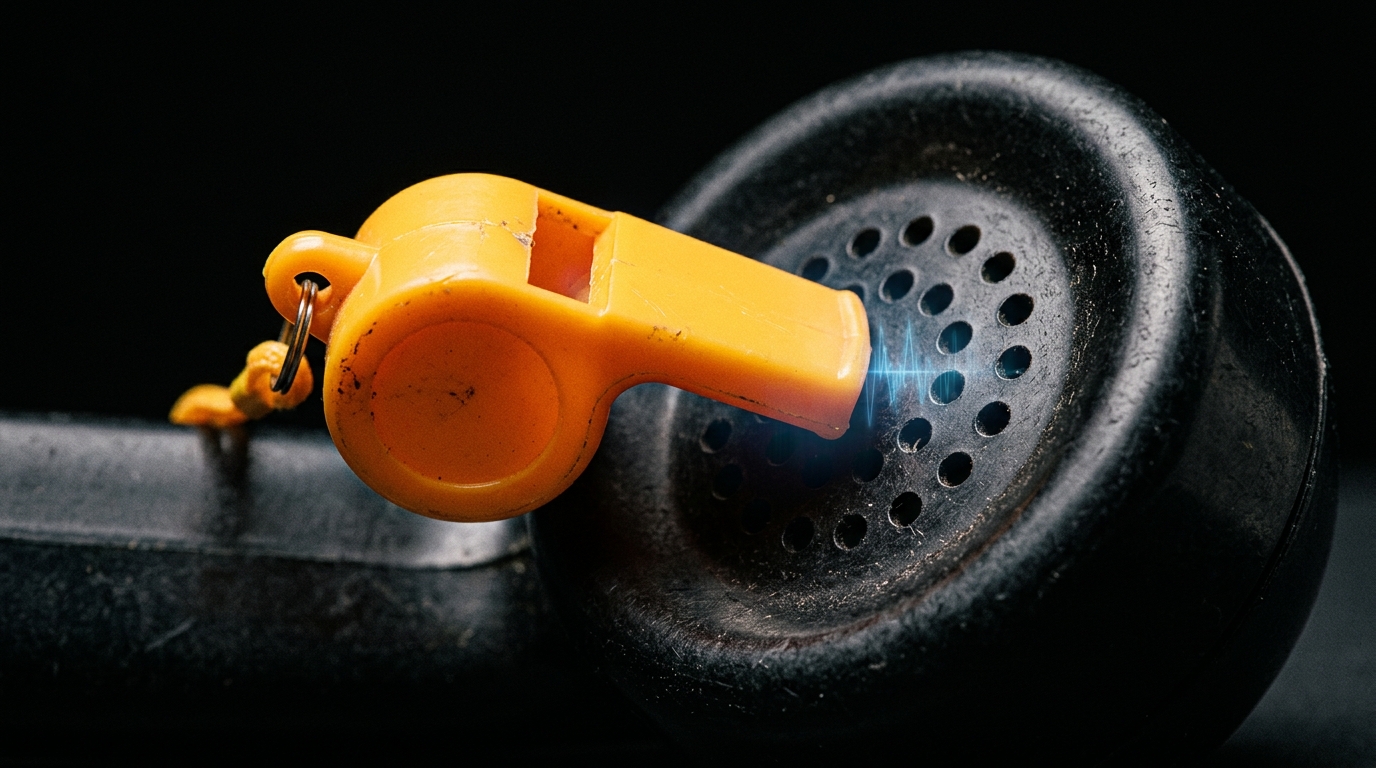
What if the most sensational security flaw in the history of telecommunications hinged on a simple plastic toy slipped to the bottom of a cereal box? Yet this is precisely what happened in the United States, where a promotional whistle allowed thousands of curious people to fool AT&T and place long-distance calls without spending a penny.
- A Cap’n Crunch cereal promotional whistle emitted a 2,600 Hz tone identical to the signal used by AT&T to indicate the end of a call.
- By reproducing this frequency during a call, it became possible to fool the telephone switch and place long-distance calls for free.
- John Draper, nicknamed “Captain Crunch,” popularized this technique of “phone phreaking,” which prompted AT&T to rethink the architecture of its network.
- A plastic whistle worth millions to AT&T
- 2600 Hz, the forgotten frequency that commanded the network
- John Draper, the hacker who turned a trick into a movement
- The flaw that forced AT&T to reinvent its own network
The tale may sound like it comes straight from an improbable script, and yet it is completely documented. In a setting where telephone networks still rested on relatively simple analog systems that were easy to understand for anyone who knew where to look, a handful of ingenious tinkerers discovered that a gadget sold for mere dollars could literally seize control of the American intercity network. A chronicle of one of the most delicious anecdotes in the history of computer hacking, long before the term existed.
A Plastic Whistle Worth Millions to AT&T
In the 1960s, Cap’n Crunch cereal, like many manufacturers of the era, routinely included a small freebie in every box to entice children. Among these trinkets was a modest red plastic whistle, meant simply to amuse the youngsters at breakfast. At first glance, this object looked no different from thousands of other promotional toys distributed at the time.
Yet this seemingly harmless whistle concealed a remarkable feature: it emitted a tone with striking precision, hovering around 2,600 hertz. A frequency that, by an almost improbable stroke of luck, matched exactly a signal used internally by the American telephone network. What might have remained merely a playful accessory would, in the right hands, become a genuine digital key opening the doors to the entire AT&T system.
2600 Hz, the Forgotten Frequency that Commanded the Network
To grasp the scale of this discovery, one must understand how AT&T’s long-distance network operated at the time. The system relied on a technique called in-band signaling, meaning the call-control information traveled over the same line as the voice itself. Concretely, once a long-distance call ended, the network would emit a precise signal at 2,600 Hz to indicate that the line was again free.
The problem arose if that same tone was reproduced during a call: the telephone switch would interpret it as if the call had terminated, while leaving the line open. It then became possible to inject new routing instructions and redirect the call to any long-distance number without ever being billed. In other words, a simple whistle was enough to convince the network that nothing was wrong, while a free call happened quietly behind the scenes.
John Draper, the Hacker Who Turned a Trick into a Movement
It was an ex-US Air Force engineer, John Draper, who truly systematized this flaw and turned it into a legend. Attracted by the potential of this whistle bought for virtually nothing, he quickly adopted the nickname Captain Crunch, a direct nod to the cereal brand’s mascot. He wasn’t alone in this venture: the blind phreak Joe Engressia, also known as Joybubbles, possessed an ear so acute that he could reproduce the 2,600 Hz tone by whistling—without needing the plastic device at all.
This practice, known as phone phreaking, spread among a tight-knit circle of enthusiasts who shared discoveries and refined their techniques. Draper’s name finally came to public attention in 1971 when an Esquire magazine article publicly chronicled his exploits. The media spotlight, while flattering, proved to be his Achilles’ heel: authorities, alerted by the feature, tracked him down and arrested him. As part of a plea agreement, Draper was barred from revealing further his methods of telephone hacking.
Notably, this community of curious tinkerers indirectly influenced two young electronics enthusiasts named Steve Jobs and Steve Wozniak, long before they founded Apple. This proximity to the world of phreaking shows how this illicit practice helped foster a true spirit of technical experimentation among an entire generation of engineers.
The Flaw That Forced AT&T to Reinvent Its Own Network
The Cap’n Crunch whistle was merely the visible, almost anecdotal, part of a much larger security problem. The most advanced phreakers quickly developed electronic devices called blue boxes, capable of not only generating the famous 2,600 Hz tone but also producing the complete set of routing signals used by the AT&T network. These devices allowed users to dial long-distance numbers in a way that the system could not detect, leaving no trace of billing.
Facing the growing scale of these practices, AT&T was forced to rethink the architecture of its network, gradually separating the control signals from the voice that users heard. This episode, as amusing as it may seem today, is now regarded as one of the earliest acts of hacking in history, long before the term became common parlance in the world of computing. It serves as a reminder that a security flaw, even one born from an improbable coincidence like a cereal-box toy, can destabilize one of the largest and most sophisticated systems of its era.
From this somewhat crazy anecdote, one takeaway remains relevant: the security of a system often depends on details its designers never imagined could be exploited, whether it’s a complex computer protocol or, more simply, a free whistle tucked into a cereal box. So, the next time you encounter a gadget that looks inconspicuous, it might be worth asking what unexpected things it could reveal.
