
How can a plane take off vertically, suck in air with twelve lift engines, and yet remain one of the great mysteries of Soviet aviation? The Bartini Beriev VVA-14 was meant to hunt American nuclear submarines. Its story did not end in flames, but in bureaucratic silence and a lack of spare parts.
- The VVA-14, designed by Robert Bartini, was meant to take off vertically thanks to twelve lift engines to hunt American nuclear submarines.
- The Rybinsk RD-36-35PR engines required for vertical takeoff were never delivered, preventing the aircraft from demonstrating its main functionality despite 107 conventional flights.
- The program faded after Bartini’s death in 1974, leaving only one example on display at the Monino museum.
- A flying monster born from the imagination of an Italian-born genius
- Twelve engines, no runway: the audacious vertical takeoff bet
- When Rybinsk cut the program mid-flight
- Bartini dies, and the VVA-14 fades away with him
A Flying Monster Born from the Imagination of an Italian-born Genius
In the Soviet design offices of the early 1970s, a project stood out in a literal sense. Its designer, Robert Bartini, an engineer born in the Austro-Hungarian Empire yet of Italian lineage, sought refuge in the USSR after fleeing fascist Italy. This man with a singular trajectory conceived one of the Cold War’s most atypical machines, capable of blending the qualities of a seaplane, a conventional airplane, and a flying hovercraft, drawing on an aerodynamic phenomenon known as ground effect. The explicit objective was not trivial: to counter the growing threat posed by American submarines armed with Polaris missiles, able to strike Soviet territory from the depths of the Atlantic or Pacific.
The result of these investigations took the form of the VVA-14, a craft with a futuristic appearance, its silhouette unlike any other aircraft of its era. Its first flight occurred on September 4, 1972, a moment that the engineers involved in the project regarded as a major technical victory, given the numerous challenges that had to be overcome. But this inaugural flight was only the visible part of a far more ambitious project, the final aim of which rested on a feat never before attempted at such a scale.
Twelve Engines, No Runway: The Audacious Vertical Takeoff Bet
What makes the VVA-14 so fascinating is its promise of vertical takeoff and landing, without requiring any airport infrastructure. The underlying idea is straightforward to grasp, even if the technical realization skirts the edge of an achievement: by multiplying thrust points with a set of fourteen engines, twelve of which were devoted to lift, the craft would be able to lift off from land or water without a clear runway, a valuable asset for monitoring vast maritime expanses from advanced, sometimes rudimentary bases.
Such a craft could have operated from remote regions, in a fashion reminiscent of a giant helicopter but with the performance of an airplane. This versatility would have given the USSR a formidable tool for patrolling the oceans and detecting enemy submarines before they could strike. Yet, this technical prowess rested entirely on a component the prototype never actually received.
When Rybinsk Cut the Program Mid-Flight
Here lies one of the lesser-known secrets of this aviation venture. The lift engines intended to enable vertical takeoff, the Rybinsk RD-36-35PR, were never delivered to Bartini’s team. Without these specific jets, it was impossible to test the most revolutionary feature of the aircraft, the very capability that justified the program’s strategic interest. The VVA-14 was thus deprived of the centerpiece of its concept.
Despite this major shortcoming, the aircraft did not stay grounded. It nonetheless completed 107 flights, for a total of 103 hours in the air, but always in a conventional configuration, never demonstrating the much-hyped vertical takeoff. This situation vividly illustrates the fragility of large Soviet military programs, often dependent on a complex industrial network where the absence of a single link could jeopardize years of work.
Bartini Dies, and the VVA-14 Fades with Him
The program’s fate shifted decisively in 1974 when Robert Bartini passed away. With him disappeared not only the principal architect but also the conviction necessary to sustain the authorities’ interest in a machine as ambitious as it was costly to develop. Without its designer to advocate the project to the military leadership, the program gradually lost steam, and the push to obtain the long-missing engines finally dwindled.
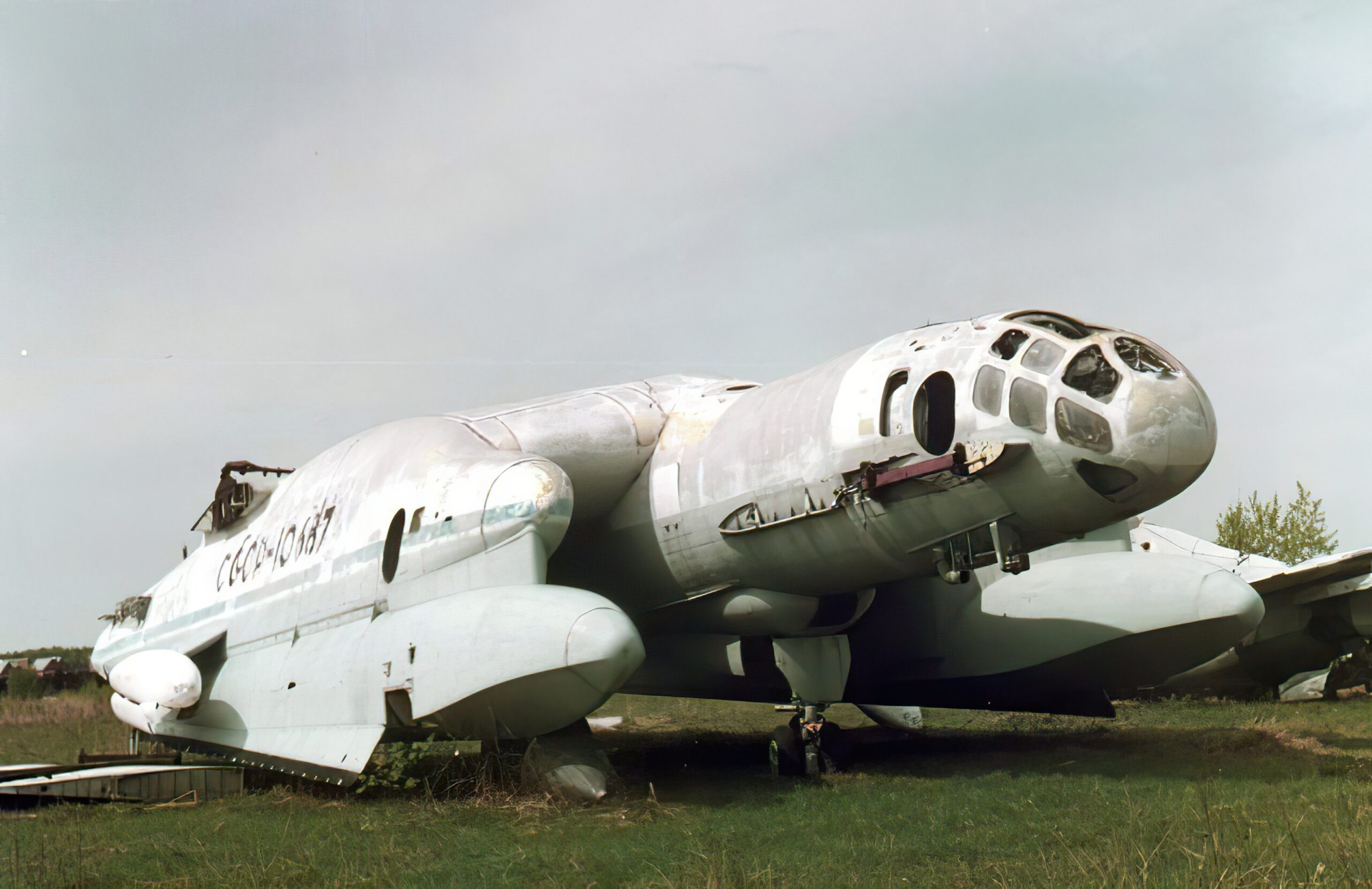
The USSR eventually turned to more conventional means to counter submarines, abandoning the idea of a hybrid aircraft of such complexity. In total, only two M1 prototypes were completed during the program’s lifetime. Today, a single example remains, bearing serial number 19172. Transferred in 1987 to the Central Museum of the Russian Air Force in Monino, it is still on display, in a visibly worn state, still sporting a civilian Aeroflot registration—the last quiet testament to an engineer’s dream never fully realized.
The story of the VVA-14 serves as a reminder of how grand technological ambitions can hinge on delicate balances between political will, industrial capability, and human energy. No dramatic crash or funding shortage led to the project’s extinction, but rather the death of a man and the absence of a few engines never delivered. It invites us, even today, to wonder how many other bold initiatives lie dormant in the annals of military history, awaiting a missing piece or a visionary to carry them through to completion.
