
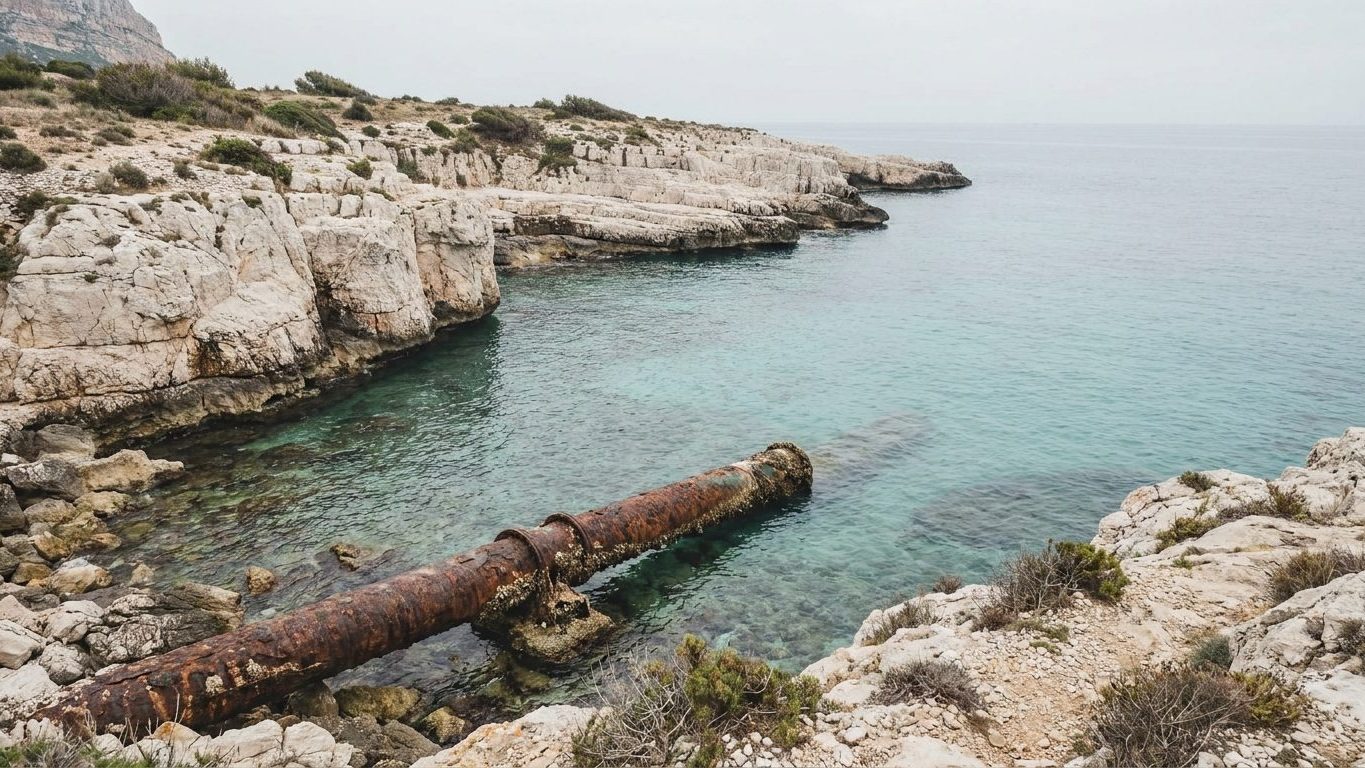
Off the coast of Cassis, a decades-old industrial pipeline runs for several tens of kilometers toward a seabed trench hidden beneath depths of several hundred meters. It long served to discharge the residues of an alumina plant installed in Gardanne, in the Bouches-du-Rhône department, right at the heart of what became in 2012 the Calanques National Park.
Yet the park’s founding decree did not bring the practice to an end overnight. It did specify in its establishing decree that red mud discharges were allowed until December 31, 2015. To understand how a site as pristine as this could coexist with such activity, one must look back to the factory itself, in Gardanne.
- A Gardanne factory has been discharging red mud into the Mediterranean via a pipeline spanning several tens of kilometers since the 1950s
- The Calanques National Park, created in 2012, surrounds the discharge point without immediately stopping the industrial pollution
- Solid red mud discharges ended in 2015, but contested liquid effluents persist within the park’s perimeter
A Century-Old Factory and a Process That Leaves Red Residues
Established in 1893, the Gardanne plant was the first in the world to implement the Bayer process for extracting alumina from bauxite.
This process, known as the Bayer process, dissolves bauxite in caustic soda to isolate alumina, a white powder that is used in aluminum production, industrial ceramics, and glass. The operation leaves a solid residue, rich in iron oxide, with the distinctive red hue that earned it the name red mud. The plant today belongs to the Alteo group, a global leader in specialty aluminas. This alumina later ends up in the touch screens of smartphones or in the batteries of electric cars, far from the Calanques that bear its trace.
A pipeline spanning several tens of kilometers to the Cassidaigne trench
After several years of study, the industrial operator had a pipeline built linking the plant to the sea, off the Cassis Bay, to dispose of these bulky residues. This conduit, buried along most of its route, runs for tens of kilometers before plunging beneath the waves.
It descends into the Cassidaigne trench, at depths of several hundred meters.
2012: a national park created around a factory still in operation
The Calanques National Park was created in 2012 to protect the ecosystems from pollution and biodiversity, whether common or exceptional. The Cassidaigne trench, where the pipeline ends, constitutes a distinct ecosystem in its own right. As a result, a protected area houses at its heart the endpoint of an industrial pollution that is older than it.
On December 28, 2015, a prefectural decree ended the discharge of solid red mud into the sea. In return, the operator obtained a derogation from national regulations for six parameters, including pH, iron, aluminum, and arsenic, for a duration of six years. A monitoring committee, the Committee for Monitoring and Information on Marine Discharges (CSIRM), was set up to oversee the composition and impact of this new liquid effluent. The decree also required more than a 90% reduction in the main contaminants such as lead, cadmium, and mercury.
2015: the end of red mud, not the end of the controversy
The factory has been placed under formal investigation for years of discharging toxic effluents into the Mediterranean, exceeding regulatory thresholds, despite multiple successive exemptions. This proceeding follows a complaint filed in 2018 by environmental associations and local residents, describing a health and environmental scandal.
The company, for its part, claims that it has not been refining bauxite for a year, a pause that does not, for the moment, end the liquid discharges that remain contested within the park’s perimeter.
Sources: calanques-parcnational.fr | alteo-environnement-gardanne.fr | questions.assemblee-nationale.fr
