
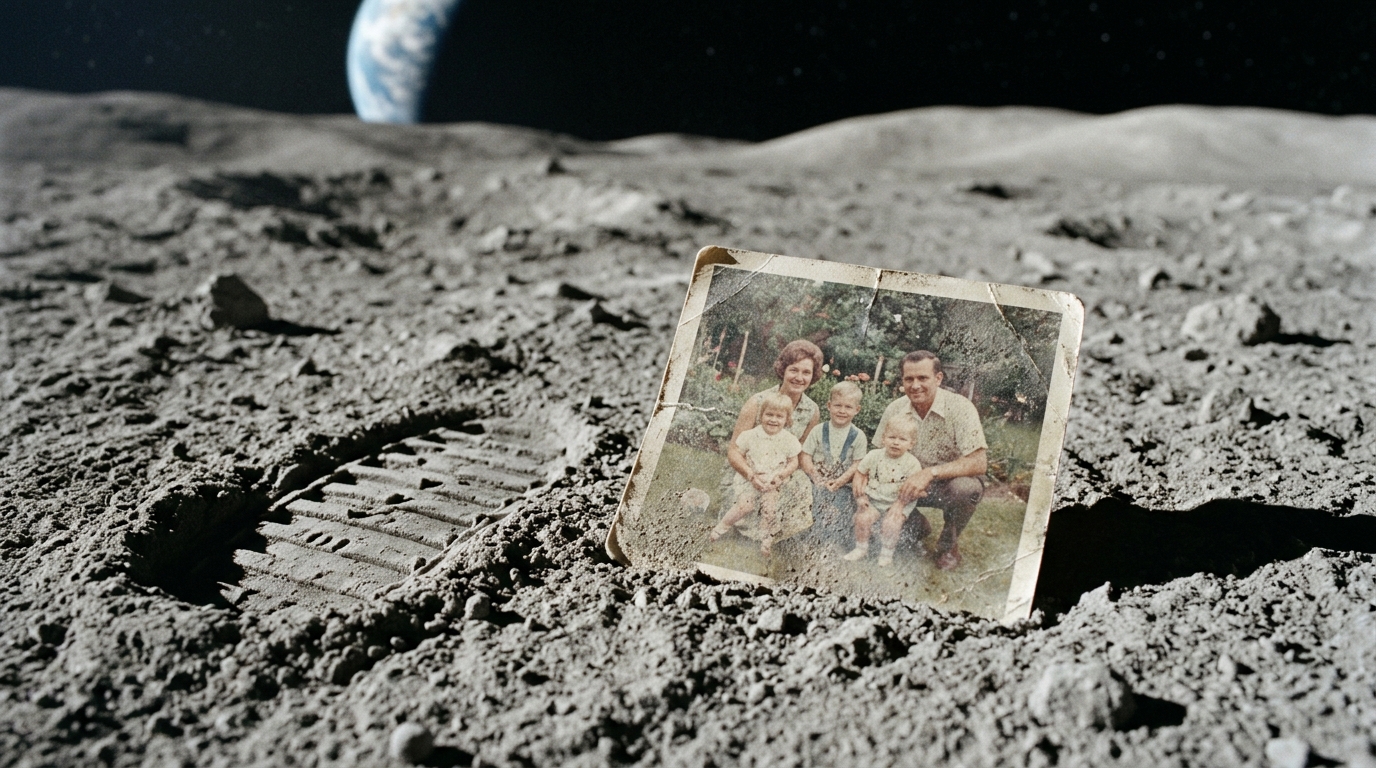
There are objects that travel across the wildest distances only to end up stuck, motionless, out of reach forever. Take, for instance, a simple family photograph slipped into a plastic sleeve, which has rested for more than fifty years on a surface that no human has trodden since. No safe, no museum, no armored display case: just lunar dust, a void, and absolute silence. This story, as discreet as it has remained for decades, reveals something disturbingly human about what space exploration has at its core: humanity itself.
- In April 1972, astronaut Charles Duke placed photograph of his family on the Moon, slipped into a plastic sleeve, during the Apollo 16 mission.
- On the back of the photo, he wrote a message signed by his entire family, identifying the photo and the mission date.
- Since 1972, no manned mission has returned to this site, leaving the photo exposed to radiation and the Moon’s extreme temperature fluctuations.
- The Forgotten Gesture of a Man Far from Home
- A Plastic Sleeve Against the Vacuum of Space
- A Message Scribbled for Eternity
- Why This Photo Will Never Return to Earth
Charles Duke wasn’t just any astronaut during Apollo 16. At 36, he became the youngest person to walk on the Moon, a record he still held in 2022, fifty years later. But behind the technical achievement and scientific prowess lies a far more intimate emotion: that of a father and husband abruptly separated from his loved ones by roughly 380,000 kilometers.
Before liftoff, Duke discreetly tucked a family photograph into his gear. It shows him standing with his wife Dorothy “Dotty” Duke and their two sons, Charles III and Thomas, who were then only 7 and 5 years old. An ordinary snapshot, like millions of American households possessed at the time, but it was destined for a completely unique fate.
This gesture wasn’t part of any official NASA protocol. It was a purely personal, almost clandestine act, in a context where every gram carried was calculated to the gram. The idea, in fact, had been whispered to him by James Irwin, a member of Apollo 15, who had himself left a photo of his family on the Moon without, however, capturing the moment once the object landed.
A Plastic Sleeve Against the Vacuum of Space
Protecting a simple paper photo on the Moon is no small matter. The celestial body has no atmosphere, which constantly exposes its surface to intense radiation and to radically extreme temperature swings, rising up to as much as 200°C by day and dropping to as low as −17°C by night, according to Duke’s own estimates.
To limit degradation, the astronaut placed the photograph inside a transparent plastic sleeve before laying it down, a few tens of meters from the lunar module, at the very end of the mission’s third and final extravehicular activity. A gesture of disarming simplicity, almost trivial in the face of the Moon’s total hostility.
Today no one knows for sure in what state that photo really remains. The repeated thermal cycles and ongoing exposure to radiation would probably have altered its colors, or even erased portions of the faces depicted. The sleeve itself may have become brittle after decades of invisible but constant bombardment.
A Message Scribbled for Eternity
On the back of the photograph, Charles Duke had taken care to inscribe a few words before leaving it on the surface. One can read: “This is the family of Astronaut Duke from Planet Earth. Landed on the Moon, April 1972.” Under this inscription appear, besides his own signature, those of Dotty and their two boys.
That text transformed a simple family keepsake into a true historical testimony. It anchored that moment in time, with explicit mention of the mission context and of this human presence on a ground never trodden before. Duke also left behind a commemorative medal from the U.S. Air Force, which celebrated, that very year, its 25th anniversary.
Asked much later about his motivations, the astronaut explained that he had always planned to leave this photo there, unable as he was to spend enough time with his loved ones during the long training periods preceding liftoff. The gesture recalls that lunar missions, often viewed as purely technical and scientific feats, were also threaded with profound human emotions.
Why This Photo Will Never Return to Earth
Since 1972, no manned mission has returned to the Apollo 16 site. Charles Duke’s photograph thus rests exactly where he left it, in the Descartes Highlands, a particularly rugged lunar region chosen at the time for its distinctive geological features.
Future Artemis missions could theoretically approach these storied sites. But the scientific and logistical priorities of those programs obviously do not concern preserving the personal objects left by earlier astronauts. No robot or automated vehicle has ever been sent specifically to recover or even photograph this relic.
Today, this photograph embodies a rare symbol: a private object, frozen in time, on territory humanity has not visited in more than half a century. It tells, in its quiet and unobtrusive way, the story of a man who wanted to leave a trace of his earthly love far beyond the Earth’s borders, turning a family memory into a discreet symbol of human presence in the vastness of space.
From this forgotten photograph on the Moon, what endures is less the technical achievement than the touching fragility of the gesture: a man, alone before the immensity, choosing to leave behind a fragment of his terrestrial life. While space programs prepare to send crews back to our natural satellite, perhaps one day someone will again chance upon, in the Descartes Highlands dust, this small rectangle of paper.
