
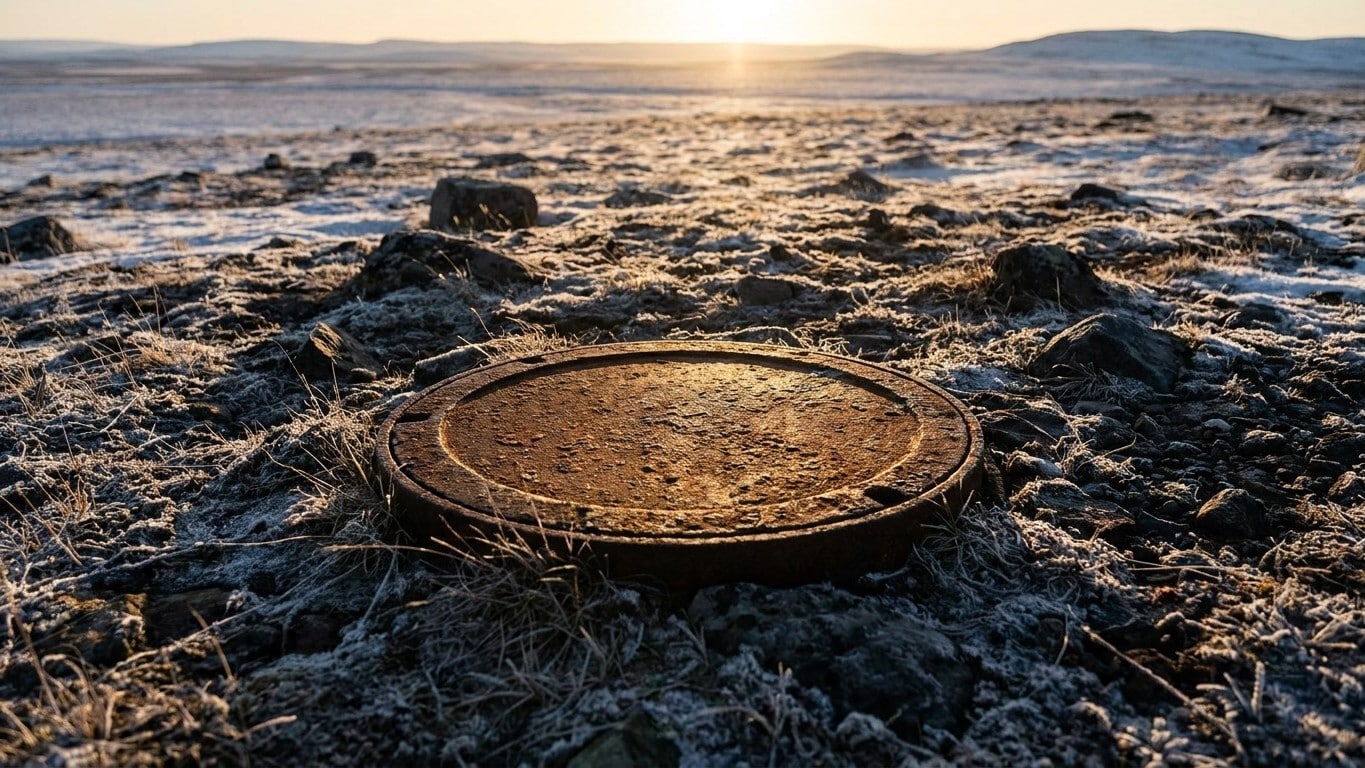
A barely 40-centimeter-diameter hole, almost hidden in the tundra of the Kola Peninsula, just a few kilometers from the Norwegian border. It looks nothing like the image of an yawning chasm. And yet, this well sealed beneath a rusted metal plate remains, more than three decades after its abandonment, the deepest hole ever drilled by humankind: 12,262 meters of true vertical depth, reached in 1989. The Soviets were aiming much farther. They had to stop abruptly, defeated by rock that had begun to behave like quasi-liquid under heat.
Key takeaways
- A Soviet project launched during the Cold War to reach the Earth’s mantle
- Geological discoveries that upended certainties of the 20th century
- Rock that flows like modeling clay beyond 12 km depth
A Bold Gamble Launched in the Heat of the Cold War
Drilling began on May 24, 1970, on the Kola Peninsula near the Norwegian border, with an initial target of 7,000 meters. A mere trifle compared to the project’s grand aim: to reach roughly 15,000 meters to finally touch the boundary between the crust and the mantle. An objective the Americans had already abandoned: in 1958 the United States launched the Mohole project, but eight years later funding was cut and the project had to be abandoned, never reaching the mantle.
The Soviets, however, stayed the course. They shattered successive records: 9,583 meters in 1979, then 12,262 meters in 1989. Along the way, in 1979, the Kola borehole surpassed an American record held by an Oklahoma oil well. The operation was far from a smooth ride: in 1984, after a year-long halt to “celebrate” surpassing 12,000 meters, the drill bit reached 12,000 meters and, after hitting 12,066 meters, a five-kilometer section of the drill string broke off and got stuck in the bore. It was necessary to re-drill an entire branch starting from 7,000 meters. Twenty years of patience and technical stubbornness yielded a result that, on a planetary scale, amounted to little more than a scratch: the Earth’s crust is about 35 kilometers thick.
What the Rock Had to Tell
The well, SG-3 by its technical designation, never reached the mantle. Yet it overturned several certainties of 20th-century geology. The first shock: the outright absence of what seismologists expected at seven kilometers depth—a basaltic layer supposed to follow granite. The initial finding was the absence of the famous “basalt layer” anticipated around seven kilometers, even as seismic waves suggested a transition from granites to basalts.
The second surprise, even more troubling for the era’s models: the presence of water at depths where it should not exist in free form, trapped by an impermeable veil of volcanic rocks. The bore also brought up unexpected gases—helium, hydrogen, nitrogen, methane and other hydrocarbons—as well as carbon dioxide whose isotopic analysis showed it partly originated from organic matter contained in sedimentary rocks. And then there were microfossils—tiny marine remains, intact, extracted from rocks billions of years old—proof that life had left traces even twelve kilometers beneath our feet.
180 Degrees: When Stone Behaves Like Modeling Clay
In the end, it was heat that defeated the project. Not some mythic inferno, but a temperature high enough to render any further drilling impossible. The operation was abandoned in 1992 after encountering temperatures of 180 degrees Celsius, far above the 100 degrees anticipated. This doubling of the predicted temperatures by Soviet thermal models.
The trouble was not merely the temperature itself, barely hotter than a kitchen oven, but its effect on the rock material under immense pressure. In such confinement, the hot rock ceased to behave like brittle material and became ductile, almost plastic; when the drill stopped and was withdrawn, the bore walls slowly closed, the rock flowing into the empty space left by the drill. Each meter gained almost immediately closed behind the bit. A technical dead end for the materials available at the time: continuing would have required tools capable of withstanding temperatures approaching 300°C at the target depth of 15,000 meters, far beyond what existing equipment could endure.
From the “Pit Toward Hell” to the Hole Finally Sealed
The story could have ended there, simply as a scientific observation. Yet rumor took hold. In the 1990s, a legend circulated in Western media: the drillers had pierced a chamber underground from which screams of the damned were emanating, a proof that hell truly existed beneath the Russian tundra. In reality, the press had circulated an audio recording of agonized cries that was actually taken from an Italian horror film from 1972, Baron Blood, played on a loop. A tale that long overshadowed the site’s genuine scientific achievement.
The collapse of the Soviet Union delivered the final blow. The USSR dissolved at the end of 1991, and the funding that had sustained a two-decade scientific marathon simply vanished. A last, more modest drilling attempt was tried in 1994 but abandoned at 8,578 meters due to lack of funds. The site, left to decay, was officially closed and the bore sealed beneath a metal plate in 2005. today, despite Chinese and Qatari rigs competing in the length of casing, no project has managed to surpass this vertical depth record. The Earth, meanwhile, keeps its mantle well hidden, kilometres beneath this small patch of rusted steel lost in the Arctic.
Sources: rtbf.be | morduedevoyages.com
