
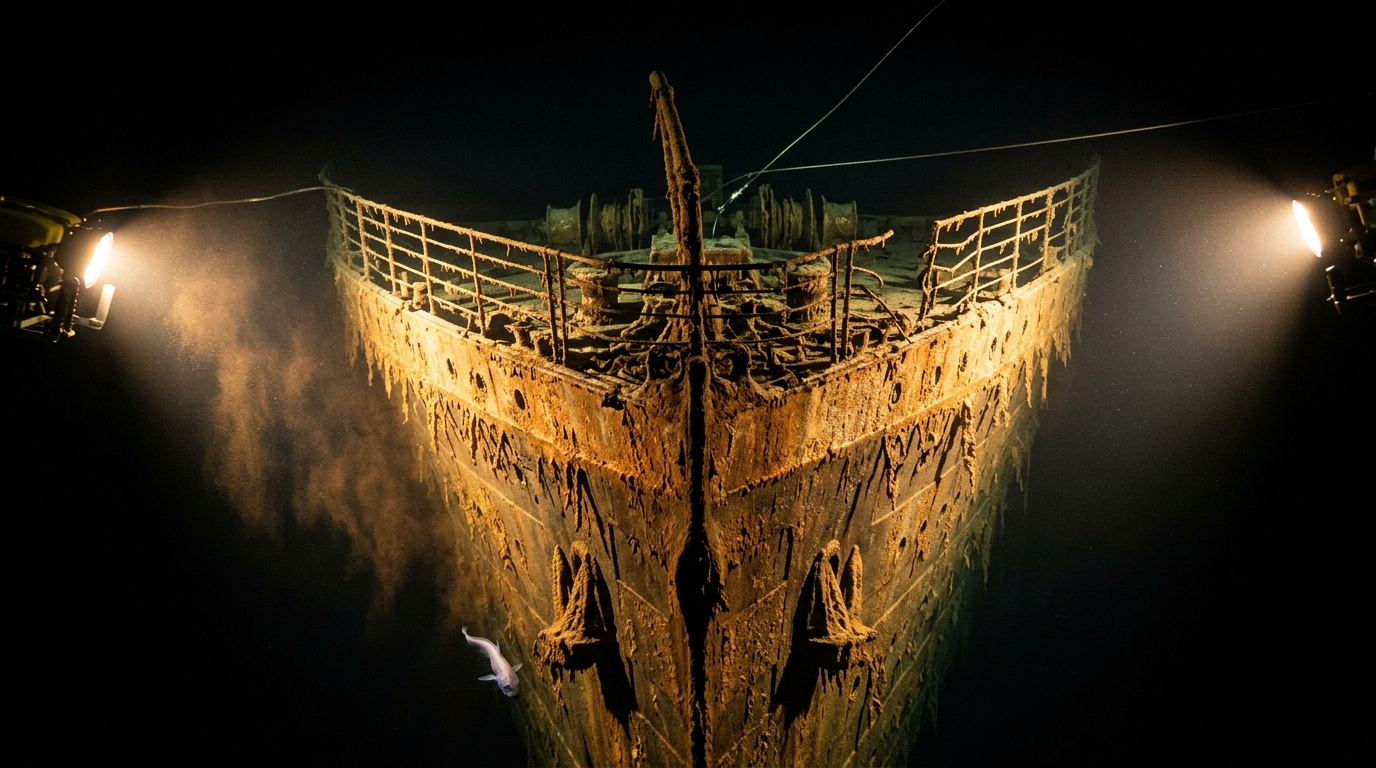
We often imagine that the steel of a sunken liner simply rusts away under the influence of seawater, with no other actors than chemistry. Yet microscopic bacteria are literally devouring the Titanic’s iron. Described in 2010, Halomonas titanicae could cause the hull to disappear much faster than one might imagine.
- Halomonas titanicae, an iron-eating bacterium isolated from the wreck’s rusticles, was formally described in 2010 by a team led by Henrietta Mann at Dalhousie University
- According to Mann’s estimates, the activity of these bacteria could lead to the complete deterioration of the Titanic’s structure by around 2030
- In July 2024, an expedition found that a section of nearly five meters of the port bow rail, which was intact in 2010, had detached from the vessel
- An iron-eating bacterium discovered in the depths
- From 1991 rusticles to Dalhousie’s test tubes: the birth of Halomonas titanicae
- Fifteen to twenty years: the countdown to the Titanic’s hull
An Iron-Eating Bacterium Discovered in the Depths
The Titanic lies at a depth of about 3,800 meters in the North Atlantic, roughly 650 kilometers off the Canadian coast. A hostile realm, shrouded in total darkness, where pressure crushes anything not built to endure it.
It is in this extreme environment that strange formations drew the attention of divers. As early as 1986, the oceanographer Robert Ballard, who had located the wreck a year earlier, named these rusty red concretions “rusticles.” The term cleverly blends rust with stalactite, since these structures evoke iron icicles hanging beneath the hull.
These rusticles are not mere inert chemical deposits. They are true miniature ecosystems, inhabited by microorganisms that feed directly on the metal. And among them, one species turned out to be particularly voracious for the ship’s iron.
From 1991 Rusticles to Dalhousie’s Test Tubes: The Birth of Halomonas titanicae
It all begins with a rusticle sample collected in 1991 from the wreck itself. This living fragment of rust would pass through the hands of several scientific teams over nearly two decades before revealing its secret.
As early as 1996, Roy Cullimore, a researcher at the University of Regina in Canada, began studying these formations and realized they harbored intense bacterial activity. The analyses grew more refined over the years, until a team led by Henrietta Mann at Dalhousie University managed to isolate and characterize the organism responsible with precision.
In 2010, the bacterium officially received its name: Halomonas titanicae, a direct homage to the ship in which it was discovered. The type strain, BH1, proved to be an aerobic, Gram-negative marine heterotroph that moves by flagella distributed around its cell. It belongs to the family Halomonadaceae, a group of bacteria already known for their salt tolerance.
The research did not stop there. In 2013, a team from the University of Seville published the raw genome sequence of the BH1 strain, enabling a finer understanding of its metabolism. Six years later, studies at the Laue-Langevin Institute used neutron imaging to show how these bacteria resist the osmotic pressure of salt thanks to a molecule called ectoine, a kind of chemical shield that allows them to thrive where few organisms survive.
Fifteen to Twenty Years: The Titanic Hull’s Countdown
It was Henrietta Mann herself who issued the most striking warning. According to her estimates, the combined action of microbes like Halomonas titanicae could lead to the total deterioration of the Titanic’s structure by around 2030, i.e., barely fifteen to twenty years after the bacterium’s formal description in 2010.
Recent observations seem to confirm this trajectory. In July 2024, an expedition by RMS Titanic Inc. found that a section of nearly five meters of the port bow railing, which was intact in 2010, had detached from the ship and now rested on the sea floor. A stark emblem of this ongoing biological erosion.
This twenty-day expedition, which returned to Providence, Rhode Island in early August 2024, yielded more than two million photographs and a complete mapping of the wreck and its debris field. It was a colossal documentation effort, allowing researchers to track, year after year, the advance of the phenomenon.
These data complement another large-scale project: the 2022 scan by the Magellan company, which generated 715,000 images and 16 terabytes of data to create a 1:1 digital twin of the Titanic. This virtual double, unveiled in a National Geographic documentary broadcast in April 2025, provides researchers with a valuable tool to measure, over time, what the living rust chews away day by day.
There is something vertiginous about imagining that an organism invisible to the naked eye could rewrite the fate of a steel structure weighing more than 46,000 tons. Like a fossil slowly dissolving rather than mineralizing, the Titanic no longer sinks merely into oblivion; it dissolves literally, cell by cell, eaten by a microscopic life that has made its hull its pantry.
